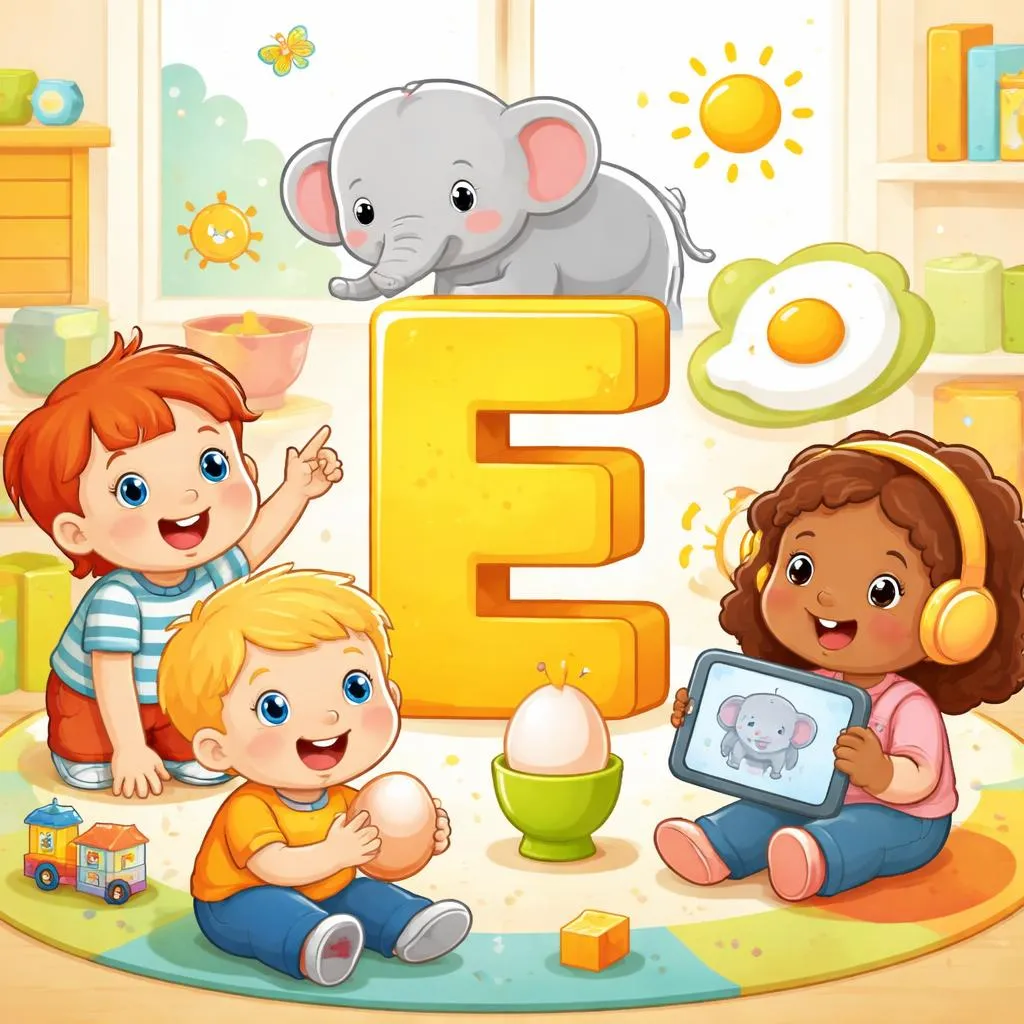

Hello, young word builders and sound detectives. Welcome to a very special lesson about a superstar letter. Today, we are going to explore the English e. What is the English e. It is the letter E. It is the fifth letter in our alphabet. It is a very, very important letter. In fact, it is the most used letter in the whole English language. Let us get to know the English e. We will learn its sounds, its jobs, and its friends. Are you ready. Let us begin.
What is English e?
The English e is a letter. It is a vowel. The vowels are A, E, I, O, U. Vowels are the most important letters. Every word must have a vowel sound. The English e is a superhero vowel. It can make different sounds. It can be loud and say its own name. It can be quiet. Sometimes it is even silent. The English e is also a shape. A capital E looks like a comb with three teeth. A small e looks like a circle with a line. We write it many times every day. Learning all about the English e is a key step in reading. It helps you unlock thousands of words.
Meaning and explanation
The meaning of the English e is about sound and function. Let us explain. The letter E has a name. Its name is "ee" (like in "see"). But it makes more than one sound. Its most common job is to make the short sound. The short sound is /e/ as in "egg" or "elephant." Say "eh." That is the short English e sound. Its other big job is to make the long sound. The long sound is its own name, /ee/ as in "eagle" or "even."
There is a special rule called "magic e" or "silent e." Sometimes, the English e sits at the end of a word and is quiet. It does not make a sound. But it makes the vowel before it say its name. Like in the word "cake." The "a" says /ay/ because of the silent e at the end. The English e is a helper. It changes other letters' sounds. This is a powerful part of learning to read. The explanation is that the English e is not just a letter. It is a tool that controls how we say words.
Categories or lists
We can sort words with the English e into fun lists. This helps us see its patterns. One category is Short E Words. The English e says /e/ here. Red, bed, pen, ten, leg, pet, web, hen, jet, net. Another category is Long E Words. The English e says its name /ee/. Here it teams up with another vowel sometimes. See, bee, tree, feet, seed, me, he, she, we, even.
A very important category is Magic E (Silent E) Words. The English e is at the end and silent. It makes the first vowel long. Cake, bike, home, cube, kite, rope, game, tube. Another list is EE and EA Words. These are common teams that make the long E sound. Feet, meet, sweet. Eat, sea, leaf, dream.
We can also have a category for Words Where E is Silent (not at the end). Like in "have" or "give." The E is there but we do not say it. Another fun list is Words Starting with E. Egg, elephant, eagle, engine, elbow, enter. Sorting the English e this way shows all its different jobs. It is a busy, hardworking letter.
Daily life examples
You can find the English e everywhere in your day. Let us look. First, breakfast time. Look at your food. You might eat an "egg." That starts with a short English e. You might drink "milk" from a glass. "Milk" has the /i/ sound, but "red" jam on your toast has a short E. Talk about your "cereal." Does it have a letter E. Yes, in the middle. Say the words. Feel the sound.
Second, on your way to school. Look at signs. You might see "EXIT." That has a short E at the start. You see a "green" light. "Green" has the long EE team. Play a game. Find things that have the short E sound. "Ten" fingers. "Legs" for walking. "Next" to your friend. Use the English e sounds as you talk.
Third, during reading or playtime. Read a simple book. Find all the words with the letter E. Circle them. Is it a short E or a long E. When you play, say "Let's play a game." "Game" has a magic E. When you build, say "I need one more piece." "Piece" has the long E sound. Daily life is full of the English e. When you notice it, you become a better reader and speaker.
Printable flashcards
Printable flashcards are perfect for learning the English e. How to make them. You can make sound cards. One card has a big letter E. Under it write "Short E: /e/ as in egg." Draw an egg. Another card has "Long E: /ee/ as in eagle." Draw an eagle. A third card has "Magic E: Silent, makes the first vowel long." Draw a magician's hat and the word "cake."
You can also make word family cards. For the "-et" family: card says "et." Have picture cards for "pet," "wet," "jet." Match them. How to use the cards. Play a sorting game. Have the three main sound cards (short, long, magic). Have a pile of word cards. Sort each word under the correct sound rule. "Bed" goes under Short E. "Be" goes under Long E. "Bike" goes under Magic E.
Play "Flashcard Quick Match." Show a picture card (like a net). The child must say the word and then point to the correct sound card (Short E). This builds quick connections. Printable flashcards make the rules of the English e visual. You can see the pattern. You can play games that make practice fun, not boring.
Learning activities or games
Learning about the English e should be an exciting game. Let us play some. First, "E Sound Scavenger Hunt." Give your child a basket. Their mission is to find objects that have the short E or long E sound. For short E: find a red pen, a toy bed, a plastic egg. For long E: find a toy bee, a green leaf, a picture of the sea. This gets them moving and listening carefully.
Second, play "Magic E Wizard." Give your child a magic wand (a stick with a star). Write simple CVC (consonant-vowel-consonant) words on a board: tap, cap, pin, kit. Let them tap the word with their wand and add a silent E at the end. They must say the new word. "Tap" becomes "tape." "Cap" becomes "cape." They are performing magic with the English e.
Third, the "E Word Bingo." Make bingo cards with pictures representing different E sounds. A picture of an egg (short E), a bee (long EE), a cake (magic E), a tree (long EE), a bed (short E). Call out words. Players cover the picture that matches the sound. First to get a line wins. This is great for sound discrimination.
For a craft, make an "English E Sound Book." Staple papers together. Each page is for a different E sound. The Short E page: draw an elephant, an egg, a bell. Write the words. The Long E page: draw a bee, a tree, a cheese. The Magic E page: draw a cake, a kite, a rose. This is a project they can keep and read. For a physical game, play "Sound Hopscotch." Draw hopscotch squares with letters inside: C, A, K, E. The child hops on each letter, saying the sound, but for the E, they stay silent and jump high. "/k/ /ay/" (for the A) and a big silent jump for E. This teaches the magic e rule with movement. Play these games and the English e will become your friend, not a mystery. You will be a master of its sounds.