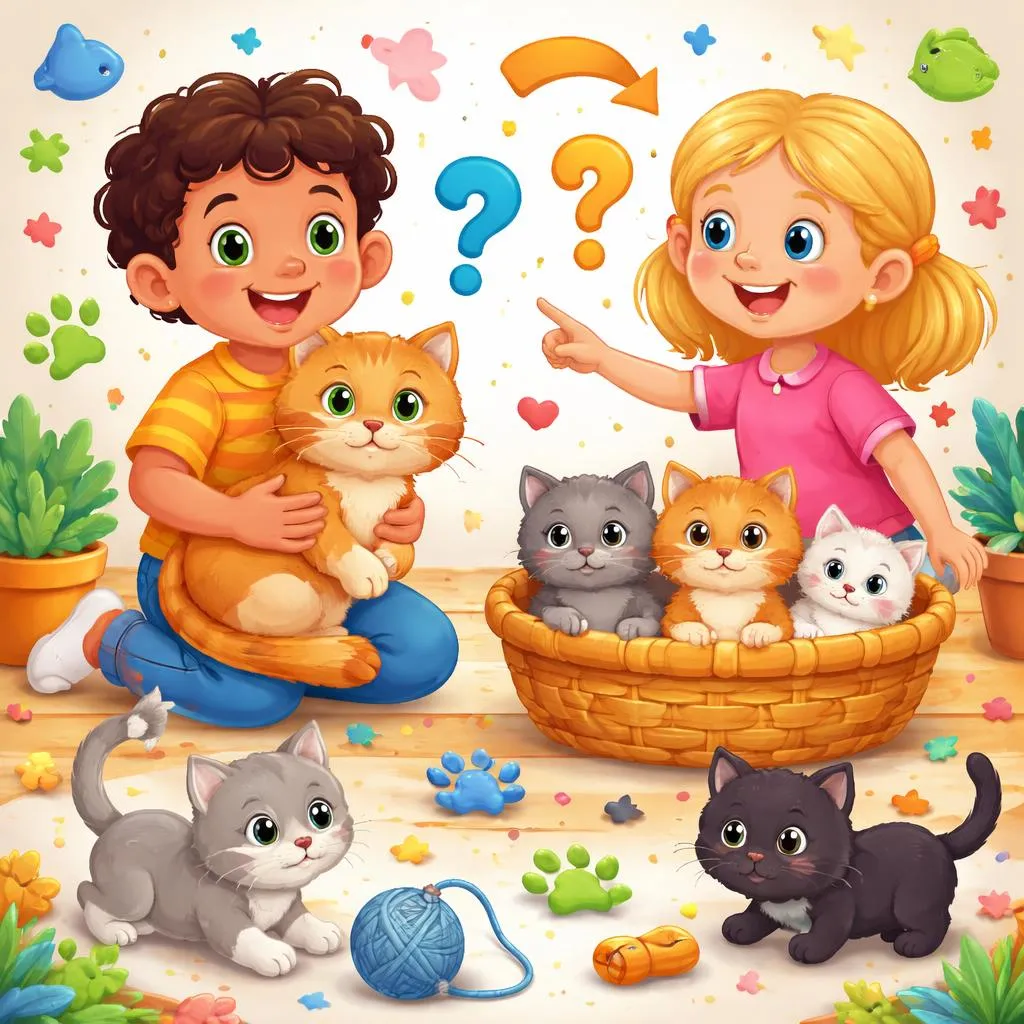

Hello, word friend! Do you love soft, furry animals? Imagine a calm pet. It sleeps in a sunny spot. Now imagine a tiny ball of fluff. It pounces on a dust mote. What do you call them? You might call both a "cat." But English has a sweet secret. It has two special words. Today we explore a word pair. We explore cat and kitten. They are like a parent and a child. They are in the same family. But they tell different stories! Knowing the difference is a superpower. Your pet tales will be purr-fectly clear. Let us start our cozy word adventure!
Be a Language Observer now. Our first clue is at home. You have a family pet. It is four years old. It is a graceful cat. Your cousin gets a new pet. It is only ten weeks old. It is a tiny kitten. They are the same species. But are they the same word? Let us listen to two sentences.
"Our cat likes to nap in the armchair." This describes a calm, adult pet. "Our new kitten chases its own shadow." This shows a playful baby.
They sound like close relatives. And they are! One is the general name. One is the little version. Your observation mission starts. Let us curl up and explore their word world.
Adventure! Prowl Through the Word World
Feel the Word's Purr!
Feel the word cat. It is a smooth, steady word. It feels independent and wise. It is like a soft purr. It is a complete, grown-up word. The word kitten is different. It is a light, bouncy word. It feels incredibly cute and curious. It is full of playful energy. Cat is for companionship and mystery. Kitten is for cuddles and new discoveries. One is a calm river. The other is a bubbling brook. Let us see this at school.
You read a poem about animals. It says, "The cat walked by itself." This feels right. It sounds mysterious and adult. Now, your friend shows a drawing. She says, "I drew a silly kitten!" This feels right too. It shows something young and funny. Saying "I drew a silly cat" could work. But it loses the adorable, baby feeling. The purr of the words is different.
Compare Their Age and Scope!
Think about a big, cozy blanket. The word cat is the whole blanket. It covers all ages and sizes. A sleek Siamese is a cat. A fluffy Persian is a cat. An old tabby is a cat. The word kitten is a small, soft corner of the blanket. It is only the baby stage. It is a young cat. A kitten is always a cat. But a cat is not always a kitten. The scope of meaning is different. Let us test this on the playground.
You play a charades game. You act out an animal. You say, "I am a cat washing its face." Your friend guesses easily. Now you say, "I am a kitten pouncing on a toy." Your actions are extra bouncy. The word kitten gives a clear age clue. The word cat is broader and more general. One names the animal. The other names its life stage.
Meet Their Best Word Friends!
Words have favorite companions. The word cat likes general and descriptive words. It teams up with 'nap', 'whiskers', 'litter', and 'tree'. The cat climbs a tree. You buy cat food. The word kitten likes baby and gentle words. It teams up with 'soft', 'playful', 'heels', and 'mittens'. You love kitten heels on shoes. You avoid kitten mittens in knitting. Their companions are different. Let us go back to school.
You have a science lesson. Your teacher says, "A cat is a carnivorous mammal." This is a general fact. Now, you write a creative story. You write, "The lost kitten mewed softly." This creates a tender image. You would not usually write "The lost cat mewed softly" for a baby. The word friends help set the right tone.
Our Little Discovery!
We followed the word trail together. We made a lovely discovery. The words cat and kitten are a perfect pair. But they are not the same. The word cat is the main word. It is for the whole animal species. It is for felines of any age. The word kitten is a special word. It is only for a baby cat. Cat is the whole book. Kitten is the delightful first chapter. One is the general term. The other is a specific, young life stage.
Challenge! Become a Feline Word Expert
"Best Choice" Challenge!
Let us play with our furry friends. Read each scene. Pick the champion word. Scene one: You visit a pet adoption fair. Many animals need homes. The banner says, "Adopt a ______ Today." Is it Cat or Kitten? The champion is Cat! The fair has cats of all ages. Scene two: Your neighbor’s pet just had a litter. You go to see. You say, "The mother cat is feeding her three ______." Is it cats or kittens? The champion is kittens! They are the newborn babies. Wonderful choice!
"My Sentence Show"!
Now, create your own sentences. Here is a fun scene: Imagine a quiet living room with a sofa. Use the word cat in one sentence. Use the word kitten in another. Try it! Here is an example. Sentence one: "The gray cat stretched on the cushion." Sentence two: "The orange kitten batted at a loose thread." See the difference? The first sentence paints a picture of a relaxed adult. The second sentence captures a playful baby moment.
"Eagle Eyes" Search!
Can you find the word that needs help? Read this sentence: "My family is adopting a kitten next week, I hope it’s a calm kitten." Hmm. This sentence is okay. But using kitten twice sounds a bit repetitive. The second part could flow better. "My family is adopting a kitten next week, I hope it’s a calm cat." This is an improvement! It uses kitten for the new baby. It uses cat to talk about its future grown-up personality. You fixed it!
What a delightful word journey! You started as a curious learner. Now you are a word expert. You know the secret of cat and kitten. You can feel their different purrs. You see their age stages. You know their best word friends. This is a real language superpower.
You can learn amazing things from this article. You now know that 'cat' is the main word for the animal at any age. You understand that 'kitten' is the special word for a baby cat. You can explain that all kittens are cats, but not all cats are kittens. You learned to use 'kitten' for tiny, playful babies and 'cat' for graceful, grown-up companions.
How can you use this today? It is easy and fun. Look at pictures of felines with your family. Point and say, "That’s an adult cat" or "That’s a little kitten." Listen to songs or watch cartoons. Hear when they use the word kitten for something young and adorable. Tell a friend about a pet. Use the right word for its age. You are using your new skill every day.
Keep your eyes and ears open. Words help us share perfect pictures. You now have the power to choose the best word. Great work, word expert. Your English journey is filled with wonderful, whiskered word friends!