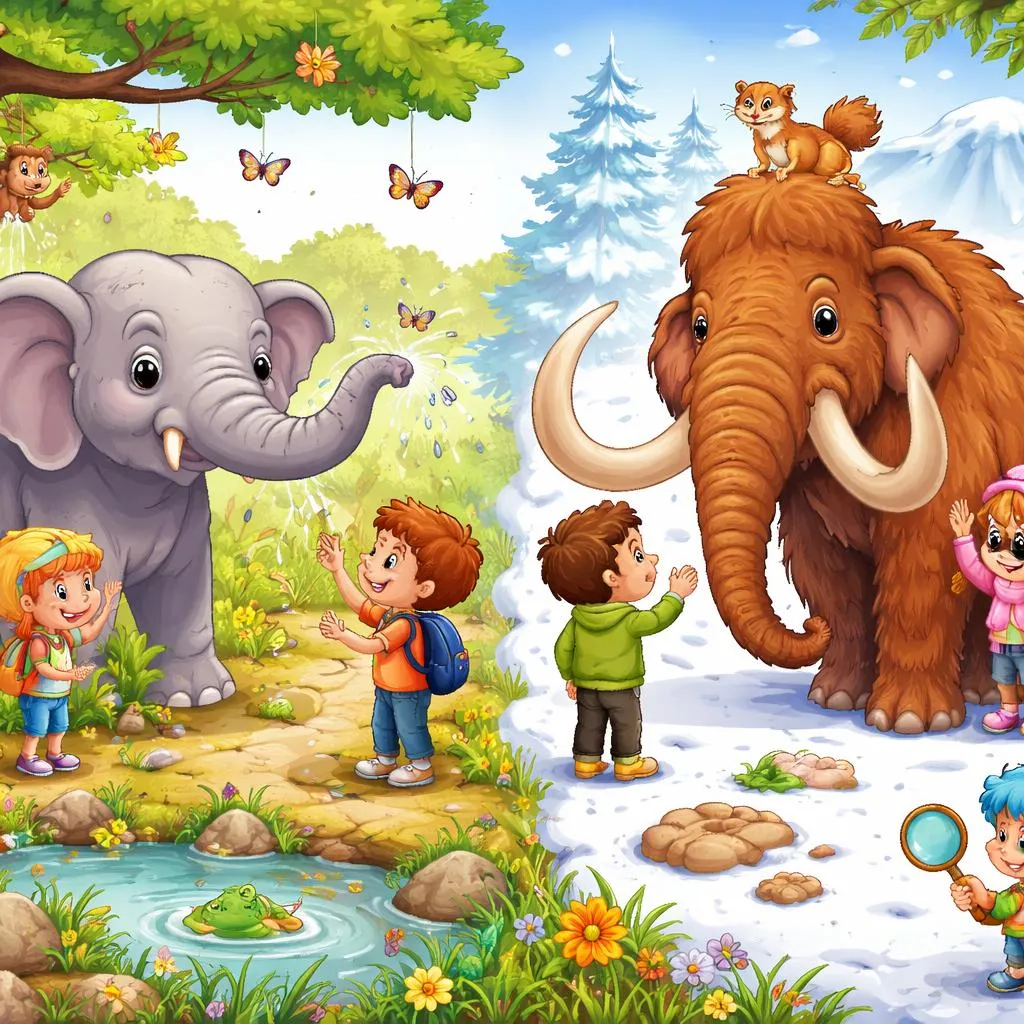

Hello, word explorer! Have you ever seen a picture of a huge, gray animal with a long trunk? What about a picture of a hairy, giant creature with long tusks? They look a bit alike, right? You might call them both "big animals." But English has two special names. Today we explore a word pair. We explore elephant and mammoth. They are like word cousins from different times. One is here today. One is from long ago! Knowing their story is a superpower. Your history and nature talks will be amazing. Let us start our word time travel!
Be a Language Time Traveler now. Our first clue is at home. You watch a nature show. It shows a family of elephants walking in Africa. Then, you watch a cartoon about ice age animals. It shows a woolly mammoth. They are both big and have trunks. But are they the same? Let us test with two sentences.
"The elephant used its trunk to spray water." This is about an animal we can see today. "The mammoth had long, curved tusks to fight the cold." This is about an ancient animal.
They seem to describe similar creatures. But one feels present. One feels ancient. Your time travel starts. Let us step into their word world.
Adventure! Travel Through the Word Time
Feel the Word's Era!
Feel the word elephant. It is a living, breathing word. It feels present and real. It is like a friend you can visit at the zoo. The word mammoth is a grand, historical word. It feels ancient and epic. It is like a legend from a frozen past. Elephant is for today's adventures. Mammoth is for yesterday's mysteries. One is a current event. The other is a history book. Let us see this at school.
In geography class, you learn: "The African elephant lives in savannahs." This is a modern fact. In history class, you learn: "The woolly mammoth lived during the Ice Age." This is a fact from the past. Saying "The woolly elephant" would be incorrect. The feeling of time is different. The word mammoth carries the weight of history.
Compare Their Reality and Size!
Think about a living giant and a legendary titan. The word elephant points to a living giant. It is a real animal you can see. It is huge, but it exists now. The word mammoth points to a legendary titan. It was even bigger and hairier. It is extinct. We know it from fossils. The mammoth feels larger-than-life because it is from stories of the past. Its size in our imagination is massive. The elephant's size is real and measurable. Let us test this on the playground.
You play a game of pretend. You say, "I am as strong as an elephant!" This is a fun comparison to a real animal. Your friend says, "I am as huge as a mammoth!" This sounds even more impressive and mythical. The word mammoth here is used for extreme, almost unreal, size. The playground shows how we use these words for different kinds of bigness.
Meet Their Best Word Friends!
Words have favorite companions from their own time. The word elephant likes words about conservation, zoos, and memory. It teams up with 'African', 'Indian', 'ears', and 'never forgets'. You visit the elephant enclosure. An elephant never forgets. The word mammoth likes words about prehistory, ice, and discovery. It teams up with 'woolly', 'tusk', 'extinct', and 'fossil'. Scientists found a mammoth tusk. The mammoth is extinct. Their companions are from different eras. Let us go back to school.
In a biology lesson, you discuss elephant conservation. This is about protecting living animals. In a paleontology lesson, you study mammoth fossils. This is about uncovering the past. You would not study "elephant fossils" in the same way. The word friends lock the word in its correct time period.
Our Little Discovery!
We traveled through word history. We made a giant discovery. The words elephant and mammoth are different. The word elephant is a present-day word. It describes the large, intelligent animals living in Africa and Asia today. The word mammoth is a prehistoric word. It describes the huge, hairy, extinct relatives of elephants. Elephant is the living relative. Mammoth is the ancient ancestor. One is a modern wonder. The other is a frozen legend.
Challenge! Become a Prehistoric Word Expert
"Best Choice" Challenge!
Let us explore nature and history. Read each scene. Pick the champion word. Scene one: You are at a modern zoo. You see a huge animal taking a bath. The guide says, "The ______ loves water and mud." Is it Elephant or Mammoth? The champion is Elephant! This is a fact about the living animal. Scene two: In a museum, you see a skeleton with giant, curved tusks. The sign says, "This ______ lived 10,000 years ago." Is it elephant or mammoth? The champion is mammoth! This correctly identifies the extinct creature. Excellent time traveling!
"My Sentence Show"!
Now, create your own sentences. Here is a scene: Imagine a vast, grassy plain under a hot sun. Use the word elephant in one sentence. Now imagine the same plain, covered in ice and snow. Use the word mammoth in another. Try it! Here is an example. Sentence one: "The elephant family walked to the watering hole." Sentence two: "The mammoth herd migrated across the icy tundra." See the difference? The first sentence is set in today's world. The second sentence is set in the ancient past.
"Eagle Eyes" Search!
Can you find the word that needs help? Read this sentence: "We saw a magnificent mammoth at the safari park yesterday; it waved its trunk at us." Hmm. This is tricky. Safari parks have living animals. The animal you saw was most likely an elephant. A mammoth has been extinct for thousands of years. "We saw a magnificent elephant at the safari park yesterday; it waved its trunk at us." This is factually correct. You spotted the time error!
What an epic journey through time! You started as a curious learner. Now you are a word historian. You know the secret of elephant and mammoth. You can feel their different eras. You understand their reality. You know their best word friends. This is a real language superpower.
You can learn amazing things from this article. You now know that an 'elephant' is a large, living animal found in Africa and Asia today. You understand that a 'mammoth' was a huge, hairy, prehistoric relative of the elephant that is now extinct. You can explain that we see elephants in zoos, but we see mammoth skeletons in museums. You learned that 'mammoth' can also be used as an adjective to describe something very, very large. Your vocabulary now connects the present and the past!
How can you use this today? It is easy and fun. Next time you visit a zoo or see a picture of an elephant, remember it is a living elephant. When you read a book about the ice age or see a movie with a hairy, tusked creature, you can say, "That's a mammoth!" Look for these words in documentaries. Notice how they are used. Tell a friend a fact about each animal. You are using your new knowledge every day.
Keep your time traveler's eyes open. Language is a bridge between now and then. You are learning to cross that bridge. Great work, word explorer. Your English adventure is growing bigger and more fascinating with every new word you discover!