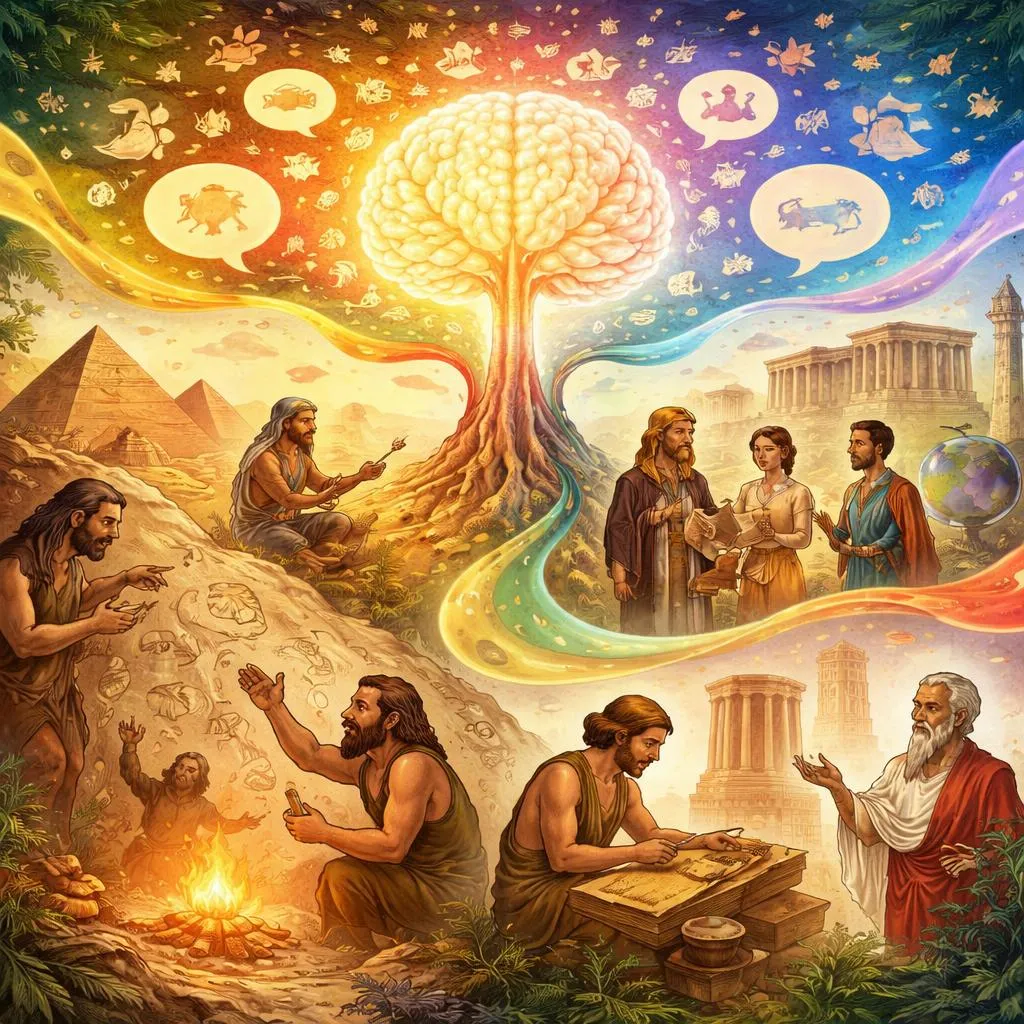

The history of languages explores how human communication developed over thousands of years. Languages did not appear suddenly. They evolved slowly as human societies changed, migrated, and interacted.
Understanding the history of languages helps explain why modern languages share similarities and why they also differ in structure, sound, and vocabulary.
The Origins of Human Language
The exact origin of human language remains unknown. Early humans likely used gestures, sounds, and simple vocal signals to communicate. Over time, these signals became more structured.
As communities grew, communication systems expanded. Words developed to name objects, actions, emotions, and relationships. Grammar patterns formed gradually.
Spoken language came long before writing. For thousands of years, stories, knowledge, and traditions were passed down orally.
The Development of Writing Systems
Writing systems appeared much later in human history. Early civilizations created symbols to record trade, laws, and religious texts.
One of the earliest writing systems developed in Mesopotamia. The Sumerians created cuneiform, using wedge-shaped marks pressed into clay tablets.
In ancient Egypt, hieroglyphs represented sounds and ideas. These symbols were used for religious and official texts.
Writing allowed knowledge to be preserved more accurately across generations.
Language Families and Shared Origins
Modern languages belong to language families. A language family includes languages that share a common ancestor.
One major family is the Indo-European family. Many widely spoken languages belong to this group.
Languages such as English, Spanish, French, German, and Russian all developed from earlier Indo-European roots.
Because of this shared origin, these languages contain similar vocabulary patterns and grammatical features.
For example, many English words have Latin or Greek roots due to historical contact and borrowing.
The Spread of Latin
Latin played a significant role in European language history. It was the language of the Roman Empire.
As the Roman Empire expanded, Latin spread across Europe. Over time, regional variations of spoken Latin developed into separate languages.
These languages became the Romance languages, including Spanish, French, and Italian.
Although these languages differ today, they share many similar words because of their Latin origin.
Germanic Language Development
English belongs to the Germanic branch of the Indo-European family.
Early forms of English developed from the languages of Germanic tribes who migrated to Britain. Old English looked very different from modern English.
Later, contact with the Vikings introduced Norse vocabulary. The Norman Conquest in 1066 brought strong French influence.
As a result, modern English contains vocabulary from Germanic, French, and Latin sources.
The Influence of Trade and Migration
Languages change through contact. Trade routes connected distant regions. Migration brought communities into contact with new cultures.
When languages interact, borrowing occurs. Words for food, technology, and culture often move between languages.
For example, many English words such as “coffee” and “algebra” entered through contact with Arabic.
Cultural exchange continues to influence language today.
Asian Language Histories
East Asian languages have long written traditions.
Mandarin Chinese developed from ancient Chinese language forms. Chinese characters have evolved over thousands of years.
Japanese adopted Chinese characters and later developed additional scripts.
Korean created Hangul in the 15th century to provide a systematic and accessible writing system.
Each language reflects unique historical and cultural development.
Language Change Over Time
Languages are not fixed. They change naturally.
Pronunciation shifts. Grammar simplifies or becomes more complex. New words appear. Old words disappear.
Old English is difficult for modern English speakers to understand. Yet it is the direct ancestor of modern English.
Language change happens slowly but continuously.
Extinct and Endangered Languages
Some languages disappear when communities shift to more widely spoken languages.
When a language loses all native speakers, it becomes extinct.
Efforts exist to preserve endangered languages. Linguists document vocabulary, grammar, and oral traditions to protect cultural heritage.
Language preservation supports cultural diversity.
Modern Global Communication
Global communication has increased language contact.
English functions as a global lingua franca in many international settings. However, thousands of languages continue to exist worldwide.
Digital communication introduces new vocabulary and expressions. Social media influences slang and informal speech.
Language evolution continues in modern times.
Why the History of Languages Matters
Studying the history of languages reveals connections between cultures. It explains why words look similar across borders. It shows how migration, trade, and power influence communication.
Languages carry stories of human movement and cultural exchange.
Understanding language history deepens appreciation for diversity and shared human heritage.
Language is not only a system of grammar and vocabulary. It is a living record of human history, shaped by centuries of interaction and change.
Proto-Languages and Reconstruction
When studying the history of languages, linguists often refer to proto-languages. A proto-language is a reconstructed ancestral language from which a group of languages developed.
For example, many European and South Asian languages are believed to descend from Proto-Indo-European. This ancient language was not written down. Its vocabulary and grammar have been reconstructed by comparing related languages.
By studying similarities among English, German, Spanish, and Russian, linguists identify patterns that point to shared origins.
Sound changes follow regular rules. When a consonant shifts in one language, similar shifts often appear in related languages. This systematic comparison allows scholars to trace language development thousands of years into the past.
The Role of Empires in Language Spread
Empires have played a powerful role in shaping language history.
The expansion of the Roman Empire spread Latin across Europe. Later, the British Empire carried English to North America, Africa, Asia, and Oceania.
Colonial expansion influenced local languages. In many regions, indigenous languages blended with European languages, creating new varieties and creoles.
Language spread often follows political and economic influence. Trade networks also encourage language adoption.
Creole and Pidgin Languages
When speakers of different languages need to communicate, simplified systems may develop. These are called pidgins.
A pidgin combines vocabulary from multiple languages with simplified grammar. When a pidgin becomes the first language of a community, it develops into a creole.
Creole languages have full grammar systems and stable vocabulary. They represent natural language evolution shaped by contact.
Such developments demonstrate that language is flexible and adaptive.
Language Isolation and Unique Development
Some languages developed in relative isolation.
For example, Basque in Europe does not belong to the Indo-European family. Its origins remain unclear. Because of geographic isolation, it preserved unique structural features.
Similarly, languages in remote regions often maintain distinctive grammar and vocabulary patterns.
Isolation protects linguistic diversity, while contact encourages blending.
Writing Reforms and Standardization
Language history also includes periods of reform and standardization.
In the 15th century, the invention of the printing press increased the need for consistent spelling. Standard forms of many European languages developed during this period.
Later, spelling reforms simplified writing systems. In the 20th century, Turkish changed from the Arabic script to a modified Latin alphabet. This reform modernized literacy and influenced national identity.
Standardization creates a unified written form, even when spoken dialects differ.
Dialects and Regional Variation
Languages contain many dialects. Dialects are regional or social varieties of a language.
Pronunciation, vocabulary, and grammar may differ across regions. For example, English has American, British, Australian, and other varieties.
Dialects develop naturally as communities grow separately. Over time, dialects may become distinct languages.
The boundary between dialect and language is often influenced by politics as well as linguistics.
Language and Identity
Language carries identity. It connects individuals to culture, tradition, and community.
Revival movements demonstrate the emotional importance of language. For instance, Hebrew was revived as a modern spoken language in the 19th and 20th centuries. It became the official language of Israel and a symbol of cultural renewal.
Language revival requires education, literature, and community support.
Technological Influence on Language
Technology continues to shape language evolution.
Printing increased literacy. Radio and television spread standardized pronunciation. The internet introduced new abbreviations and expressions.
Digital communication accelerates vocabulary change. New words appear to describe technology, social media, and online culture.
Even pronunciation can shift as global communication increases contact between speakers.
The Future of Languages
Thousands of languages exist today, yet many are endangered. Globalization often encourages use of widely spoken languages for economic opportunity.
Organizations work to document endangered languages. Recording grammar, vocabulary, and oral traditions helps preserve linguistic heritage.
At the same time, new varieties continue to develop in multicultural cities.
Language history is ongoing. It does not stop.
Patterns of Simplification and Complexity
Languages sometimes simplify certain grammar features while developing complexity in other areas.
For example, Old English had more noun endings than modern English. Over time, many endings disappeared. Word order became more important instead.
In contrast, other languages maintain rich inflection systems. Complexity shifts rather than disappears.
Language change follows patterns influenced by usage frequency and social interaction.
Why the History of Languages Continues to Matter
The history of languages explains connections across continents. It reveals how migration, trade, conquest, and cooperation shaped communication systems.
Shared vocabulary across Spanish, French, and Italian reflects shared ancestry.
Structural similarities between English and German reflect deeper historical roots.
Language history reveals both diversity and unity.
Human language began as simple spoken signals. It expanded into complex systems with grammar, writing, and literature. Over thousands of years, languages have divided, merged, disappeared, and reemerged.
The study of language history connects past and present. It shows how human societies evolve and how communication adapts with them.
Language remains a living record of human civilization, continuously shaped by cultural exchange, innovation, and shared experience.