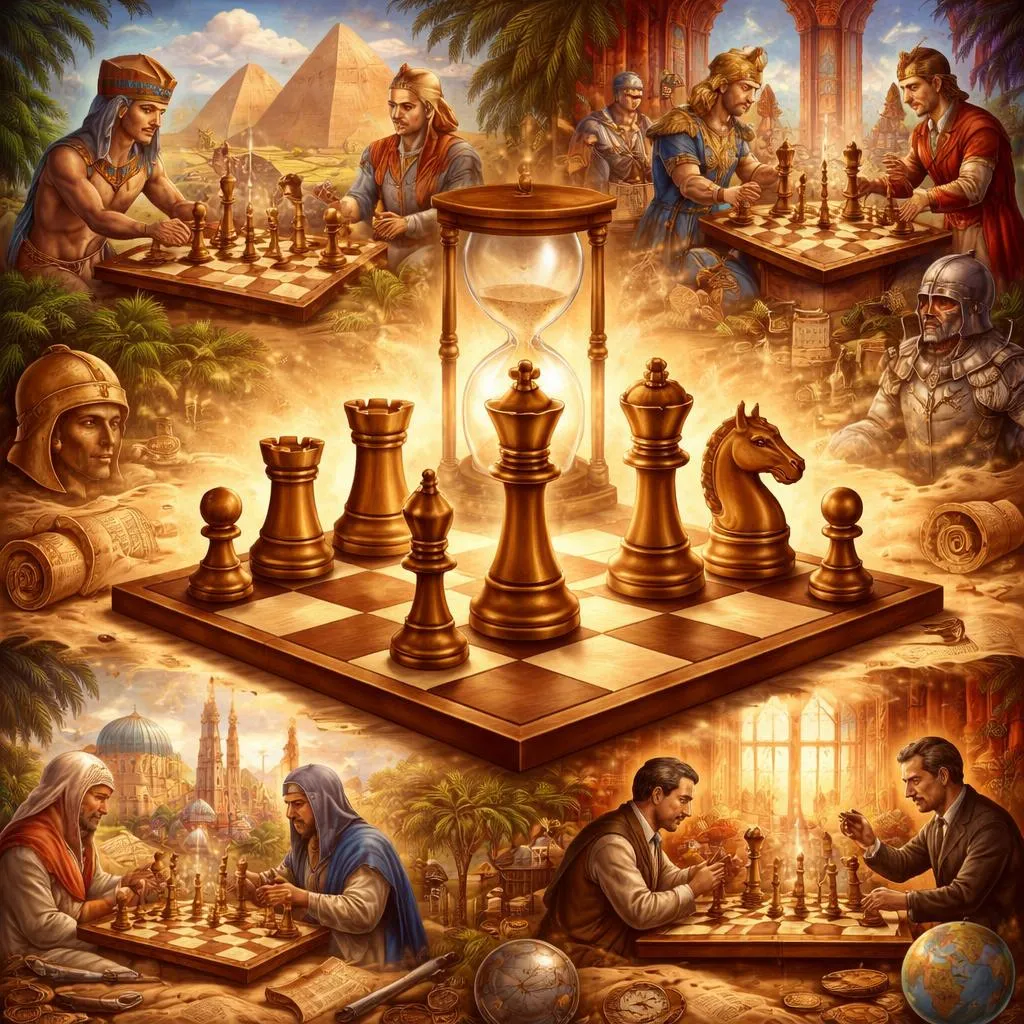

The history of the chess game is long and fascinating, stretching back more than a thousand years. Chess was not invented in its modern form overnight. Instead, it developed gradually across different countries and cultures, with each region adding new ideas and rules.
Understanding the history of chess helps players appreciate how the game became one of the most popular strategy games in the world.
The Early Beginning in India
Most historians agree that chess began in ancient India around the 6th century. The early version of the game was called Chaturanga. The word “Chaturanga” means “four divisions of the army,” which included infantry, cavalry, elephants, and chariots. These military units later evolved into the modern chess pieces.
Chaturanga was played on an 8×8 board, similar to today’s chessboard. The game focused on strategy and planning, which are still essential in modern chess.
Spread to Persia
From India, the game traveled to Persia, where it became known as Shatranj. In Persia, the rules were refined and organized. Many chess terms used today come from Persian language roots. For example, the word “check” comes from the Persian word “shah,” meaning king.
When a king was trapped and could not escape, players said “shah mat,” which later became the English word “checkmate.”
Arrival in Europe
After the Islamic expansion, chess spread to North Africa and then to Europe around the 9th and 10th centuries. In medieval Europe, the game became popular among nobility and intellectuals. However, the rules were still different from modern chess.
During the 15th century, major rule changes took place in Europe. The queen became the most powerful piece on the board, and the bishop gained greater movement. These changes made the game faster and more dynamic. This version became the foundation of modern chess.
Standardization of Modern Chess
By the 19th century, chess tournaments became more common, and rules were standardized. In 1851, the first international chess tournament was held in London, marking an important step in competitive chess history.
Later, in 1924, the organization known as FIDE (International Chess Federation) was founded. FIDE established official rules and organized world championships.
The first official World Chess Champion was Wilhelm Steinitz, who won the title in 1886.
Chess in the Modern World
In the 20th century, chess gained global popularity, especially during famous matches such as the 1972 World Championship between Bobby Fischer and Boris Spassky. This match attracted worldwide attention and increased interest in the game.
In recent years, technology has changed chess dramatically. Online platforms allow players to compete across countries instantly, and powerful computer programs can analyze games at an advanced level.
Why Chess Has Lasted So Long
Chess has survived for centuries because it combines simple rules with deep strategy. It trains logical thinking, patience, and planning skills. From ancient India to modern international tournaments, chess continues to connect people through competition and intellectual challenge.
The history of the chess game shows how a simple board game can travel across cultures and become a global tradition. Chess in the Middle Ages
During the Middle Ages, chess became more than just a board game; it was considered a symbol of intelligence and noble behavior. In many European courts, learning to play chess was seen as part of a proper education for knights and members of the upper class. The pieces were sometimes beautifully carved from wood, ivory, or stone, and wealthy families treated chess sets as valuable objects.
Writers and poets also mentioned chess in literature, using it as a metaphor for strategy, power, and human relationships. Because the game represented order and hierarchy, it reflected the social structure of medieval society.
The Evolution of Chess Pieces
The design and movement of chess pieces changed gradually over time. In early versions, the queen was not very powerful and could move only one square at a time. However, in the late 15th century, the queen’s movement was expanded, allowing it to move any number of squares in multiple directions. This change made the game much faster and more exciting.
The bishop also gained greater mobility, which increased the importance of long diagonal moves. These rule changes transformed chess from a slow and defensive game into a dynamic and tactical competition.
The modern design of chess pieces, known as the Staunton pattern, became popular in the 19th century because it was easy to recognize and practical for tournaments.
The Rise of Competitive Chess
As communication improved in the 18th and 19th centuries, chess clubs began to form in major cities. Organized tournaments allowed strong players to compete against each other regularly. Newspapers started publishing chess puzzles and famous matches, which helped spread knowledge of advanced strategies.
In 1851, London hosted one of the first major international tournaments, bringing together top players from different countries. This event marked the beginning of modern competitive chess culture.
Later, official world championships created global chess heroes. Champions studied openings, endgames, and tactics carefully, turning chess into both a science and an art.
Famous Modern Champions
In the 20th century, chess became especially important during political and cultural rivalry between countries. The 1972 championship match between Bobby Fischer and Boris Spassky attracted worldwide attention and was often described as a symbolic battle during the Cold War.
Later champions, including Garry Kasparov and Magnus Carlsen, brought new energy and modern preparation methods to the game. Their matches were followed by millions of fans and analyzed deeply by experts.
These champions helped inspire younger generations to study and enjoy chess.
Chess and Technology
The development of computers had a major impact on chess history. In 1997, a computer program called Deep Blue defeated world champion Garry Kasparov in a historic match. This event showed that artificial intelligence could compete with top human players.
Today, chess engines analyze millions of positions per second, and online platforms allow players from around the world to compete instantly. Technology has made learning chess easier, because players can review their games and receive automatic feedback.
Chess in Education and Culture
Chess is now widely used in schools to develop logical thinking, concentration, and problem-solving skills. Many educators believe that studying chess improves memory and strategic planning abilities. Because the rules are simple but the possibilities are nearly endless, chess challenges players of all ages.
The game has also appeared in movies, books, and television series, further increasing its popularity. Online streaming and digital tournaments continue to introduce chess to new audiences.
A Game That Crosses Centuries
From its early beginnings in ancient India to modern global competitions, chess has traveled across continents and adapted to changing societies. It survived wars, political changes, and technological revolutions because its core idea—strategic thinking on a simple board—remains timeless.
The history of the chess game demonstrates how a traditional board game can grow into an international sport and intellectual challenge, connecting players across cultures and generations.