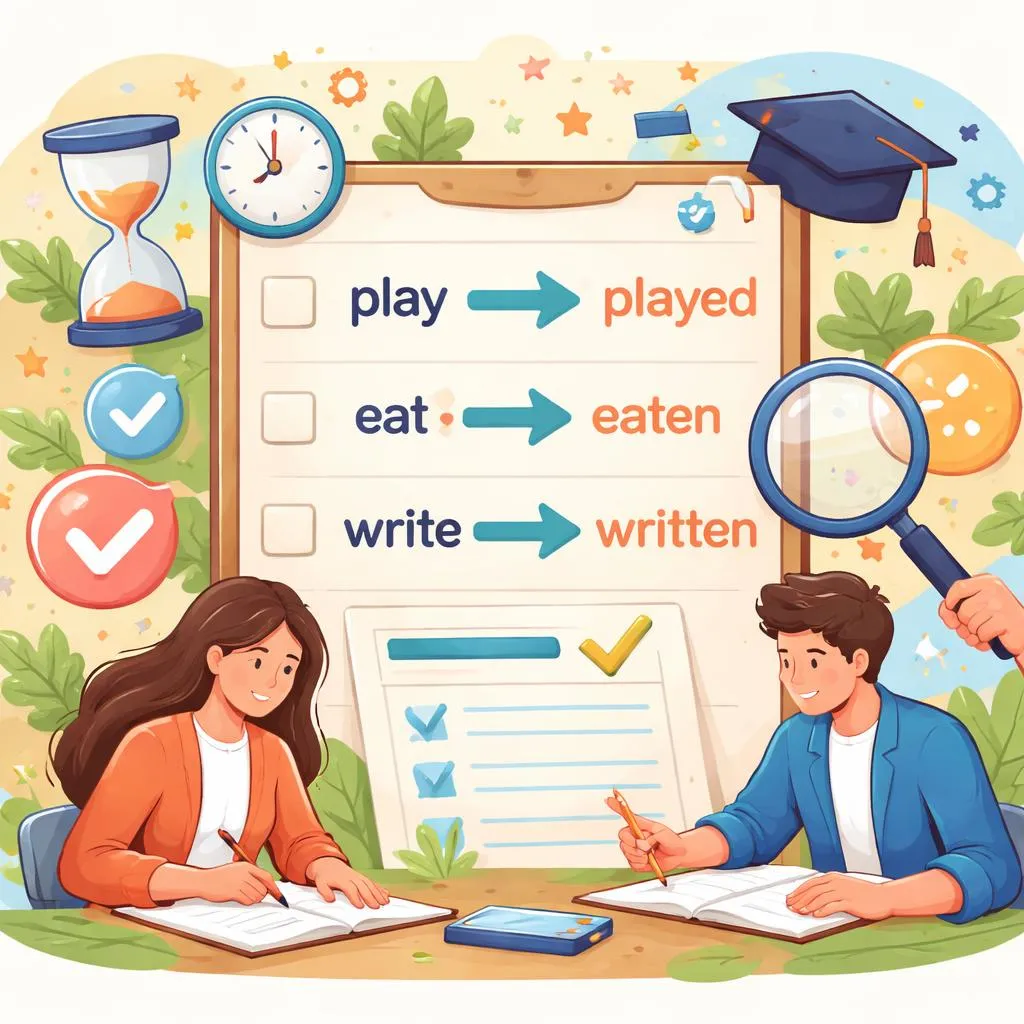

The past participle is a form of a verb. It is often used with helping verbs. It appears in perfect tenses, passive voice, and sometimes as an adjective.
Understanding the past participle helps build correct sentence structure.
What Does Past Participle Mean?
A past participle is usually the third form of a verb.
For regular verbs, it ends in -ed.
walk – walked – walked play – played – played clean – cleaned – cleaned
The second and third forms are the same for regular verbs.
For irregular verbs, the past participle form is different.
go – went – gone eat – ate – eaten see – saw – seen write – wrote – written
These forms must be memorized.
Past Participle in Present Perfect
The past participle is used with have or has.
I have finished my homework. She has eaten breakfast. They have seen that movie.
The structure is:
subject + have/has + past participle
This tense connects past actions to the present.
Past Participle in Past Perfect
The past participle is also used with had.
I had finished before dinner. She had left when I arrived.
Structure:
subject + had + past participle
This shows an action completed before another past action.
Past Participle in Passive Voice
The passive voice uses the verb be + past participle.
The homework is finished. The letter was written yesterday. The project will be completed soon.
Structure:
subject + be + past participle
The focus is on the action, not the person doing it.
Past Participle as an Adjective
Sometimes the past participle describes a noun.
A broken window A tired student A closed door
In these cases, the past participle functions like an adjective.
The window is broken. The door is closed.
Why Past Participle Is Important
The past participle appears in many grammar structures. It is essential for perfect tenses and passive voice. It also adds descriptive detail when used as an adjective.
Learning the meaning of past participle helps improve writing and speaking accuracy. It supports clear and correct sentence formation in English.
Past Participle in Future Perfect
The past participle is also used in the future perfect tense. This tense shows that an action will be completed before a specific time in the future.
Structure:
subject + will have + past participle
Examples:
She will have finished the report by tomorrow. They will have completed the project next week. I will have learned the lesson before the test.
The past participle remains the same. Only the helping verbs change.
Past Participle in Perfect Continuous Forms
The past participle appears in perfect continuous tenses as part of the helping verb “been.”
Structure:
subject + have/has/had + been + verb -ing
Examples:
She has been studying all day. They had been waiting for hours.
Here, “been” is the past participle of “be.” It works with another verb in -ing form.
Regular vs. Irregular Past Participles
Regular verbs are easier to form. Adding -ed creates both the past tense and the past participle.
work – worked – worked open – opened – opened watch – watched – watched
Irregular verbs require memorization.
take – took – taken break – broke – broken choose – chose – chosen drive – drove – driven begin – began – begun
Practicing verb lists improves accuracy.
Common Mistakes with Past Participles
One common mistake is using the past tense instead of the past participle in perfect tenses.
Incorrect: She has went home. Correct: She has gone home.
Incorrect: They have ate dinner. Correct: They have eaten dinner.
After “have,” “has,” or “had,” the past participle must be used.
Another mistake is forgetting the helping verb.
Incorrect: She finished already. Correct: She has finished already.
Perfect tenses require both parts.
Past Participle in Reduced Clauses
Past participles can appear in reduced clauses. These structures shorten sentences.
Full sentence:
The homework that was finished early received praise.
Reduced form:
The homework finished early received praise.
The past participle replaces a longer clause. This makes writing more advanced.
Past Participles in Adjective Position
Past participles often describe feelings or conditions.
interested bored excited confused surprised
She is excited about the trip. They were confused by the question.
These forms describe emotional states.
Some past participles describe physical condition.
broken damaged locked closed painted
The window is broken. The door was locked.
These examples show how past participles function as descriptive words.
Past Participle vs. Present Participle
It is important to understand the difference between past participle and present participle.
Present participle ends in -ing.
running playing studying
Past participle often ends in -ed or takes irregular form.
played studied written
Present participles are used in continuous tenses.
She is running.
Past participles are used in perfect tenses.
She has run.
Understanding this difference improves grammar control.
Why Mastering Past Participle Matters
The past participle appears in many important grammar structures:
Present perfect Past perfect Future perfect Passive voice Adjective forms Reduced clauses
Strong understanding improves writing variety and sentence complexity.
For example:
The book was written by a famous author. She has completed her work. The broken chair needs repair.
Each sentence uses a past participle in a different way.
Learning the meaning and function of the past participle strengthens grammar skills. It builds confidence in speaking and writing. It supports more advanced sentence structures in English communication.