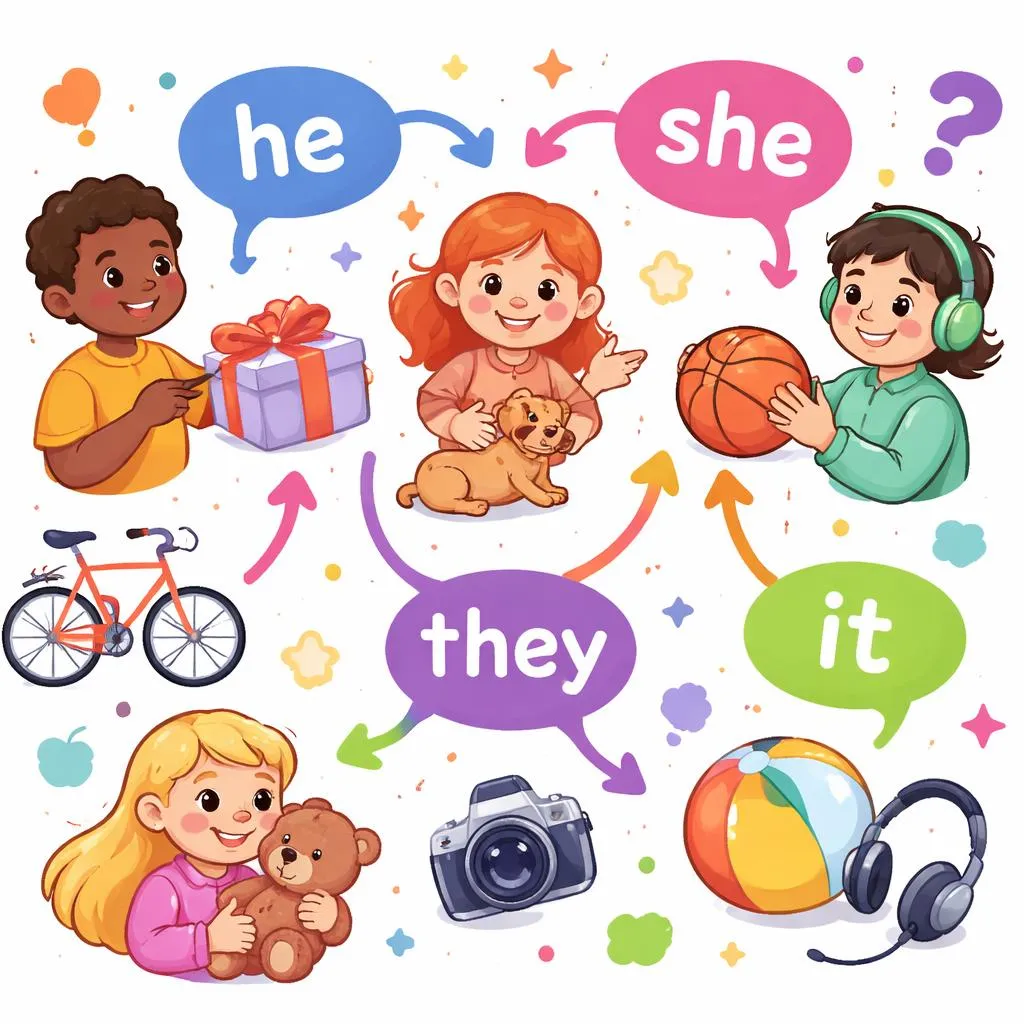

The object of a pronoun receives the action.
It does not perform the action.
It answers the question “whom” or “what.”
It appears after a verb.
It can appear after a preposition.
Grammar position determines form.
Form changes meaning.
What Are Object Pronouns?
Object pronouns replace nouns.
They function as objects in a sentence because English distinguishes between subject case and object case in personal pronouns.
Me
You
Him
Her
It
Us
Them
These forms differ from subject pronouns.
Case marks grammatical role.
Role controls structure.
Subject vs Object Pronouns
Subject pronouns perform the action.
Object pronouns receive the action because English case distinction reflects syntactic function within clause structure.
Subject forms:
I
You
He
She
It
We
They
Object forms:
Me
You
Him
Her
It
Us
Them
She called me.
I called her.
Position changes form.
Correct case ensures accuracy.
Object of a Verb
An object pronoun often follows a verb.
The verb acts on the pronoun because transitive verbs require a direct object to complete meaning.
The teacher helped me.
They invited us.
She saw him.
The action moves toward the object.
Verb-object relationship is central.
Syntax determines order.
Object of a Preposition
Object pronouns also follow prepositions.
Prepositions require object form because English grammar demands objective case after prepositional phrases.
With me
For her
To him
Between us
Among them
This gift is for her.
He sat beside me.
Preposition controls case.
Structure shapes grammar.
Direct Object and Indirect Object
The direct object receives the main action.
The indirect object receives benefit or direction because English sentence structure can include two objects in certain constructions.
She gave me a book.
“Me” is indirect object.
“Book” is direct object.
They sent us a message.
Object pronouns can fill either role.
Sentence pattern determines function.
Object Pronouns in Questions
Object pronouns appear in questions.
Whom did you call?
Who did you see?
Formal English prefers “whom” as object because traditional grammar distinguishes object case in interrogative pronouns, although modern usage often replaces it with “who.”
Did she invite him?
Have you met them?
Question structure may invert subject and auxiliary.
Case remains consistent.
Common Errors
Incorrect: She gave the gift to I.
Correct: She gave the gift to me.
Incorrect: Him and me went home.
Correct: He and I went home because compound subjects require subject case while compound objects require object case.
Grammar accuracy prevents confusion.
Practice improves control.
Linguistic Explanation Sentence
In English grammar, the object of a pronoun refers to a pronoun in the objective case that functions syntactically as the receiver of a verb’s action or as the complement of a preposition, illustrating the language’s case distinction between subject and object forms within clause structure.
Why Is Understanding Object Pronouns Important?
They ensure grammatical accuracy.
They clarify meaning.
They prevent ambiguity because correct case marking signals syntactic role and maintains clarity in both spoken and written communication.
Accurate pronoun use improves fluency.
Clear structure strengthens sentences.
Mastering object pronouns supports overall grammatical competence and enhances confidence when forming statements, questions, and complex sentences in English communication.
How Do Object Pronouns Function in Complex Sentences?
Object pronouns appear in simple sentences.
They also appear in complex sentences.
They may belong to dependent clauses because English allows pronouns to function across multiple clause layers within a single sentence structure.
I know her.
I know that she invited him.
She said that they helped us.
Pronoun case does not change inside clauses.
Clause structure becomes more advanced.
Function remains object role.
Grammar consistency is important.
Object Pronouns After Gerunds
Gerunds end in “-ing.”
They act like nouns.
Object pronouns may follow them because gerunds can take objects just like regular verbs.
I enjoy seeing them.
She avoided calling him.
They discussed meeting us.
The gerund keeps verb properties.
Object form remains required.
Syntax influences selection.
Object Pronouns in Infinitive Structures
Infinitives use “to” + base verb.
Object pronouns can appear before infinitives because English sometimes places the object between certain verbs and infinitive forms.
She asked me to help.
They told him to wait.
The teacher advised us to study.
Verb patterns control placement.
Object position depends on structure.
Correct order prevents error.
Object Pronouns in Passive Voice
Passive voice changes focus.
The object of an active sentence may become subject in passive because English voice transformation shifts grammatical roles while preserving meaning.
Active: She helped me.
Passive: I was helped by her.
“Me” becomes “I.”
Case changes with function.
Role determines form.
Voice affects structure.
Understanding transformation improves grammar control.
Object Pronouns With Phrasal Verbs
Phrasal verbs combine verb and particle.
Object pronouns often appear between them because English word order rules require object pronouns to separate the verb and particle in many phrasal verb constructions.
Turn it off.
Pick them up.
Take it out.
The pronoun cannot follow the particle in these cases.
Incorrect: Turn off it.
Correct: Turn it off.
Word order is strict.
Syntax controls placement.
Object Pronouns in Comparisons
Object pronouns appear in comparisons.
She is taller than me.
He works harder than us because spoken English often uses object form after “than,” although formal grammar sometimes prefers subject form when a verb is implied.
Formal: She is taller than I am.
Informal: She is taller than me.
Register affects choice.
Context shapes correctness.
Usage evolves over time.
Object Pronouns and Emphasis
Pronouns can be stressed.
Stress adds emphasis.
It was him.
That was me because cleft constructions and emphatic patterns may highlight the object pronoun for focus.
Spoken emphasis changes tone.
Intonation supports clarity.
Focus influences meaning.
Pragmatics interacts with grammar.
Reflexive Pronouns vs Object Pronouns
Reflexive pronouns end in “-self” or “-selves.”
They differ from object pronouns because they refer back to the subject within the same clause.
She hurt herself.
They prepared themselves.
Object pronouns refer to different person or thing.
She hurt him.
They prepared us.
Reference relationship determines form.
Understanding distinction prevents confusion.
Common Advanced Errors
Using subject form after preposition.
Incorrect: Between you and I.
Correct: Between you and me.
Using object form in compound subject.
Incorrect: Me and him finished first.
Correct: He and I finished first because pronoun case must match grammatical role even in coordinated structures.
Attention to structure ensures precision.
Editing improves accuracy.
Practice strengthens skill.
Extended Linguistic Explanation Sentence
The object of a pronoun in English represents the objective case form that occupies syntactic positions such as direct object, indirect object, complement of a preposition, or internal argument within verb phrases, and its correct selection depends on grammatical role, clause structure, voice transformation, coordination patterns, and interaction with phrasal verbs or comparative constructions within broader sentence architecture.
Why Mastery Matters
Accurate object pronouns improve fluency.
They strengthen sentence clarity.
They prevent misunderstanding because case marking signals who performs an action and who receives it within English syntax.
Confidence grows with practice.
Clear grammar supports communication.
Strong foundation enables complex sentences.
Understanding the object of a pronoun enhances overall grammatical competence, refines written precision, supports advanced sentence formation, and develops awareness of how syntactic roles interact with case forms across diverse communicative contexts in English.