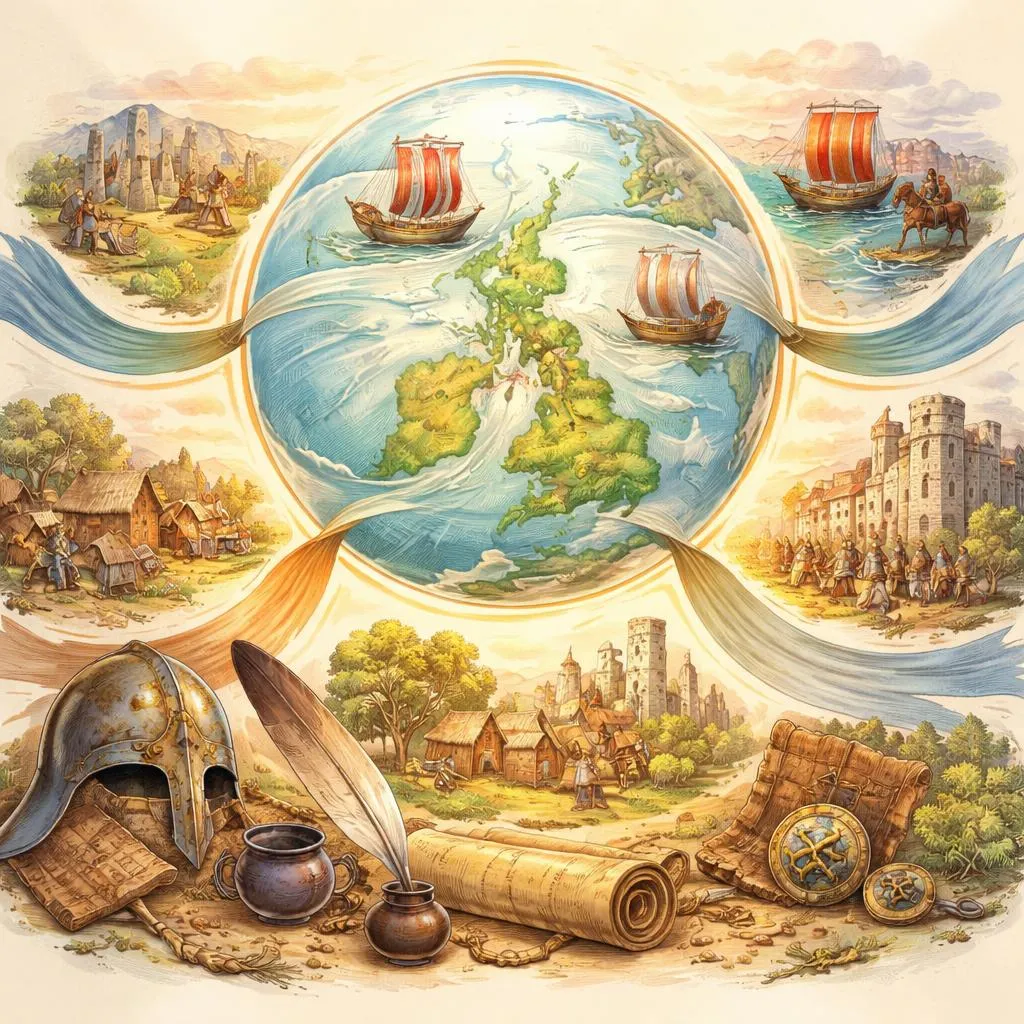

The English language origin can be traced back more than 1,500 years. English did not appear suddenly. It developed slowly over centuries through migration, invasion, trade, and cultural exchange. The language spoken today is the result of many historical influences and changes.
Understanding the origin of English helps explain why modern English has such a large vocabulary and mixed grammar system.
Early Beginnings: The Germanic Tribes
The story of English begins in the 5th century. During this time, Germanic tribes from northern Europe moved to Britain. The main groups were the Angles, the Saxons, and the Jutes.
The Angles gave their name to “England” and “English.” The language they spoke belonged to the Germanic branch of the Indo-European language family.
This early form of English is called Old English, also known as Anglo-Saxon. It looked and sounded very different from modern English.
Old English Period
Old English was spoken from around the 5th century to the 11th century. It had complex grammar, including grammatical gender and many noun endings.
A famous example of Old English literature is the epic poem Beowulf. Modern English speakers cannot easily understand it without translation because vocabulary and spelling were very different.
For example, the Old English word for “king” was “cyning,” which later became “king.”
Viking Influence
In the 8th and 9th centuries, Vikings from Scandinavia invaded parts of England. They spoke Old Norse, another Germanic language.
Because Old Norse and Old English were related, many words were borrowed and mixed. Common everyday words such as “sky,” “egg,” “knife,” and “window” come from Old Norse.
The Vikings also influenced grammar, helping simplify some of the complex endings found in Old English.
The Norman Conquest
A major turning point in the origin of the English language happened in 1066 with the Norman Conquest. After the Battle of Hastings, William the Conqueror became king of England. The ruling class spoke Norman French.
For about 300 years, French was used in government, law, and the upper classes, while English remained the language of common people.
As a result, English borrowed thousands of French words. Many legal and government terms, such as “court,” “judge,” and “government,” come from French. Words related to food and culture, like “beef” and “beauty,” also entered the language.
Middle English Period
Between 1100 and 1500, English changed into Middle English. Grammar became simpler, and many Old English endings disappeared.
One of the most important writers of this period was Geoffrey Chaucer, who wrote The Canterbury Tales. His language is closer to modern English, but it still looks unusual to today’s readers.
During this time, English became the main language of England again.
The Renaissance and Vocabulary Growth
From the 16th century onward, English entered the Early Modern English period. This era saw major vocabulary expansion due to trade, exploration, science, and literature.
Many words were borrowed from Latin and Greek, especially in science and education. Writers such as William Shakespeare introduced new expressions and creative vocabulary that are still used today.
The invention of the printing press also helped standardize spelling and grammar.
Modern English
Modern English developed after the 18th century. British colonial expansion spread English to North America, Africa, Asia, and Australia.
As English spread globally, it absorbed words from many languages, including Hindi, Arabic, Spanish, and others. Today, English is spoken as a first or second language by millions of people around the world.
Modern English continues to change through technology, media, and global communication.
Why English Has So Many Words
Because of its history of invasions and cultural contact, English has vocabulary from Germanic roots, French influence, Latin and Greek learning, and many other languages. This mixed origin explains why English sometimes has multiple words with similar meanings, such as “ask” (Germanic) and “inquire” (French/Latin origin).
The origin of the English language shows how historical events shaped its grammar, vocabulary, and global importance. English today is a living language that continues to evolve while carrying traces of its long and complex past.
The Great Vowel Shift
One of the most important events in the origin of the English language was the Great Vowel Shift, which took place between the 15th and 18th centuries. During this period, the pronunciation of long vowels changed dramatically.
For example, the word “time” was once pronounced more like “teem,” and “house” sounded closer to “hoos.” Over time, vowel sounds shifted upward in the mouth, creating the pronunciation patterns we recognize today.
This shift explains why English spelling often does not match pronunciation. The spelling system was already becoming fixed due to printing, but pronunciation continued to change. As a result, modern English spelling can appear irregular.
The Printing Press and Standardization
In the late 15th century, the printing press was introduced to England by William Caxton. This invention played a major role in standardizing English spelling and grammar.
Before printing, spelling varied widely because there was no central authority controlling written language. Printers had to choose one spelling form, and over time these choices became standard.
Although spelling became more consistent, pronunciation kept evolving, which is one reason English spelling can be challenging for learners today.
Expansion Through Exploration and Empire
From the 16th century onward, England expanded its global influence through trade, exploration, and colonization. English spread to North America, the Caribbean, Africa, South Asia, and Australia.
In North America, English developed into American English. Over time, differences appeared in spelling, vocabulary, and pronunciation. For example:
British English: colour, centre American English: color, center
Both forms are correct within their own systems.
As English reached different regions, it also borrowed words from local languages. Words like “bungalow” (from Hindi) and “algebra” (from Arabic) became part of English vocabulary.
English as a Global Language
Today, English is considered a global language or international language. It is widely used in business, science, technology, aviation, and the internet.
Many international organizations use English as an official working language. For example, the United Nations includes English as one of its official languages.
Because of globalization, English continues to grow and adapt. New words are created regularly, especially in technology and social media.
Varieties of Modern English
Modern English is not uniform. There are many varieties around the world.
British English American English Canadian English Australian English Indian English
Each variety has unique pronunciation patterns and vocabulary, but they remain mutually understandable.
For example, a truck in American English is often called a lorry in British English. An apartment in American English is a flat in British English.
These differences reflect history and regional development.
Influence of Technology
In recent decades, technology has strongly influenced English. The internet, social media, and digital communication have created new vocabulary.
Words like “email,” “hashtag,” “blog,” and “selfie” did not exist centuries ago. Language evolves to describe new inventions and cultural changes.
English continues to absorb new expressions quickly because of its global role.
Why English Is So Flexible
The origin of the English language explains why it is flexible and adaptable. Because English has borrowed vocabulary from many sources and simplified much of its grammar over time, it can easily accept new words and expressions.
Its mixed roots—Germanic structure, French vocabulary influence, Latin and Greek scientific terms—have created a rich and diverse lexicon.
A Language That Continues to Evolve
The English language did not stop developing after the Middle Ages or the Renaissance. It continues to change today. Pronunciation shifts, slang develops, and new words enter the dictionary every year.
Understanding the origin of English helps learners see it not as a fixed system, but as a living language shaped by history, culture, and global communication. The journey from Old English to modern global English shows how language adapts to the needs of its speakers across time.