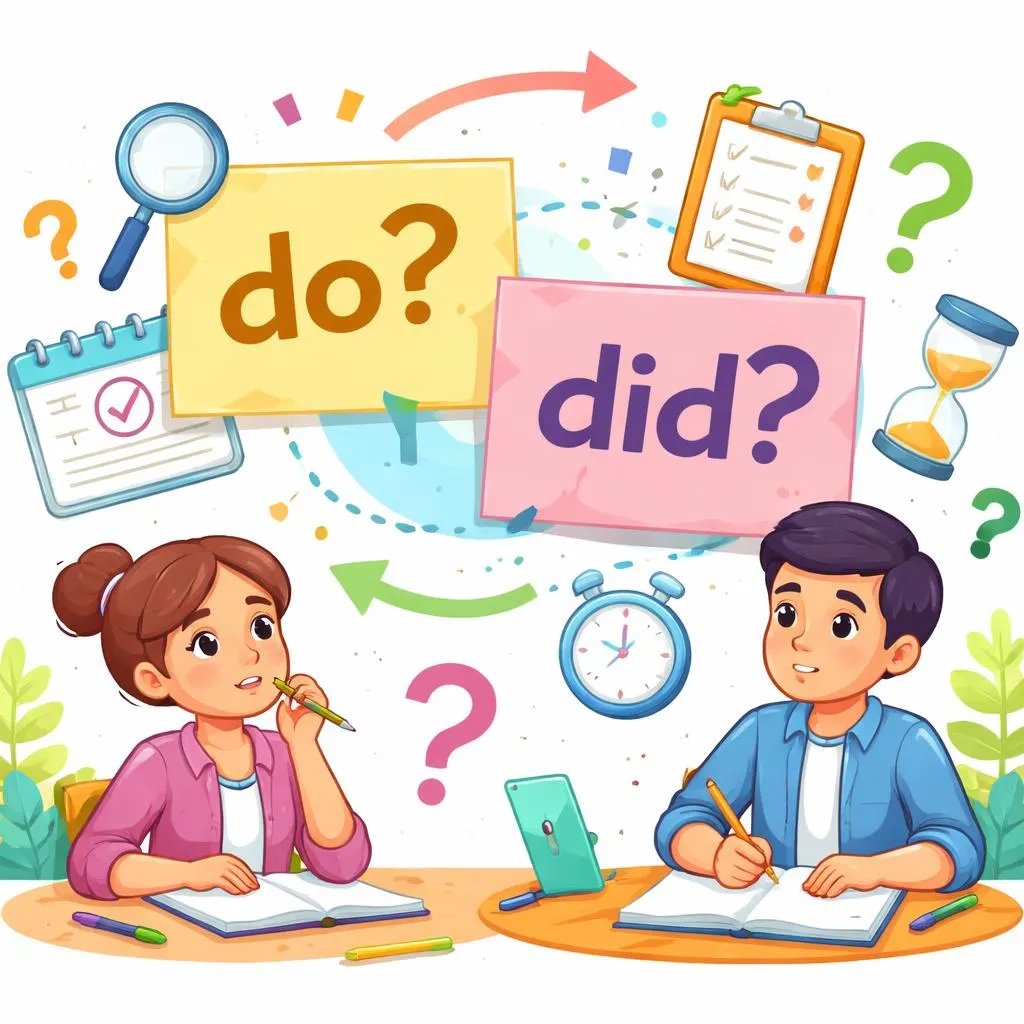

Meaning Let's explore a very important verb: "do." When we ask about the past tense of do, we are asking about the form we use to talk about completed actions or to form questions and negatives in the past. The verb "do" is unique because it often functions as a helper or auxiliary verb.
The past tense of do helps us shift actions into yesterday. It allows us to ask "What did you do?" or state "I did my homework." Understanding this verb is crucial because it is used constantly in everyday conversation to form correct grammar in the past.
Conjugation The conjugation of "do" is irregular. Its past tense form is not created by simply adding "-ed." The base form is "do." The past tense form is "did." This form is used for all subjects in the past tense.
We say: I did, you did, he did, she did, it did, we did, they did. The verb "did" remains the same regardless of the subject. This consistency makes the past tense of do simpler to learn than many other verbs.
Present Tense First, let's review the present tense to see the contrast. In the present, we use "do" and "does." We use "do" with I, you, we, and they. We use "does" with he, she, and it.
For example: I do my chores. You do a good job. She does her work. It does not matter. The present tense describes habitual actions or general truths happening now.
Past Tense Now, let's focus on the past tense of do: "did." We use "did" as the main verb to talk about a completed action. We also use it as a helping verb to form questions and negatives about other past tense verbs.
As a main verb: I did the laundry. You did a great dance. He did his best. They did the project. These sentences describe specific actions that are finished. The word "did" itself carries the meaning of the past action.
Future Tense To talk about future actions, we do not use a past tense form. We use "will do" or "going to do." The future tense expresses actions that have not happened yet.
For example: I will do it tomorrow. She is going to do her presentation. We will do better next time. Using "did" for future events would be incorrect, as "did" specifically refers to the past.
Questions Forming questions in the past tense often requires the past tense of do, which is "did." We use "did" at the beginning of a question, and the main verb returns to its base form.
For example: Did you eat? Did she call? Did they finish? The word "did" shows the question is about the past. To answer, we say "Yes, I did" or "No, she didn't." This structure is essential for everyday conversation.
Other Uses The word "did" is also used for emphasis in positive statements, even though this is less common for young learners. For example: "I did finish my work!" Here, "did" adds strong emphasis to the statement.
Its primary use, however, is as a helper to form past tense questions and negative statements. For negatives, we use "did not" or the contraction "didn't." For example: I did not go. She didn't like it.
Learning Tips A great tip is the "Question Word Game." Use question words (What, Where, When) and have learners create past tense questions starting with "Did." For example: "What did you eat? Where did you go?" This drills the question structure.
Another tip is to use sequencing with "First, I did... Then, I did..." Have learners describe their morning or a story using this frame. It connects the grammar to narrative and personal routine.
Educational Games Play "Find Someone Who... Did." Create a checklist with past actions: "Find someone who did their homework, who did a kind deed, who did a puzzle." Learners mingle and ask "Did you...?" questions to complete their checklist. This encourages speaking and listening.
Try the "Sentence Scramble." Write words from past tense sentences on cards (e.g., "did / I / my / room / clean"). Learners must physically arrange the cards to form a correct sentence like "I did clean my room." This reinforces word order and grammar structure.
Mastering the past tense of do is like getting a key to talking about yesterday. It unlocks the ability to ask questions, tell stories, and share completed experiences. By practicing with clear patterns, engaging games, and personal narratives, this fundamental verb becomes a natural part of a learner's language toolkit. The confidence to discuss the past clearly and correctly is a significant milestone in language learning.