
Start! Find a Pair of 'Frozen Twin' Words
Hello, word explorer! Do you know cold things? You put a cube of ice in your drink. You see sparkly white frost on the grass. They are both frozen and cold. Are they the same? This is a chilly word puzzle. Today we explore a word pair. We explore ice and frost. They are like a thick book and a thin, sparkly cover. One is a solid block. One is a delicate coating. Knowing the difference is a superpower. Your talk about winter will be clear and smart. Let us start our frosty word lesson!
Be a Language Observer now. Our first clue is at home. You get a cold drink with clinking ice cubes. Your car window has pretty, white frost in the morning. They are both frozen water. But are they the same? Let us test with two sentences.
"The hockey players skated on the smooth ice of the rink." This is about a solid, thick surface. "Each blade of grass wore a jacket of shiny morning frost." This is about a thin, white coating.
They are both cold. But one feels thick and solid. One feels thin and sparkly. Your observation mission starts. Let us explore their chilly word world.
Adventure! Explore the Chilly Word World
Feel the Word's Solid and Delicate Vibe!
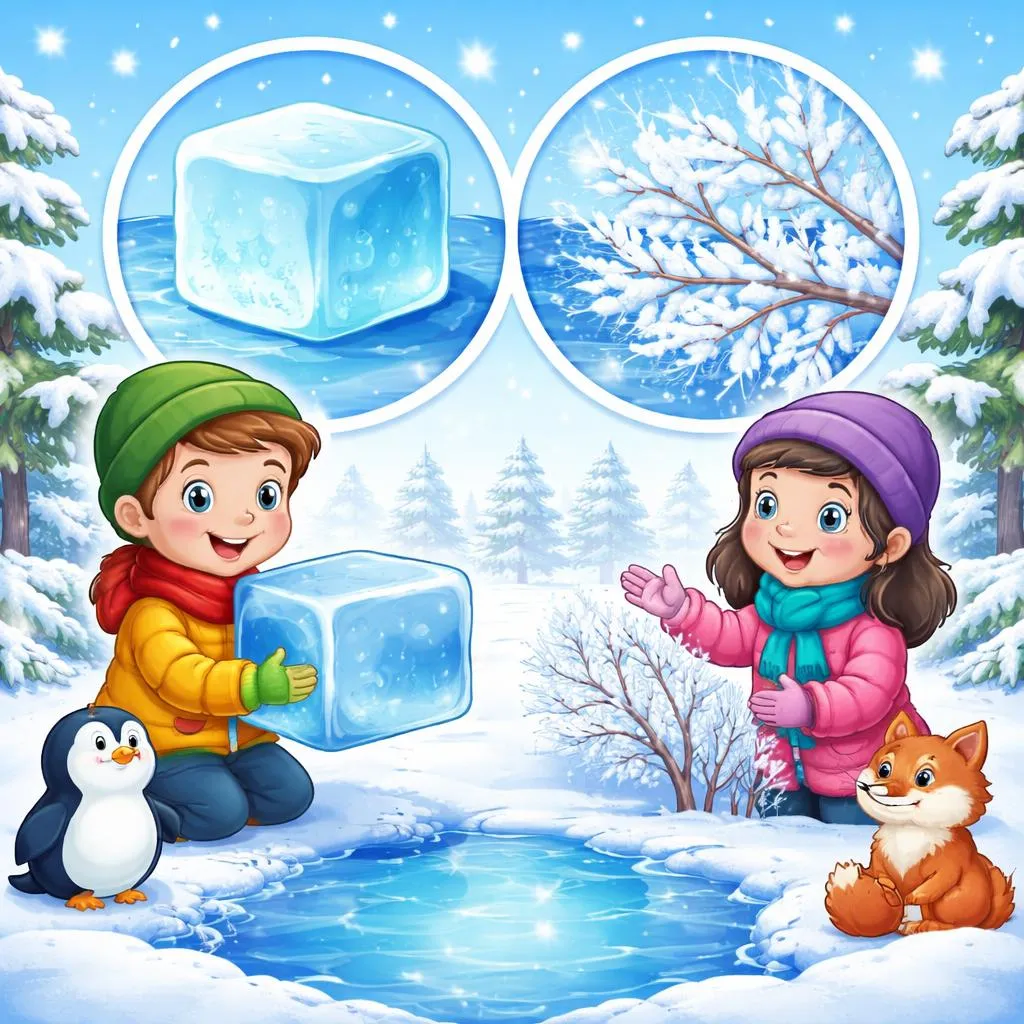
Feel the word ice. It is a solid, strong word. It feels like cubes, blocks, a smooth surface, and a hard chill. The word frost is a delicate, pretty word. It feels like feathers, lace, a light dusting, and sparkly crystals. Ice is like a thick book. Frost is like a thin, glittery cover. One is for walking on. The other is for looking at. Let us see this at school.
In a science class, you learn that ice is the solid state of water. This is about its physical form. In an art class, you might draw a window with beautiful frost patterns. This is about its artistic appearance. You study the properties of ice. You admire the patterns of frost. The feeling of the words is different. One is scientific and structural. The other is artistic and decorative.
Compare Their Thickness and How They Form!
Think about a deep pond and a thin morning mist. The word ice is the pond. It forms when liquid water freezes completely. It can be thick and solid. The word frost is the mist. It forms when water vapor in the air freezes directly onto a cold surface. It makes thin, white crystals. Their formation is the key. Ice comes from liquid water. Frost comes from water vapor. One is a frozen puddle. The other is frozen dew. Let us test this on the playground.
The puddle is frozen solid into a sheet of ice. You can slide on it. The metal slide is covered in a white, dusty frost. You can draw in it with your finger. The word ice describes the solid, walkable sheet. The word frost describes the thin, dusty coating. The playground shows the difference.
Meet Their Best Word Friends!
Words have favorite frozen partners. The word ice likes sports, drinks, and solid things. It teams up with 'skating', 'hockey', 'cube', 'break the', 'cold as', and 'pack'. Ice skating. An ice cube. The word frost likes weather, mornings, and decorations. It teams up with 'morning', 'jack', 'window', 'pattern', 'light', and 'frosting'. Frosty morning. Window frost. Their partners are different. Let us go back to school.
In a cooking class, you might learn to crush ice for a smoothie. This is about handling a solid. In a geography class, you learn about permafrost, a layer of frozen ground. The word friends set the scene. You would not say "perma-ice." The word friends help you choose.
Our Little Discovery!
We explored the chilly world of frozen water. We made a clear discovery. The words ice and frost are different. Ice is the solid, frozen form of water. It is thick, clear, or cloudy, and you can hold it. Frost is a thin, white, icy coating. It forms from water vapor on cold surfaces. Ice is a block or sheet. Frost is a light dusting or pattern. One comes from freezing water. The other comes from freezing vapor. This is the main difference.
Challenge! Become a Frosty Word Expert
"Best Choice" Challenge!
Let us look at a nature scene. A pond is so cold that the surface turns into a hard, clear layer. This is a sheet of solid ice. Is it Ice or Frost? The champion is Ice! It is a thick, solid layer from frozen water. Now, imagine a spider web on a cold morning. It is covered in tiny, sparkling white crystals. This is a beautiful frost. Is it ice or frost? The champion is frost! It is a delicate, feathery coating on the web. Excellent!
"My Sentence Show"!
Now, create your own sentences. Here is a fun scene: Imagine a winter road. It is dangerous because it is covered in a slippery, hard surface. Use the word ice in one sentence. Now imagine waking up early. The whole world looks white and sparkly from a light, frozen dust. Use the word frost in another. Try it! Here is an example. Sentence one: "The road was very slippery with black ice." Sentence two: "The whole field was white with a thick morning frost." See the difference? The first is about a hard, solid, slippery hazard. The second is about a white, dusty coating on the ground.
"Eagle Eyes" Search!
Can you find the word that needs help? Read this sentence: "The children were excited to see a layer of sparkling ice covering every leaf and twig in the garden after the cold night." Hmm. This is a mix. A "layer" of sparkling frozen crystals on leaves is usually called frost, not ice. Ice would be thicker, like a glaze. A better sentence is: "The children were excited to see a layer of sparkling frost covering every leaf and twig in the garden after the cold night." You fixed it!
What a cool and sparkly exploration! You started as a curious observer. Now you are a word expert. You know the secret of ice and frost. You can feel their different solid and delicate vibes. You see that ice is a thick solid and frost is a thin coating. You know their best word friends. This is a real language superpower.
You can learn amazing things from this article. You now know that 'ice' is the solid, frozen water you find in cubes, on ponds, or on roads. You understand that 'frost' is the pretty, white, icy coating that forms on grass, windows, and spider webs on cold mornings. You can explain that ice forms from freezing water, and frost forms from freezing water vapor in the air. You learned terms like 'ice cube' and 'morning frost'.
How can you use this today? It is easy and fun. Look in your drink. That is ice. Look at a cold window in winter. That is frost. On a cold day, check for black ice on the sidewalk. On a frosty morning, draw a picture in the frost on a window. Draw two pictures. Draw a glass with ice cubes. Draw a window with frost patterns. You are using your new skill every day.
Keep your explorer eyes open. The world is full of amazing ice and beautiful frost. You are learning the words to describe them all. Great work, word expert. Your English journey is getting more precise and cool with every new word pair you discover!