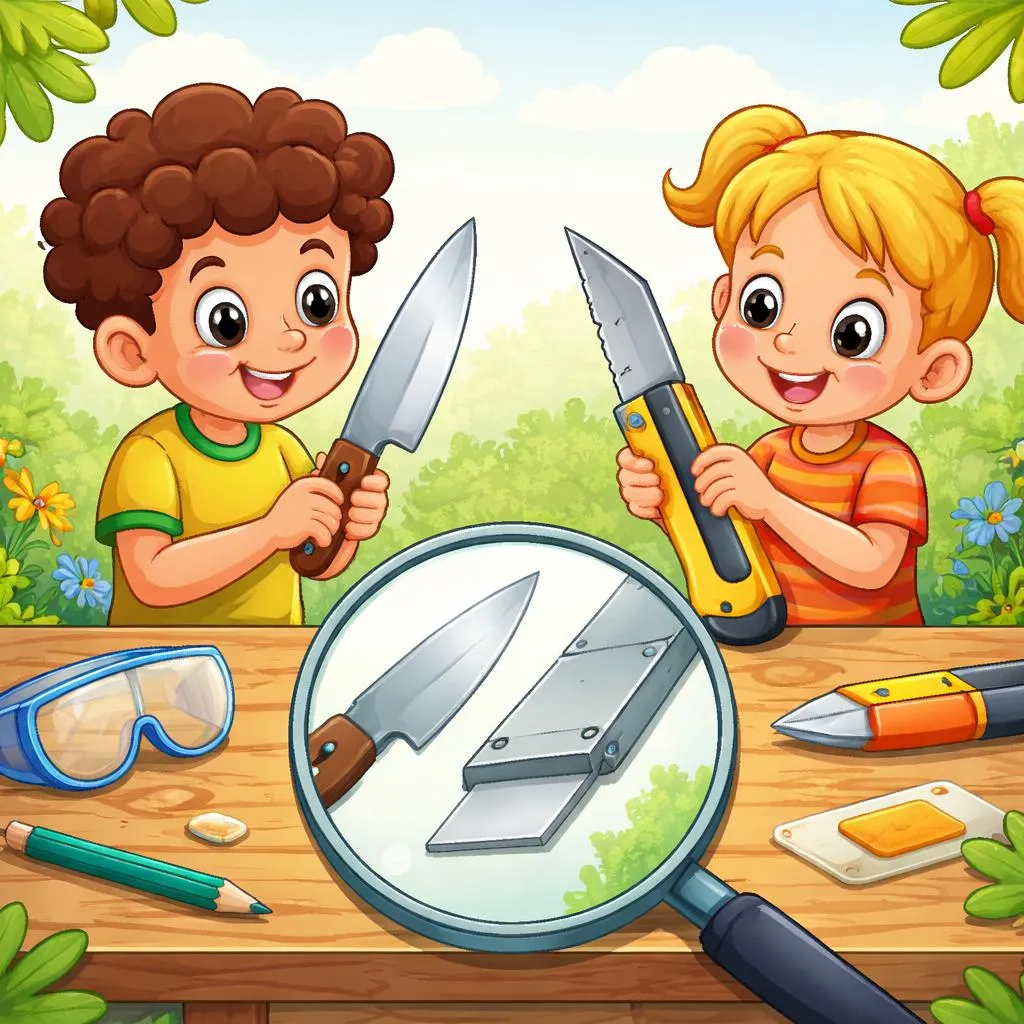

Start! Find a Pair of 'Sharp Twin' Words
Hello, word explorer! Do you help in the kitchen? What do you use to cut an apple? A knife! Look closely at that knife. What is the sharp, metal part called? That is the blade! They are both about cutting. Are they the same? This is a fun tool puzzle. Today we explore a word pair. We explore knife and blade. They are like a whole pencil and the lead inside. One is the complete tool. One is the part that does the work. Knowing the difference is a superpower. Your talk about tools will be clear and smart. Let us start our word lesson!
Be a Language Observer now. Our first clue is at home. Your dad cuts bread with a bread knife. You look at it. The long, sharp metal part is the blade. They are connected. But are the words the same? Let us test with two sentences.
"Use a butter knife to spread the jam." This is about the whole utensil with a handle. "The blade of the knife was very sharp and shiny." This is about just the cutting part.
They are both about cutting objects. But one is the complete object you hold. One is the important cutting edge. Your observation mission starts. Let us cut into their word world.
Adventure! Cut Into the Word World
Feel the Word's Whole and Part Vibe!
Feel the word knife. It is a whole, complete word. It feels like a tool, a utensil, or a weapon. You can hold it. The word blade is a part, a piece word. It feels like an edge, a sharp surface, or a cutting component. It is the business end of a tool. Knife is the whole car. Blade is the engine. One is the object. The other is the powerful part. Let us see this at school.
In a cooking class, you learn to chop vegetables with a chef's knife. This is the whole tool. In a science lesson, you look at a fan. It spins on its blades. These are the flat parts that move air. Saying "the fan spins on its knives" is wrong. The relationship of the words is different. One is a specific tool. The other is a component of many things.
Compare Their Relationship: The Tool vs. Its Cutting Edge!
Think about a saw and its teeth. The word knife is the whole saw. The word blade is the toothed, cutting edge of the saw. Their relationship is the key. A knife is a tool that has a blade. You cannot have a knife without a blade. But you can have a blade that is not on a knife. A razor, a sword, or a lawnmower has a blade too. Let us test this on the playground.
You find a flat, sharp stone. You use it to cut a string. The stone is like a simple blade. You tie it to a stick to make a handle. Now it is like a simple knife. The word blade describes the sharp part. The word knife describes the whole tool with a handle. The playground shows the difference.
Meet Their Best Word Friends!
Words have favorite sharp partners. The word knife likes utensil and tool words. It teams up with 'pocket', 'butter', 'steak', 'switch', 'under the', and 'like a hot'. Like a hot knife through butter. Under the knife for surgery. The word blade likes part and edge words. It teams up with 'razor', 'shoulder', 'grass', 'sharp', 'cutting', and 'on the'. On the blade of grass. A razor blade. Their partners are different. Let us go back to school.
In a history lesson, you see a picture of a stone knife. This is a complete ancient tool. In a sports class, you see figure skaters. They glide on the blades of their skates. This is the metal part that touches the ice. You would not say the "knives of their skates." The word friends lock in the meaning.
Our Little Discovery!
We explored the world of sharp tools. We made a clear discovery. The words knife and blade are different. A knife is a whole cutting tool with a handle and a sharp edge. A blade is the flat, sharp part of a knife, sword, or other tool that does the cutting. A knife has a blade. A blade is part of a knife. One is the complete object. The other is its cutting component. This is the main difference.
Challenge! Become a Sharp Word Expert
"Best Choice" Challenge!
Let us look at a nature scene. A beaver has long, sharp front teeth. These teeth are like natural blades for cutting wood. Is it Knife or Blade? The champion is Blade! This describes the sharp, cutting part of the beaver's tooth. Now, imagine an ancient human. They tie a sharp piece of flint to a wooden handle. They have made a stone knife. Is it knife or blade? The champion is knife! This describes the whole, assembled cutting tool. Excellent!
"My Sentence Show"!
Now, create your own sentences. Here is a fun scene: Imagine you are making a sandwich. You need a tool to cut it in half. Use the word knife in one sentence. Now, look at that tool. Describe its sharpness. Use the word blade in another. Try it! Here is an example. Sentence one: "I used a table knife to cut my sandwich." Sentence two: "The blade was not very sharp, so it squished the bread." See the difference? The first is about the whole utensil. The second is about the quality of its cutting part.
"Eagle Eyes" Search!
Can you find the word that needs help? Read this sentence: "The old lawnmower was broken because one of its knives was bent and wouldn't spin." Hmm. This is a mix. A lawnmower has blades, not knives. The cutting parts are called blades. A better sentence is: "The old lawnmower was broken because one of its blades was bent and wouldn't spin." You fixed it!
What a sharp and precise session in the word world! You started as a curious observer. Now you are a word expert. You know the secret of knife and blade. You can feel their different whole and part vibes. You see that a knife is the tool and a blade is its cutting edge. You know their best word friends. This is a real language superpower.
You can learn amazing things from this article. You now know that a 'knife' is a whole cutting tool with a handle, used in the kitchen or for other tasks. You understand that a 'blade' is the sharp, flat cutting part of a knife, sword, razor, or machine like a fan or lawnmower. You can explain that a knife has a blade, and a blade is the part that cuts. You learned terms like 'butter knife' and 'razor blade'.
How can you use this today? It is easy and fun. Look at a kitchen knife. The metal part is the blade. The part you hold is the handle. Together, they are the knife. Look at a wind turbine. Its arms are called blades. Be safe and always let an adult handle sharp knives and blades. Draw two pictures. Draw a whole kitchen knife. Draw a close-up of a sharp blade. You are using your new skill every day.
Keep your explorer eyes open. The world is full of knives and the blades that make them useful. You are learning the words to describe them all. Great work, word expert. Your English journey is getting more precise and sharp with every new word pair you discover!