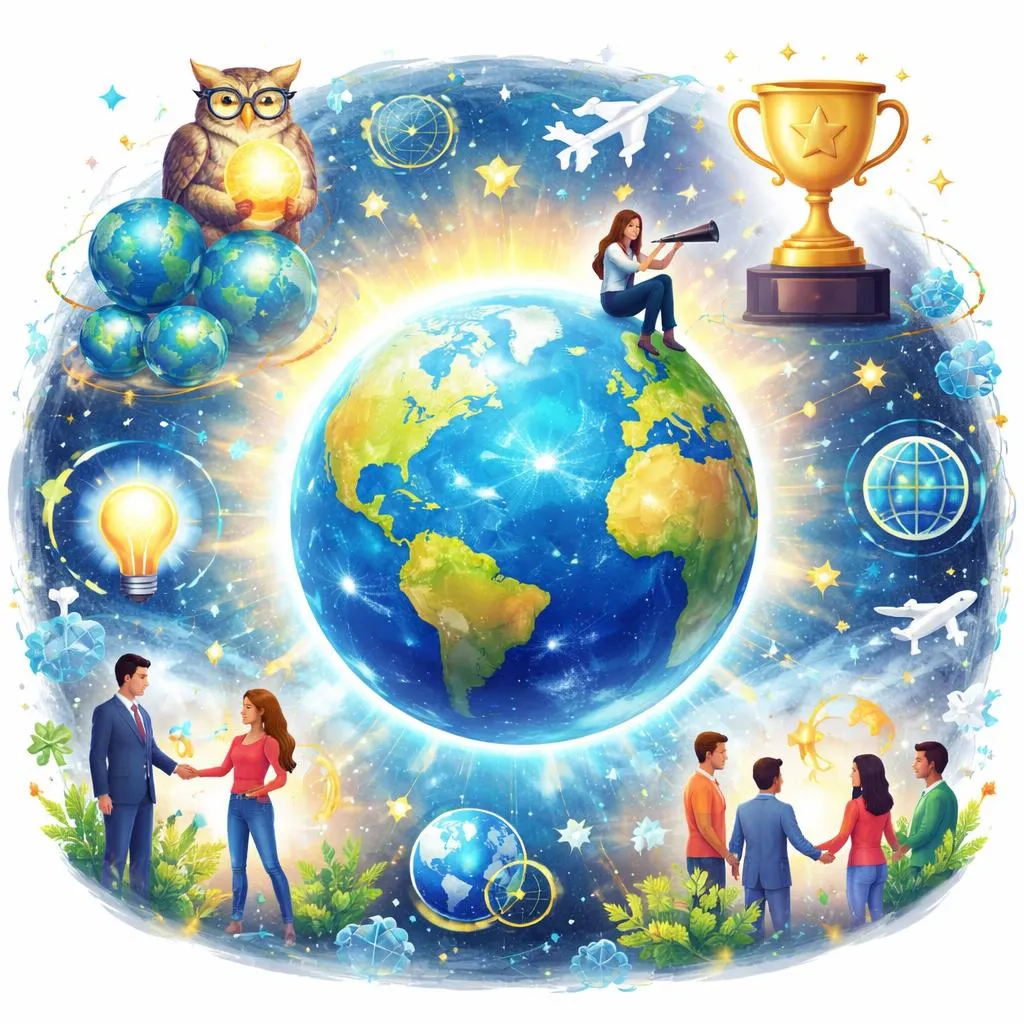

The world is our planet Earth. Worldly people have experience in many cultures. The words “world, worldly, worldwide, world-class” all come from one family. Each word talks about the earth or human society. But each one has a different job in a sentence. Learning this family helps children understand global connections. Let us explore these four words together.
What Does “Same Word, Different Forms” Mean? One core idea can grow into many word shapes. The meaning stays the same at the heart. But the word changes its ending or combines for a new role. For example, “world” is a noun. “Worldly” is an adjective. “Worldwide” is an adjective or an adverb. “World-class” is an adjective. Knowing these four forms helps a child talk about the globe and top quality.
Personal Pronouns Change Their Form Pronouns change from “he” to “him” or “his”. Our word family changes by adding suffixes and compounds. Think of “world” as the core earth or society. “Worldly” turns that idea into a description of experience. “Worldwide” combines world with wide to mean across the world. “World-class” combines world with class to mean best in the world. Each form answers a simple question. What is our planet? World. What is experienced in life? Worldly. What spans the globe? Worldwide. What is among the best? World-class.
From Verb to Noun to Adjective to Adverb – One Family, Many Words This family has a noun and adjectives. Let us start with the noun “world”. Noun: The world is full of amazing places. “World” means the earth and all its people.
Next is the adjective “worldly”. Adjective: His worldly wisdom came from travel. “Worldly” means experienced in life or focused on material things.
Then “worldwide” as an adjective or adverb. Adjective: The pandemic caused a worldwide crisis. Adverb: The news spread worldwide in seconds. “Worldwide” means happening in every part of the world.
Finally the adjective “world-class”. Adjective: She is a world-class violinist. “World-class” means among the best in the entire world.
One Root, Many Roles – How Words Grow from Actions to Qualities The Old English word “weorold” came from “wer” (man) and “eld” (age), meaning the age of man. From this root, we built a family about the earth and society. “World” kept the main noun meaning. Adding -ly made “worldly” (of the world). Combining “world” with “wide” made “worldwide” (as wide as the world). Combining “world” with “class” made “world-class” (of the highest class in the world). Children can see the same pattern in other families. For example, “earth, earthly, earthwide (rare), earth-class (no)”. Learning compounds helps kids describe global phenomena.
Same Meaning, Different Jobs – Is It a Verb or a Noun? Look at each word’s job carefully. “World” is a noun. Example: Our world needs more kindness.
“Worldly” is an adjective. Example: Some people prefer spiritual life over worldly goods.
“Worldwide” is an adjective or an adverb. Adjective example: The band has worldwide fame. Adverb example: The movie was released worldwide.
“World-class” is an adjective. Example: The restaurant serves world-class sushi. Each form has a clear job. Only “worldwide” has two roles.
Adjectives and Adverbs – When Do We Add -ly? We can make an adverb from “worldly”. Add -ly to get “worldlily” (very rare). For young learners, focus on “world” and “worldwide.” A simple reminder: “World is the planet. Worldly means material or experienced. Worldwide means everywhere on Earth. World-class means the best in the world.”
Watch Out for Tricky Spelling Changes (Double Letters, y to i, and More) “World” has no double letters. Add -ly to make “worldly”. World + ly = worldly (no changes). Combine with “wide” to make “worldwide”. World + wide = worldwide (no changes). Combine with “class” to make “world-class”. World + class = world-class (use a hyphen). A common mistake is writing “world” as “word” (language unit). Say “We live in the world. A word is a part of language.” Another mistake is “worldly” spelled “worldley” (with e). Say “Worldly ends with ly.” Another mistake is “worldwide” spelled “world wide” as two words. “Worldwide” as one word is correct. Another mistake is “world-class” written without a hyphen: “worldclass” is less common. Use the hyphen.
Let’s Practice – Can You Choose the Right Form? Try these sentences with your child. Read each one aloud. Pick the correct word from the family.
The ______ is home to billions of people. Answer: world (noun)
His ______ possessions meant little to him after his illness. Answer: worldly (adjective)
The company has a ______ reputation for quality. Answer: worldwide (adjective)
That athlete is a ______ sprinter. Answer: world-class (adjective)
The news was broadcast ______ via satellite. Answer: worldwide (adverb)
A ______ traveler learns many languages. Answer: worldly (adjective)
We live on a beautiful ______. Answer: world (noun)
The ______ pandemic changed how we live. Answer: worldwide (adjective)
The chef prepared a ______ meal that tasted amazing. Answer: world-class (adjective)
Her ______ experience helped her solve the problem. Answer: worldly (adjective)
After the practice, ask your child one question. Is this word the planet, a material/experienced description, a global description, or a top-quality description? That simple question teaches grammar through geography and excellence.
Tips for Parents – Help Your Child Learn Word Families in a Fun Way Use a map to teach “world”. Say “The world has seven continents.”
Use a story to teach “worldly”. Say “Grandfather’s worldly advice comes from many years of work.”
Use a product to teach “worldwide”. Say “This toy is sold worldwide, from Tokyo to New York.”
Use a talent to teach “world-class”. Say “Your drawing is world-class. You are so talented!”
Play “fill in the blank” during car rides. Say “The ______ is round.” (world) Say “He cares more about spiritual than ______ things.” (worldly) Say “The internet connects people ______.” (worldwide) Say “She is a ______ pianist.” (world-class)
Read a story about an explorer or a famous athlete. Ask “How does the character see the world?” Ask “What worldwide impact did they have?”
Turn a drawing activity into a word lesson. Draw a globe. Label “world”. Draw a person with a suitcase and a stamp. Label “worldly traveler”. Draw a map with arrows across oceans. Label “worldwide shipping”. Draw a star next to a gold medal. Label “world-class athlete”.
When your child makes a mistake, stay calm. If they say “The worldwide is big,” say “Almost. The world is big. Worldwide is an adjective.” If they say “She is world class,” say “Yes! But write it with a hyphen: world-class.”
Write the four words on sticky notes. Put them on a globe or a world map. Each time you learn about a new country, point to “world”.
Remember that we share one world. Use these words to build global citizenship. “You can have a worldwide impact with small acts of kindness.” “World-class does not mean perfect. It means doing your best.” Soon your child will love learning about the world. They will listen to worldly advice. They will think about worldwide issues. And they will strive to be world-class in their own unique way. That is the global power of learning one small word family together.