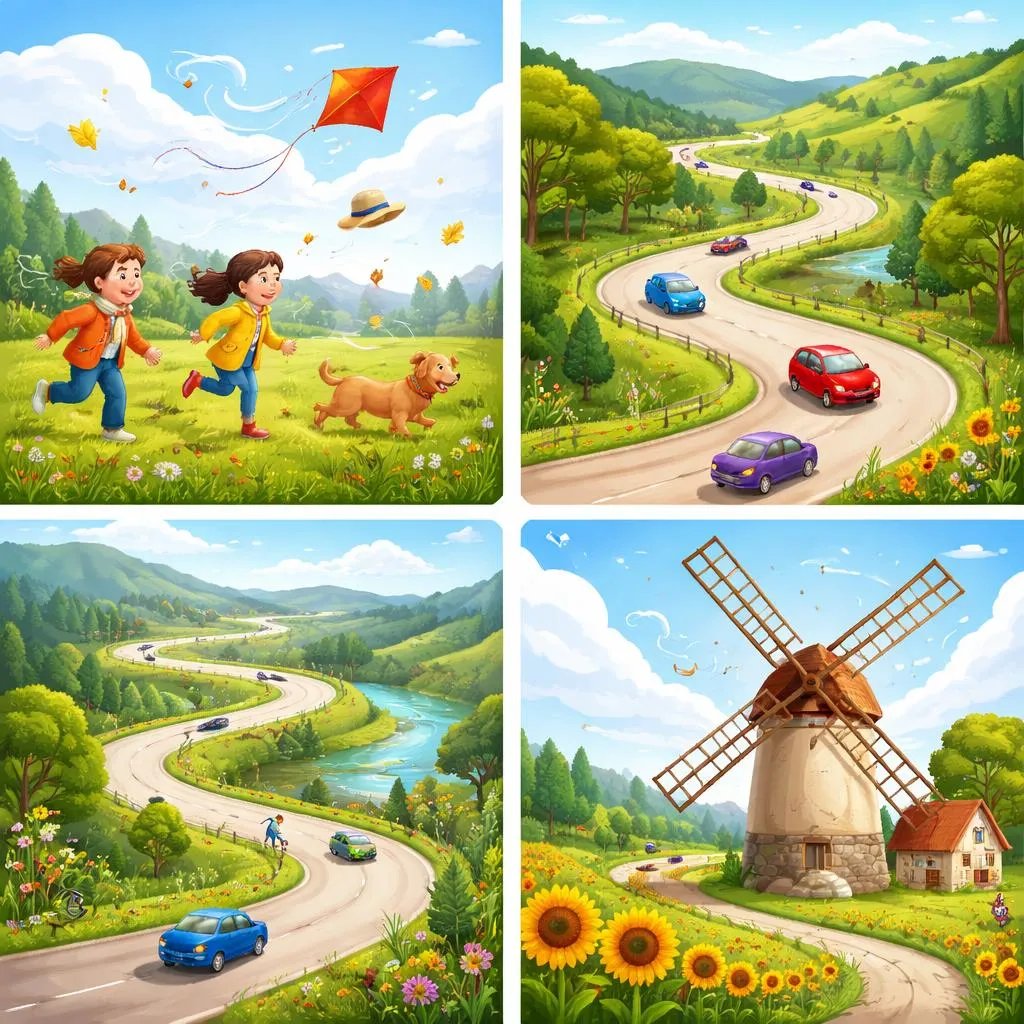

Wind blows leaves across the yard. A windy day is perfect for flying a kite. The words “wind, windy, winding, windmill” all come from one family. Each word talks about air moving or things that curve. But each one has a different job in a sentence. Learning this family helps children describe weather and shapes. Let us explore these four words together.
What Does “Same Word, Different Forms” Mean? One core idea can grow into many word shapes. The meaning stays the same at the heart. But the word changes its ending or combines for a new role. For example, “wind” is a noun or a verb. “Windy” is an adjective. “Winding” is an adjective or a verb form. “Windmill” is a noun. Knowing these four forms helps a child talk about air and curves.
Personal Pronouns Change Their Form Pronouns change from “he” to “him” or “his”. Our word family changes by adding suffixes and compounds. Think of “wind” as the core moving air or the action of twisting. “Windy” turns that air into a description. “Winding” turns the twisting action into a description of a path. “Windmill” combines wind with mill to name a machine. Each form answers a simple question. What moving air? Wind. What is full of wind? Windy. What twists and turns? Winding. What machine uses wind? Windmill.
From Verb to Noun to Adjective to Adverb – One Family, Many Words This family has a noun, a verb, an adjective, and another noun. Let us start with the noun “wind” (pronounced like “winned”). Noun: The strong wind knocked over the trash can. “Wind” means moving air.
“Wind” can also be a verb (pronounced like “wined”). Verb: Please wind the clock every day. “Wind” means to twist or turn around.
Next is the adjective “windy”. Adjective: It is too windy to play tennis. “Windy” means having a lot of wind.
Then “winding” as an adjective. Adjective: The winding path led through the forest. “Winding” means curving back and forth. “Winding” can also be a verb form. Verb (ongoing): She is winding the yarn into a ball.
Finally the noun “windmill”. Noun: The old windmill pumped water for the farm. “Windmill” means a machine with blades that turn in the wind.
One Root, Many Roles – How Words Grow from Actions to Qualities The Old English word “wind” meant moving air. The verb “wind” (to twist) came from a different root but sounds the same in spelling. From this root, we built a family about air and turning. “Wind” kept the main noun and verb meanings. Adding -y made “windy” (full of wind). Adding -ing made “winding” (turning). Combining “wind” with “mill” made “windmill” (a mill powered by wind). Children can see the same pattern in other families. For example, “rain, rainy, raining, rainwater (compound)”. Learning compounds helps kids describe inventions.
Same Meaning, Different Jobs – Is It a Verb or a Noun? Look at each word’s job carefully. “Wind” (air) is a noun. Example: The wind howled all night.
“Wind” (to twist) is a verb. Example: Wind the string around the stick.
“Windy” is an adjective. Example: A windy forecast means secure your patio furniture.
“Winding” is an adjective or a verb form. Adjective example: The winding river took us far from home. Verb example: He is winding the rope.
“Windmill” is a noun. Example: The windmill’s blades spun slowly. Each form has a clear job.
Adjectives and Adverbs – When Do We Add -ly? We can make an adverb from “windy”. Add -ly to get “windily”. Example: The flag flapped windily. But “windily” is rare. For young learners, focus on the difference between “wind” (air) and “wind” (turn). A simple reminder: “Wind the clock with a key. The wind blows the leaves.”
Watch Out for Tricky Spelling Changes (Double Letters, y to i, and More) “Wind” (air) has no double letters. Add -y to make “windy”. Wind + y = windy (no changes). Add -ing to make “winding” (from the verb wind, to turn). Wind → winding (no changes). Combine with “mill” to make “windmill”. Wind + mill = windmill (keep the d? Yes, windmill has “wind” + “mill.” Keep the d.) A common mistake is confusing the pronunciation of “wind” (air) and “wind” (to turn). Say “The wind (rhymes with pinned) blows. Wind (rhymes with find) the toy.” Another mistake is writing “windy” as “windey” (with e). Say “Windy ends with y.” Another mistake is “winding” spelled “winding” (correct) but some write “winding” (same). Good. Another mistake is “windmill” spelled “wind mill” as two words. “Windmill” as one word is correct.
Let’s Practice – Can You Choose the Right Form? Try these sentences with your child. Read each one aloud. Pick the correct word from the family.
The ______ blew my hat off my head. Answer: wind (noun)
Please ______ the ribbon around the present. Answer: wind (verb)
It is too ______ to play outside today. Answer: windy (adjective)
The ______ path through the canyon was narrow. Answer: winding (adjective)
The old ______ pumped water for the cattle. Answer: windmill (noun)
A cold ______ came from the north. Answer: wind (noun)
Can you ______ the handle to start the music box? Answer: wind (verb)
A ______ day is good for drying laundry outside. Answer: windy (adjective)
She is ______ the thread onto a spool. Answer: winding (verb form)
The ______’s blades generated electricity. Answer: windmill (noun)
After the practice, ask your child one question. Is this word moving air, a twisting action, a breezy description, a curvy description, or a wind-powered machine? That simple question teaches grammar through weather and mechanics.
Tips for Parents – Help Your Child Learn Word Families in a Fun Way Use a flag to teach “wind”. Say “The flag moves when wind blows.”
Use a toy car to teach “wind as verb”. Say “Wind up the car to make it go.”
Use a weather forecast to teach “windy”. Say “Tomorrow will be windy. Hold onto your hat.”
Use a road to teach “winding”. Say “A winding road has many curves.”
Use a field trip to teach “windmill”. Say “A windmill uses wind power to grind wheat.”
Play “fill in the blank” during car rides. Say “The ______ is strong today. Hold my hand.” (wind) Say “______ the rubber band around the stick.” (wind) Say “A ______ day is not safe for a boat.” (windy) Say “The ______ staircase went up the tower.” (winding) Say “The ______ was painted white with blue doors.” (windmill)
Read a story about a storm or a journey. Ask “How does the wind affect the characters?” Ask “Is the path straight or winding?”
Turn a drawing activity into a word lesson. Draw wavy lines in the air. Label “wind”. Draw a hand turning a key. Label “wind up”. Draw leaves blowing. Label “windy day”. Draw a bent road. Label “winding road”. Draw a tower with spinning blades. Label “windmill”.
When your child makes a mistake, stay calm. If they say “The wind (rhymes with find) is strong,” say “Almost. Wind (rhymes with pinned) is moving air. Wind (rhymes with find) means to turn.” If they say “The road is winded,” say “Close. The road is winding. Winding means curvy.”
Write the four words on sticky notes. Put them on a window or a weather station. Each time you feel a breeze, point to “wind”.
Remember that wind is a powerful force. Use these words to teach science and safety. “A windy day can be fun, but strong winds are dangerous.” “A winding path is fun to walk.” Soon your child will feel the wind. They will know a windy forecast. They will enjoy a winding trail. And they will learn how a windmill works. That is the breezy power of learning one small word family together.