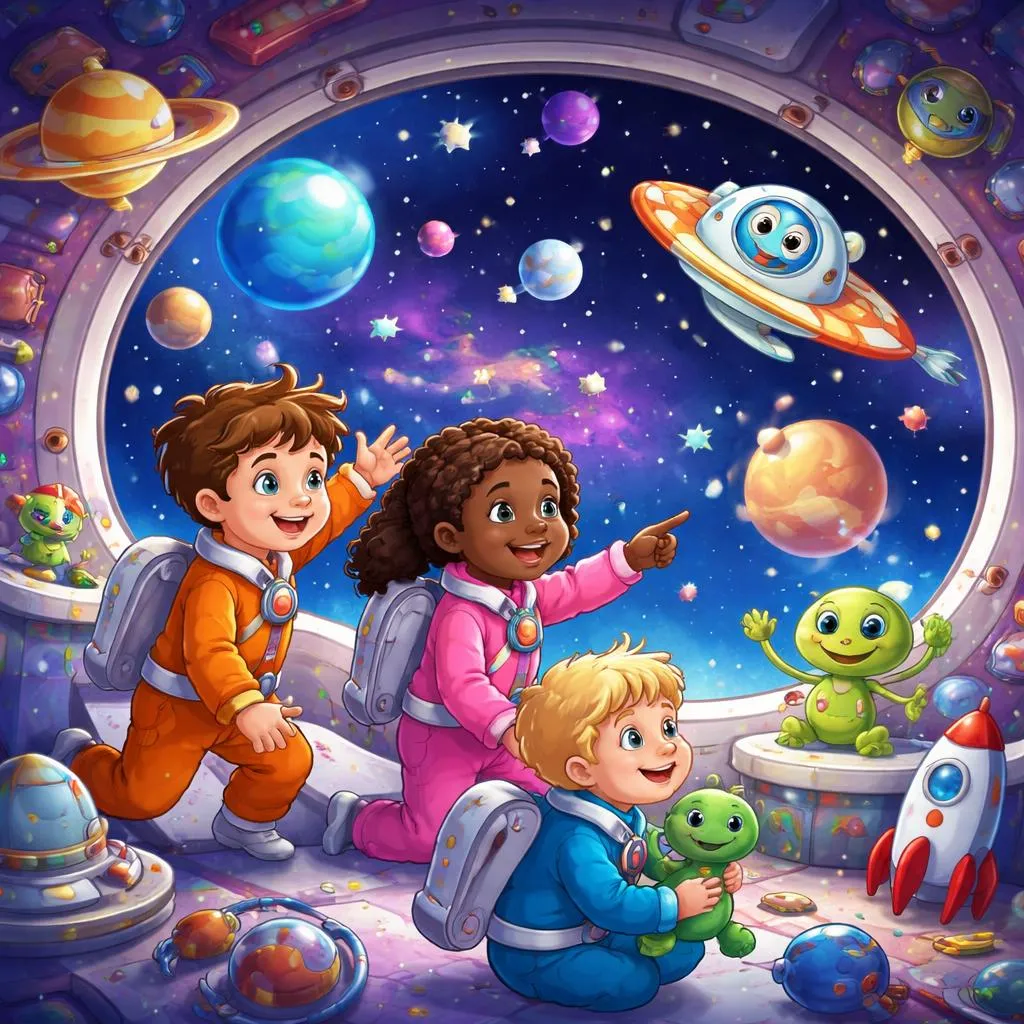

What Is a Children's Space Story? Let us explore this exciting genre together. A children's space story takes readers beyond our planet. It launches young imaginations into the vast cosmos. Characters might travel to the moon or distant planets. They could meet aliens or explore mysterious galaxies. These stories blend facts about space with creative adventures. Some tales feature real astronauts and space missions. Others imagine futures where space travel is common. The setting includes stars, planets, rockets, and space stations. Zero gravity creates fun and strange situations. The vastness of space provides endless adventure possibilities. These stories make the universe feel accessible to children. They turn distant celestial bodies into places to visit and explore.
Meaning and Purpose of Space Stories Space stories serve multiple important purposes for children. They introduce scientific concepts in engaging ways. Children learn about planets without feeling like they are studying. Gravity, orbits, and atmosphere become part of exciting adventures. These stories spark curiosity about the real universe. A child who reads about Mars might want to learn actual facts. Space tales also nurture wonder and imagination. The universe is vast and full of mystery. Stories capture this feeling of awe and possibility. They show children that exploration matters. Characters in space stories are brave and curious. They ask questions and seek answers. This models scientific thinking for young readers. Space stories also teach about teamwork and problem solving. Astronauts must work together to survive and succeed.
Common Elements in Space Stories We can identify several elements common to space tales. A spacecraft transports characters through the cosmos. Rockets, shuttles, or imaginary ships appear regularly. Space suits protect characters from the harsh environment. Helmets, oxygen tanks, and special gear keep them safe. Planets serve as destinations for adventures. Some are real like Mars or Jupiter. Others are invented for the story. Stars provide light and navigation points. Constellations might have special meaning in the tale. Aliens appear as friends or challenges for human characters. They might look strange but think familiar thoughts. Space stations offer places to rest and refuel. They orbit planets or float between destinations. Zero gravity creates fun moments throughout the story. Floating food and sleeping in air delight young readers.
Categories of Space Stories for Children We can organize space stories into helpful categories. Realistic space adventures stick close to actual science. Characters might visit the International Space Station. Imaginary planet stories create new worlds to explore. Authors invent landscapes, creatures, and weather. Alien encounter stories focus on meeting other beings. Some aliens are friendly, others create challenges. Space mission stories follow a specific goal. Characters must fix a satellite or rescue a crew. Time travel space stories combine two exciting genres. Characters visit past or future space events. Animal astronaut stories feature creatures in space. Dogs, mice, or monkeys become unlikely explorers. Friendship stories use space as a backdrop. Characters bond while facing cosmic challenges together.
Daily Life Connections Through Space Stories Space stories connect to children's everyday experiences. Looking at the night sky starts the adventure. Children already wonder about stars and the moon. A space story gives language to this natural curiosity. Playing with rockets and spaceships extends story themes. Many children have toy space vehicles at home. Dreams of flying connect to space travel ideas. Waking from dreams about floating feels like zero gravity. Learning about day and night relates to Earth's rotation. Understanding why the sun appears connects to space concepts. Feeling small in a big world mirrors space's vastness. Both experiences inspire wonder and perspective. We can point out these connections naturally. "Remember how the astronauts floated? That's like dreaming." "The stars we see at night are like in our story." These links make space feel relevant and close.
Vocabulary Learning from Space Stories Space stories introduce rich scientific vocabulary. Planet names provide foundational knowledge. Mercury, Venus, Earth, Mars, Jupiter, Saturn, Uranus, Neptune appear regularly. Spacecraft words build understanding of travel. Rocket, shuttle, capsule, and probe describe different vehicles. Astronaut equipment words teach about space survival. Helmet, glove, tether, and backpack keep characters safe. Space phenomena words describe what characters see. Comet, asteroid, meteor, and eclipse create exciting moments. Position words locate things in space. Orbit, atmosphere, surface, and galaxy set the scene. Action words describe space movement. Launch, dock, float, and land carry the plot forward. We can teach these words with picture cards showing examples. Use them in sentences about the story. Practice using them during space-themed play.
Phonics Points in Space Reading Space stories provide excellent phonics practice. Planet names contain useful sound patterns. Mars has the AR sound. Venus has the long E and short U. Jupiter has the soft G and ER ending. Spacecraft words offer sound practice. Rocket has the short O and CK ending. Shuttle has the SH digraph and short U. Launch has the AU digraph and CH ending. Space phenomena words demonstrate patterns. Comet has the short O and long E. Asteroid has the long A and OY diphthong. Action words provide various patterns. Launch has the AU digraph. Float has the OA digraph. Dock has the short O and CK ending. We can focus on one sound pattern from each story. Find all words with that sound in the space adventure. Write them on rocket shapes for practice.
Grammar Patterns in Space Narratives Space stories model useful grammar for young readers. Past tense carries the main adventure. "The astronauts launched on Tuesday morning." Present tense appears in dialogue and mission updates. "We see Earth from here," the commander reports. Future tense shows mission plans. "We will land on the moon in three hours." Questions drive the exploration forward. "What is that strange light?" "Can we collect a sample?" Commands appear in mission control communications. "Check your oxygen levels." "Prepare for re-entry." Descriptive language paints space pictures. "The enormous, silent planet glowed red against the black sky." Prepositional phrases describe positions. "Above Earth, inside the capsule, beyond the asteroid belt." We can point out these patterns during reading. Notice how questions move the plot. See how prepositions locate everything in space.
Learning Activities for Space Stories Many activities extend the magic of space reading. Create a solar system model using balls or clay. Paint and arrange planets in order from the sun. Design a spacecraft that could travel to another planet. Draw it and label important parts. Make a mission patch for the story's astronauts. Include symbols representing their journey. Build a moon landing scene in a shoebox. Use foil, rocks, and small figures. Create a space journal from an astronaut's perspective. Write about each day of the mission. Cook space-themed snacks for story time. Freeze dried fruit or star-shaped sandwiches work well. These activities make the space world tangible. They invite children to become part of the cosmic adventure.
Printable Materials for Space Learning Printable resources support deep engagement with space stories. Create planet fact cards showing each solar system member. Include size, color, and distance from sun. Design a rocket template for children to cut and assemble. Add windows, flames, and their name on the side. Make astronaut identification cards for mission roles. Commander, pilot, engineer, and scientist each have duties. Create a space vocabulary booklet with words and pictures. Design a moon phase chart showing each stage. Children track the real moon while reading. Make simple comprehension sheets with space questions. "Where did the astronauts go? What problem did they face?" These printables structure space learning activities. They provide tools for organizing space discoveries.
Educational Games Inspired by Space Games make space learning active and playful. Play "Planet Order Race" arranging planet cards correctly. Time how fast children can complete the task. Create "Zero Gravity Tag" where movements are slow and floating. Players move like astronauts in space. Play "Mission Control Says" like Simon Says with space actions. "Mission Control says put on your helmet." Design a "Space Scavenger Hunt" hiding space objects around the room. Give clues using space vocabulary. Play "Alien Drawing Game" where one child describes an alien. Others draw what they hear and compare results. Create "Rocket Launch Countdown" practicing counting backward from ten. Blast off at zero with jumping and cheering. These games build space knowledge through physical activity. Children learn while moving and having fun.
Teaching Scientific Facts Through Stories Space stories naturally introduce scientific information. Children absorb facts while enjoying the adventure. They learn that the moon has less gravity than Earth. They discover that Mars looks red from iron oxide. They understand that astronauts train for years before missions. The story context makes facts memorable. We can pause during reading to highlight real science. "This part is actually true. Real astronauts do train underwater." After reading, we can separate fact from fiction. What parts of the story could really happen? What parts are imagination? This builds critical thinking about science. Children learn to distinguish real from pretend. They become curious about what space is really like. This curiosity leads to nonfiction reading and research. The story becomes a gateway to genuine scientific interest.
Inspiring Future Explorers Space stories plant seeds for future dreams and careers. A child who loves space stories might study astronomy later. They might become engineers who build rockets. They could work at NASA or other space agencies. The stories show that space exploration is possible. They feature characters who make it happen. Children see themselves in these roles. The stories also build appreciation for Earth. Seeing our planet from space in stories creates perspective. Children understand why Earth is special and worth protecting. Space stories connect to humanity's greatest adventures. The moon landing, Mars rovers, and space telescopes become real. Children want to learn more about these achievements. The stories create a foundation for lifelong interest in space. Young readers today might become the explorers of tomorrow.