
What Is This Plant?
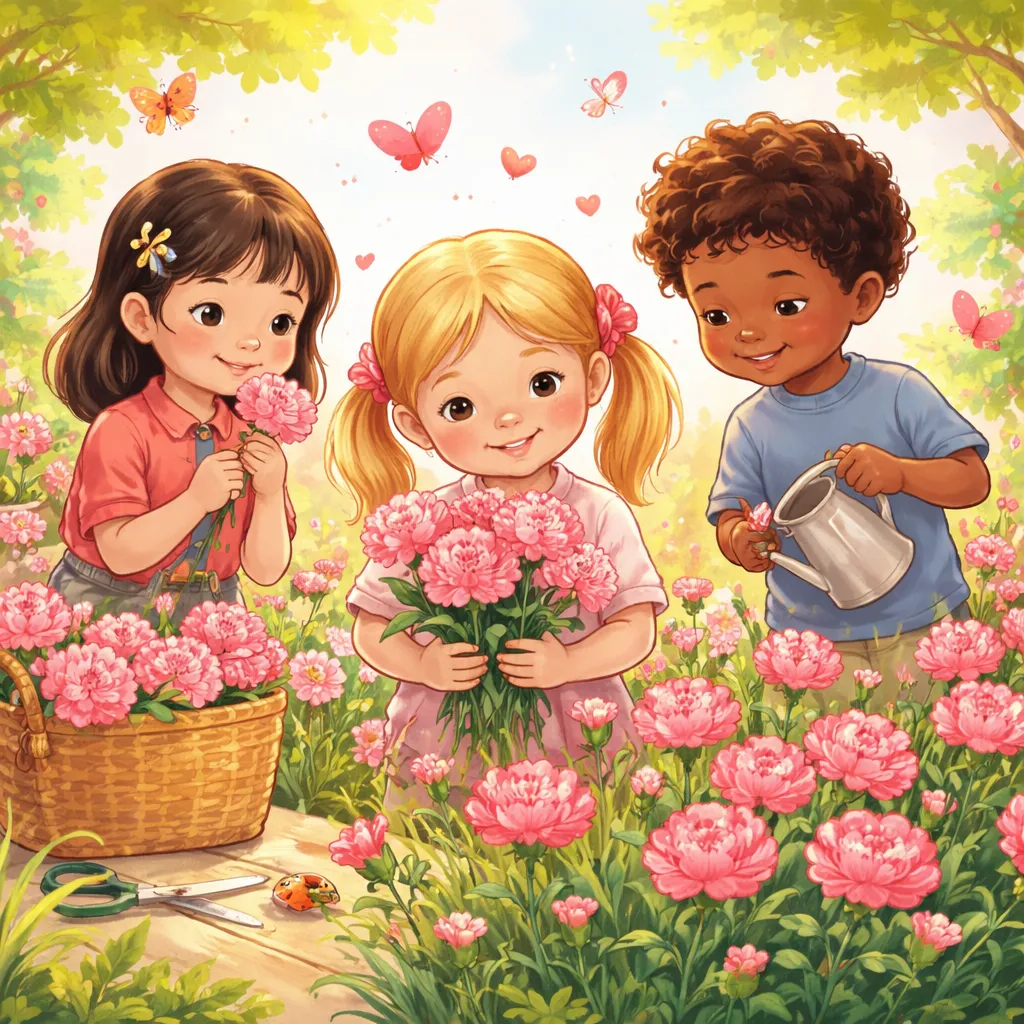
The carnation plant is a beautiful flower with a sweet, spicy scent. It grows on slender stems that stand straight and tall. The flowers have ruffled petals that look like soft fabric. They come in many colors. You can find pink, red, white, yellow, and purple carnations. Some have stripes or edges of a different color. The leaves are narrow and grayish-green. They grow in pairs along the stem. The stems have swollen joints called nodes. Carnations bloom in late spring and summer. They also bloom again in fall if you cut them back. For children, carnations feel like a special flower. They are often given as gifts to show love and appreciation. Parents can point to a carnation in a garden or a bouquet. This flower helps children connect plants to feelings and kindness.
English Learning About This Plant
The English name “carnation” has an interesting history. Some say it comes from the word “coronation.” People used carnations in crowns for ceremonies. Others say it comes from the Latin word for flesh, which refers to the pink color. The pronunciation is “kar-nay-shun.” The International Phonetic Alphabet (IPA) is /kɑːrˈneɪʃən/. The word has three syllables. Children can say it: kar-nay-shun. When we learn about carnation plant, we learn words for its parts. The stem is the long, slender part that holds the flower. The leaf is the narrow, grayish-green part along the stem. The flower is the ruffled, colorful part. The petal is the soft, fringed part that makes the flower look full. The node is the swollen joint on the stem where leaves grow. These words help children describe this elegant plant.
There is a famous saying about carnations. It says, “A carnation speaks the language of love.” This means carnations carry messages of affection. People give them to show they care. Another lovely quote comes from the writer John Keats. He wrote about flowers that “stay sweet and fresh.” Carnations last a long time after cutting. They keep their beauty. Parents can share these ideas with children. They become gentle lessons about how small gifts can carry big feelings.
Plant Facts and Scientific Knowledge
The carnation plant belongs to the species Dianthus caryophyllus. The name Dianthus comes from Greek words. “Dios” means divine, and “anthos” means flower. So carnations are “divine flowers.” They are part of the pink family, Caryophyllaceae. Carnations are native to the Mediterranean region. People have grown them for over 2,000 years.
Carnations have fringed petals. The edges look like they have tiny teeth. This is called serration. The flowers can be single with five petals. They can also be double with many layers of petals. Double carnations look like small, soft balls.
Carnations come in many colors. They do not naturally have blue flowers. Breeders have created many shades. Some carnations change color when the weather changes. The scent is strong and clove-like. It becomes stronger in the evening.
Carnations have strong symbolism. Pink carnations represent a mother’s love. Red carnations represent admiration. White carnations represent pure love and good luck. In many countries, people wear carnations on special days. They are the official flower for Mother’s Day in many places. Carnations also represent strength and resilience.
How to Grow and Care for This Plant
Growing a carnation plant is a rewarding family activity. You can start with seeds or small plants from a garden store. Choose a sunny spot. Carnations need at least six hours of sunlight each day. The soil should be well-drained. Carnations do not like wet feet.
If planting seeds, sow them indoors in early spring. Cover them lightly with soil. Keep the soil moist. In a few weeks, seedlings appear. When the weather warms, transplant them outside. Space them about twelve inches apart.
Water carnations regularly but not too much. Let the soil dry between waterings. Water at the base. Avoid wetting the leaves. This helps prevent disease. Children can help water with a small watering can. They can learn to check the soil with their fingers.
Pinching is important for bushy growth. When the plant is about six inches tall, pinch off the growing tips. This makes the plant branch out. Children can help pinch with their fingers. It is a gentle task that builds connection.
After the first flowers fade, cut the stems back. This encourages a second bloom in fall. In winter, add mulch to protect the roots. In cold areas, carnations may need extra protection. They are perennial in mild climates.
Benefits of Growing This Plant
Growing a carnation plant brings many gifts to a family. First, it adds soft color and sweet scent to the garden. The ruffled flowers look lovely among other plants. Second, carnations are excellent for cutting. They last a long time in a vase. Children can pick flowers to give as gifts. This builds generosity and thoughtfulness.
Carnations attract butterflies. Children love watching butterflies visit the flowers. It shows how plants support other living things. This builds an early understanding of ecosystems.
The plant also offers educational value. Children learn about different flower forms. They see single flowers and double flowers. They learn about scents and how flowers attract pollinators. These are real-life science lessons.
Carnations also teach about giving. People have given carnations for centuries to show love. Children learn that plants can carry meaning. A flower can say “I care about you.” This connects gardening to emotional growth.
What Can We Learn From This Plant
A carnation plant teaches children about lasting beauty. Carnation flowers stay fresh for a long time after cutting. They do not fade quickly. Children learn that some things have lasting value. Kind words and small gifts can stay in people’s hearts.
Carnations also teach about layers. The ruffled petals have many layers. Each layer adds to the beauty. Children learn that life is richer with many layers. A single kindness is nice. Many kind acts create something beautiful.
Another lesson is about resilience. Carnations can bloom in different seasons. They come back after cutting. Children learn that they too can bounce back. When things are hard, they can grow again.
Carnations also teach about giving without expectation. People give carnations simply to make someone smile. Children learn that giving is its own reward. They do not need to receive something back to feel good.
Fun Learning Activities
There are many simple activities to help children learn about carnation plant. One classic activity is the color-changing experiment. Take a white carnation. Put it in a cup of water with food coloring. Watch over the next day. The petals will change color. This shows how plants take up water through the stem. Children love this magic trick.
Another activity is flower pressing. Pick a fresh carnation. Place it between two sheets of paper. Put it inside a heavy book. Wait one week. Take it out carefully. You now have a pressed flower. Use it to make a card or bookmark.
A nature journal works well for carnations. Draw the flower. Count the petals. Notice the fringed edges. Draw the leaves and the nodes on the stem. Label each part. Write the date when the first flower opens.
For art, try making paper carnations. Use tissue paper. Cut circles of different sizes. Stack them. Push a green stem wire through the center. Fluff the layers. This creates a soft, ruffled flower. It teaches about the layered structure of carnations.
Vocabulary games are fun too. Write the words carnation, petal, stem, leaf, node, and scent on cards. Say each word. Ask your child to find the part on the plant. Practice saying carnation together. Clap the syllables: kar-na-tion.
Finally, try a giving activity. Help your child pick a few carnation flowers. Tie them with a ribbon. Give them to someone special. Talk about how the gift makes the person feel. This connects the plant to kindness and emotional awareness.
Through these activities, children build a deep appreciation for beauty and giving. They learn new words, observe carefully, and develop patience. The carnation plant becomes a symbol of lasting love. Each time they see a carnation, they remember that small gifts carry big feelings. They remember that beauty has layers and that giving brings joy. This flower opens a world of connection between nature, language, and the heart.