
What Is This Plant?
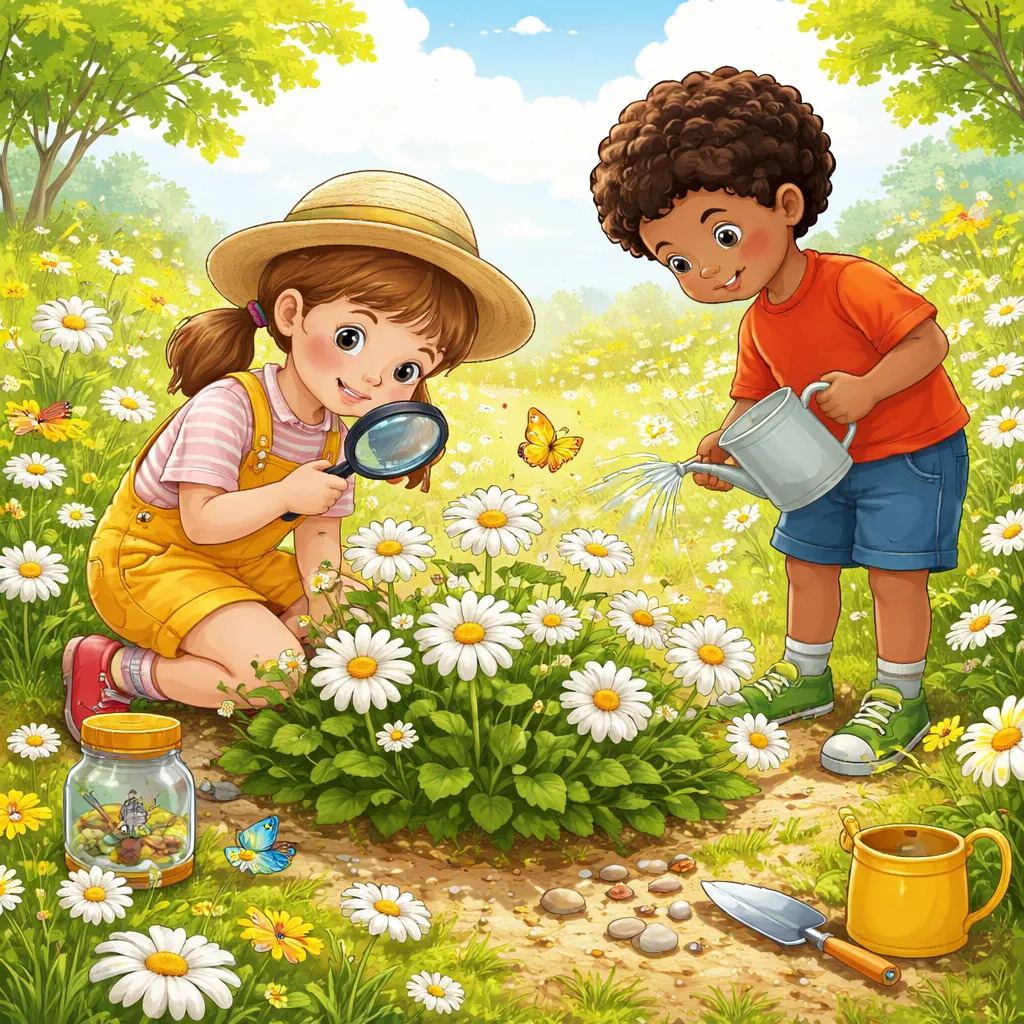
The daisy plant is one of the most familiar flowers in the world. You can find it growing in meadows, parks, and gardens. It has a simple but cheerful look. A bright yellow center sits in the middle. Around it, white petals spread out like a star. The petals are long and thin. They open wide during the day and close at night. The leaves are small and grow close to the ground. They are often oval-shaped with gentle edges. The stem is thin and green. It holds the flower above the grass. Daisies grow in clumps. Where you see one, you often see many. For children, daisies are easy to recognize. They feel friendly and familiar. Parents can point to a daisy in the yard or on a walk. This simple flower becomes the first step in exploring the plant world together.
English Learning About This Plant
The English name “daisy” comes from an old phrase. It meant “day’s eye.” This name describes how the flower opens at dawn and closes at dusk. The pronunciation is “day-zee.” The International Phonetic Alphabet (IPA) is /ˈdeɪ.zi/. The word has two syllables. Children can say it slowly: day-zee. When we learn about daisy plant, we learn words for its parts. The flower head is the round part with the yellow center and white petals. The petal is the white part that surrounds the center. The stem is the thin green part that holds the flower up. The leaf is the small green part that grows at the base. The root is the part underground that takes in water. These words are simple and easy for young children to practice.
There is a famous saying about daisies. It goes, “Daisies are the friendliest flowers.” This means daisies feel welcoming and kind. They do not seem fancy or proud. They simply grow and bring joy. Another lovely line comes from the poet William Wordsworth. He wrote about a field of daisies. He called them “little white flowers.” He said they make the earth look happy. Parents can read this line to their child. Then they can ask what makes them feel happy. This connects the flower to feelings and language.
Plant Facts and Scientific Knowledge
The daisy plant belongs to the family Asteraceae. This is one of the largest plant families in the world. The common daisy is called Bellis perennis. The name means “pretty perennial.” Daisies are native to Europe but now grow in many places. They are perennial plants. This means they come back year after year.
A daisy flower is not one flower. It is a composite flower. The yellow center is made of many tiny flowers called disk flowers. Each disk flower can produce a seed. The white petals are ray flowers. They attract insects. Bees and butterflies love daisies. They visit to collect nectar and pollen.
Daisies bloom from spring through fall. They grow best in sunny places. They can also grow in partial shade. The flowers close at night and open in the morning. They also close before rain. This is a natural weather sign.
Daisies have symbolic meanings. They represent innocence, purity, and new beginnings. Children often make daisy chains. They weave the stems together to make crowns or necklaces. This tradition goes back for centuries. Daisies also appear in many stories. They often stand for simple, honest beauty.
How to Grow and Care for This Plant
Growing a daisy plant is easy for families. You can start with seeds or small plants from a garden store. Choose a sunny spot. Daisies like at least four to six hours of sunlight. The soil should be well-drained. They do not like wet feet.
To plant seeds, scatter them on the soil surface. Press them gently. Do not cover them with too much soil. Daisies need light to germinate. Water lightly. Keep the soil moist until the seeds sprout. In a few weeks, small seedlings appear.
Water daisies regularly but not too much. Let the soil dry between waterings. Overwatering can cause root rot. Daisies are tough plants. They can handle dry spells better than soggy soil.
Deadheading means removing old flowers. This encourages the plant to make more flowers. Show your child how to pinch off the faded flower head. This is a simple task for small hands. It helps children feel involved.
Daisies do not need much fertilizer. A little compost in spring is enough. They spread over time. You can divide the clumps every few years. This gives you more plants to share or move to new spots.
Benefits of Growing This Plant
Growing a daisy plant brings many simple joys. First, it adds charm to any garden or balcony. The white flowers with yellow centers look fresh and clean. Second, daisies attract bees and butterflies. Watching these visitors delights children. It shows how plants support other living things.
Daisies are also good for cutting. You can pick a small bunch and put them in a cup. They last several days in water. Children feel proud when their flowers decorate the kitchen table. This builds a sense of contribution.
Daisies are low-maintenance. They grow well without much fuss. This makes them perfect for busy families or first-time gardeners. Children can take responsibility without feeling overwhelmed. A few minutes of watering and deadheading each week is enough.
The plant also provides comfort. Daisies grow in many places. When children learn to recognize them, they feel connected to nature. A walk in the park becomes a chance to spot familiar friends. This simple connection brings a sense of peace.
What Can We Learn From This Plant
A daisy plant teaches children about simplicity. The daisy does not try to be grand or fancy. It grows quietly and shares its beauty. Children learn that they do not need to be flashy to be wonderful. Being themselves is enough.
Daisies also teach about resilience. They grow in lawns, along roadsides, and between cracks in the pavement. They face mowing, foot traffic, and weather. Yet they keep coming back. Children learn that they too can face difficulties and still grow strong.
Another lesson is about community. A daisy flower is actually many tiny flowers working together. The disk flowers in the center produce seeds. The ray flowers attract pollinators. They each have a job. Children learn that working together helps everyone thrive.
Daisies also show the value of daily rhythms. They open in the morning and close at night. They follow the sun. Children learn that routines are natural. Waking up, resting, and following a rhythm helps living things grow.
Fun Learning Activities
There are many simple activities to help children learn about daisy plant. One classic activity is making a daisy chain. Show your child how to make a small slit in the stem. Thread the next stem through. Continue until you have a circle. Wear it as a crown or necklace. This builds fine motor skills and patience.
Another activity is a daisy count. Go outside and find a patch of daisies. Count how many flowers you see. Count the petals on one flower. Notice that some flowers have more petals than others. This builds observation and counting skills.
A nature journal works well for daisies. Draw the flower. Label the parts: petal, center, stem, leaf. Write the date and where you found the daisy. Return to the same spot each week. Draw how the patch changes over time.
For art, try flower pressing. Pick a fresh daisy. Place it between two sheets of paper. Put it inside a heavy book. Wait one week. Take it out carefully. You now have a pressed flower. Glue it onto a card or use it to decorate a notebook.
Vocabulary games are fun too. Write the words daisy, petal, stem, leaf, root, and flower on paper. Cut them into cards. Ask your child to match each word to the part on a real plant. Say the words aloud together. Clap the syllables for daisy (day-zee) and petal (pet-al).
Finally, try storytelling. Ask your child to imagine what a daisy sees during the day. Does it see birds? Does it see children playing? Let them tell a story from the daisy’s point of view. This builds imagination and language skills.
Through these activities, children build a gentle connection with nature. They learn new words, observe living things, and develop patience. The daisy plant becomes a familiar friend. Each time they see a daisy, they remember their own experiences of discovering, caring, and wondering. This simple flower opens a door to a lifelong love of learning.