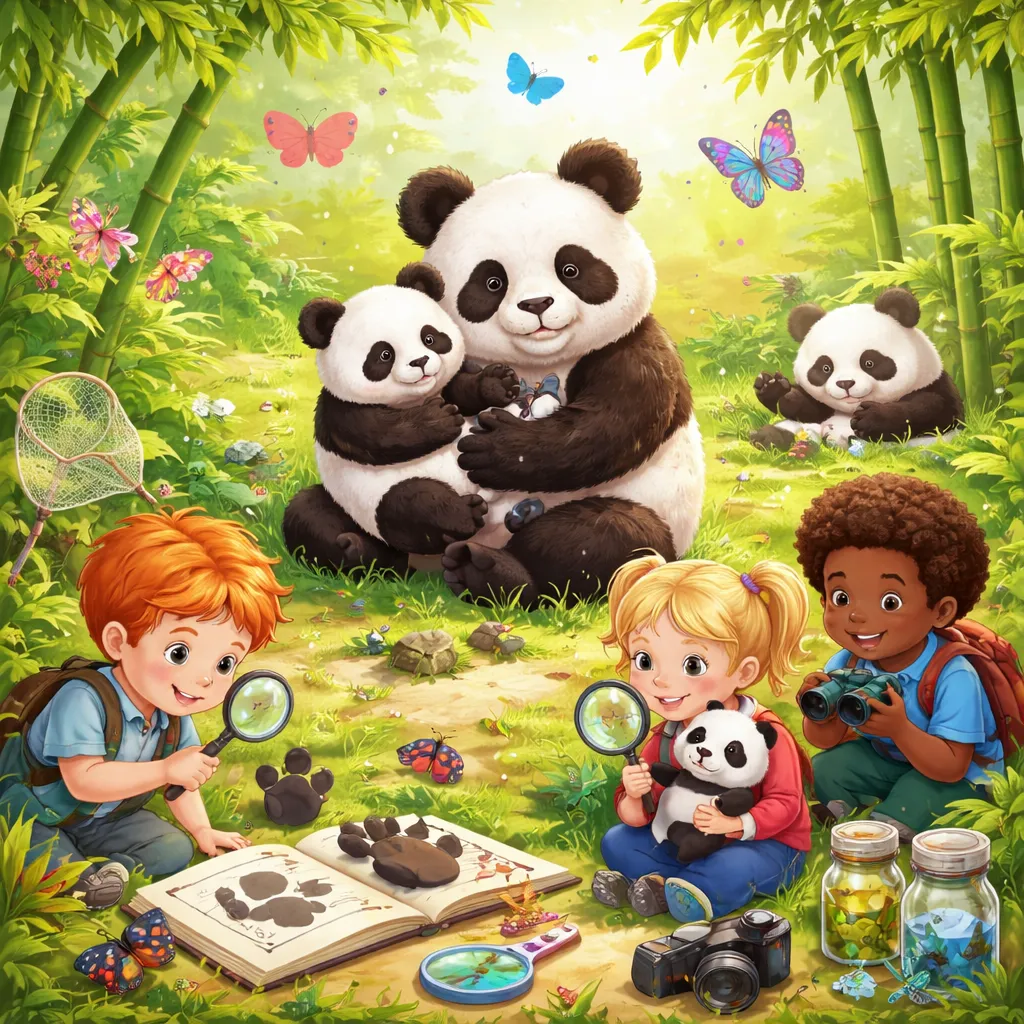

Have you ever seen a panda munching on bamboo? Maybe in a zoo, on a poster, or in a cartoon movie. With their big, black eye patches, round bodies, and gentle moves, pandas look like living, cuddly toys. Learning about pandas is a wonderful adventure that takes us to misty mountains far away. Let’s discover the world of these beloved black and white bears.
English Language Learning
Vocabulary and Spelling The word for this cuddly-looking bear is panda. The word "panda" is a noun. A noun names a person, place, or thing. So, a panda is a thing—a very special and gentle animal. Let’s spell it: P-A-N-D-A. The 'P' stands proud at the start. The 'A' is in the middle like a round belly. The 'N' and 'D' are strong letters, and it ends with another 'A'. P-A-N-D-A spells panda.
Sound and Pronunciation Let’s say the word just right. It sounds like this: /ˈpæn.də/. We can say it in two short parts. First, say "pan". It rhymes with "can" or the kitchen "pan". Next, say "duh". It’s a soft sound, like the start of "the". Now, blend it together! "Pan" "duh". Panda! Well done! The word "panda" has two beats, or two syllables. Clap your hands twice: Pan-da. It’s a soft, friendly-sounding word.
Related Words Learning about pandas is more fun with new words! Here are some important ones. Food: A panda’s favorite food is bamboo. It is a tall, green grass that grows in forests. Baby: A baby panda is called a cub. It is tiny, pink, and blind when it is born! Home: Pandas come from the country of China. They live in its misty, green mountains.
A Famous Saying People love pandas so much they made a fun word: "Panda-monium!" This is a playful mix of "panda" and "pandemonium," which means a lot of noisy excitement. It’s what you might call the happy, excited feeling when you see a cute panda! It reminds us that pandas bring joy and smiles to people all over the world. Say the fun word with me: "Panda-monium!" Can you imagine the happy noise at a zoo when a panda cub is born?
Now you know the word "panda"! Are you ready to learn about their peaceful bamboo forest life? Let’s munch our way from words to wonderful facts!
Animal Knowledge
Who Are They? – Family and Group What kind of animal is a panda? Pandas are mammals. They have fur, are warm-blooded, and mother pandas feed their babies milk. Even though they eat mostly plants, they are actually bears! Their full name is the Giant Panda. They are the most peaceful members of the bear family.
What Do They Look Like? – Amazing Bodies Pandas are big, round, and cuddly-looking! They are about the size of a large couch. Their fur is famous: white with black patches on their ears, eyes, legs, and shoulders. Their most special feature might be their "thumb." It’s not a real thumb, but a special wrist bone that sticks out. It works like a thumb to help them hold bamboo stalks tightly while they eat. Pandas have strong jaws and big, flat teeth for crushing tough bamboo. Their thick, woolly fur keeps them warm in the cool, wet mountains where they live.
Where Do They Live and How? – Home and Habits Pandas live in a few mountain ranges in China. Their home is the temperate forest, filled with tall bamboo plants. The weather is often cool, cloudy, and misty. Pandas are herbivores that eat almost only one thing: bamboo. They are specialists! An adult panda can eat for 12 hours a day, munching on hundreds of pounds of bamboo to get enough energy. Pandas are mostly solitary and quiet. They like to live alone in their own peaceful area. They do not roar like other bears; they are generally silent. They spend most of their day slowly walking, sitting, and eating bamboo.
A Panda’s Life Story – Growing Up A baby panda is called a cub. Pandas are mammals, so cubs are born live from their mother. A newborn cub is incredibly tiny, pink, and blind—about the size of a stick of butter! The mother panda is very caring but also very protective. She holds the tiny cub in her paw or cradles it. The cub drinks her milk and grows slowly. It is completely dependent on its mother for many months. The cub changes a lot! After a few weeks, its soft fur grows in, first with all-white markings, and then the black patches appear. It learns to walk, climb, and of course, eat bamboo by watching its mother. It stays with her for about one and a half to two years.
How Do They "Talk"? – Communication Pandas are quiet animals. They do not make loud roars. They sometimes make softer sounds like bleats, honks, or huffs. They communicate a lot through smell. They have scent glands and will rub against trees to leave a smelly message for other pandas that might walk by later. Their most important sense is smell. Their excellent sense of smell helps them find the best bamboo shoots and understand messages from other pandas in the forest.
Are They Okay? – Taking Care of Them Pandas are doing better but are still vulnerable. Thanks to huge efforts by people in China and around the world, their numbers are slowly growing. This is a great conservation success story! The main threat was the loss of their bamboo forest homes. Now, the big job is to protect and connect these forests so pandas can find food, meet other pandas, and live safely. You can help pandas! You can learn about them and share their story. You can support zoos and groups that work with scientists in China to protect pandas. Choosing to save paper and recycle helps protect forests everywhere, which is good for all animals.
Life Connections and Inspiration
How to Be With Them – Safety and Love Pandas are wild animals and national treasures of China. We must love them from a respectful distance. The rule is: Admire from afar. We see them in zoos that have special partnerships to care for them. We never try to touch or approach a panda. They are gentle but very strong wild bears. We show our love by respecting their space and supporting the work to keep their mountain forests green, healthy, and full of bamboo. That is the best gift we can give them.
Super Qualities We Learn from Them Pandas teach us beautiful lessons. One super quality is peaceful determination. Pandas spend their days calmly and patiently doing one important thing: eating bamboo to survive. They teach us to be peaceful, patient, and dedicated to our tasks, even simple ones. Another quality is the power of being unique. Pandas are one of a kind. Their special look and diet make them stand out in the animal world. They remind us that it is wonderful to be ourselves, to be different, and that our uniqueness is a strength. Think about it: How can you be peacefully determined about something you are learning? What makes you uniquely wonderful, just like a panda’s special black and white fur?
Take Action! – Your "Panda Habitat" Project Let’s do a fun and peaceful activity! Your project is to build a miniature panda habitat in a box. Find a small cardboard box, some green paper or paint, and cotton balls. Turn the box on its side. Paint or glue green paper inside to look like a forest floor. Crumple up more green paper to make bushes. Draw and cut out simple bamboo shapes from green paper and tape them inside. Now, for the panda! You can mold one from clay, draw one on paper and cut it out, or even use a small black and white toy. Place your panda in its bamboo forest. Is it eating? Is it resting? Create a peaceful scene for your gentle giant.
Closing Learning about panda friends is a heartwarming adventure! We learned the word "panda" and how to say its gentle, two-part name. We discovered amazing facts about their bamboo diet, their tiny cubs, and their life in the misty mountains. We know that pandas are peaceful, unique bears who are a wonderful symbol of wildlife protection. You can use your new words to tell others about these special animals. You can use your knowledge to appreciate how caring for our planet helps every creature. The natural world is full of gentle giants that teach us about calm and uniqueness. Always remember to be a kind and respectful friend to all wildlife. Keep exploring with a peaceful heart, be proud of what makes you special, and support those who protect our animal friends. Your interest and care help write a happy future for amazing animals like the panda.