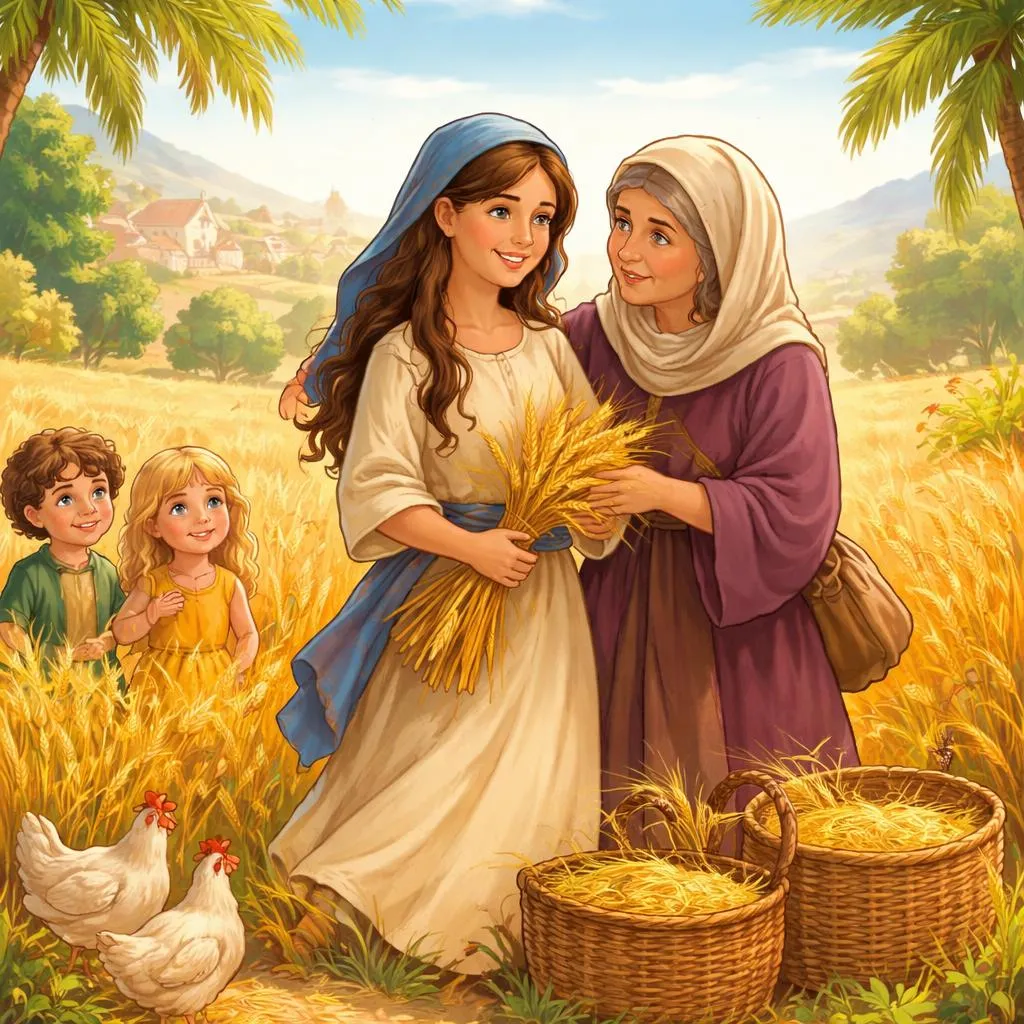

What Is the Children's Bible Story About Ruth? Let us explore this beautiful story together. The children's bible story about Ruth comes from the Old Testament. It tells of a woman named Ruth and her mother-in-law Naomi. The story begins with a family facing difficult times. They lived in a place called Bethlehem long ago. A famine forced them to move to the country of Moab. While there, the father and his two sons died. This left Naomi alone with her two daughters-in-law. One daughter-in-law was named Ruth. The other was named Orpah. Naomi decided to return to Bethlehem alone. She told the young women to stay in their own land. Orpah sadly agreed and stayed behind. But Ruth made a different choice. She promised to stay with Naomi forever. This begins a journey of loyalty, hard work, and unexpected kindness.
Meaning and Explanation of Ruth's Loyalty The heart of this story is Ruth's amazing loyalty. She loved Naomi very deeply. Even when given permission to leave, she refused. Ruth spoke famous words of commitment. She said where Naomi goes, she will go. Where Naomi lives, she will live. Naomi's people will become her people. Naomi's God will become her God. This promise shows us true friendship and devotion. Ruth gave up her home and country for someone she loved. She chose to care for Naomi in her old age. This decision was not easy. It meant starting a new life in a strange place. Ruth did not know what awaited her in Bethlehem. But she trusted and moved forward bravely. Her loyalty becomes an example for all of us. We learn that love means staying with people through hard times.
The Setting and Characters in This Story Understanding the characters helps us appreciate the tale. Naomi was an older woman who had lost everything. She felt sad and empty after losing her family. She even asked people to call her Mara, which means bitter. Ruth was a young Moabite woman with a strong heart. She worked hard and thought of others first. Boaz enters the story later as a kind landowner. He was a relative of Naomi's husband. The fields of Bethlehem provide the main setting. Barley grew there and needed harvesting. The harvest time brought workers to the fields. This is where Ruth goes to find food for them. The city gate appears as another important place. This is where legal matters were settled. Each character plays a vital role in the story's events.
Daily Life Examples from Ruth's Story We can connect this ancient story to modern life. Ruth's loyalty reminds us of family members who care for elders. Many people today move to help aging parents or grandparents. Her willingness to work hard appears in daily life too. We see people taking jobs to support their families. Ruth gleaned in the fields after the harvesters. This meant gathering leftover grain for food. Today, people still find creative ways to provide. The kindness of Boaz appears when people help strangers. He told his workers to leave extra grain for Ruth. We see similar generosity in food banks and community meals. The story also shows how small kindnesses lead to big blessings. Boaz noticed Ruth's character and protected her. This teaches us to pay attention to those around us.
Vocabulary Learning from the Ruth Story This story introduces many meaningful words. Let us look at some important vocabulary. Loyalty means staying faithful to someone. Kindness means doing good things for others. Harvest means gathering crops from the fields. Glean means picking up leftover grain after harvest. Kinsman means a male relative or family connection. Redeem means to buy back or rescue something. Famine means a time with no food. Barley is a type of grain used for food. We can teach these words with simple explanations. Show pictures of harvest time and barley fields. Demonstrate gleaning by dropping small items for children to collect. Use the words in sentences throughout the day. "You showed loyalty by waiting for your friend." "That was kindness to share your snack." This repetition builds understanding naturally.
Phonics Points in Key Story Words We can find excellent phonics practice in this story. The letter L appears in loyalty, love, and leave. Practice the L sound at the beginning of these words. The letter R starts Ruth, redeem, and relative. Work on the R sound with clear pronunciation. Short vowel sounds appear in many words. The short U in Ruth and but. The short I in kin and win. The short E in glean and help. Long vowel sounds show in Naomi, Boaz, and grain. Word families emerge from story vocabulary. The -ind family gives kind and find. The -eed family provides need and indeed. Write words on paper grain shapes. Have children sort them by beginning sounds. Create simple rhyming pairs from the words. This connects phonics practice to the meaningful story.
Grammar Patterns Found in This Bible Tale The story of Ruth gives us many grammar teaching moments. We see past tense verbs throughout the narrative. "Ruth went to the fields." "Naomi returned to Bethlehem." "Boaz noticed Ruth working." Present tense appears when we retell the story. "Ruth loves Naomi." "Boaz shows kindness." "They live happily." Dialogue in the story models question formation. "Whose young woman is that?" "Why have I found such favor?" We find comparative language in descriptions. "Ruth worked harder than anyone." "Boaz was kinder than others." Prepositions describe locations throughout. "Ruth went to the field." "She stayed with Naomi." "He came from Bethlehem." We can point out these patterns during reading. Ask children to find all the past tense words. Have them listen for questions the characters ask.
Learning Activities for the Ruth Story Many activities bring this story to life for children. Start with a storytelling session using simple props. Use a scarf for Naomi and a small basket for Ruth. Create a barley field in the classroom using paper stalks. Hide paper grains for children to find and glean. Act out the meeting between Ruth and Boaz. Practice speaking kindly to workers like Boaz did. Make a timeline of the story events. What happened first, next, and last? Draw pictures of the main characters. Write one word to describe each person. Loyal for Ruth, kind for Boaz, sad then happy for Naomi. Compare Ruth's loyalty to examples in the classroom. When do we stay with friends who need us? These activities make the story memorable and personal.
Printable Materials for Teaching Ruth Printable resources support learning about this story. Create story cards with simple pictures and sentences. Each card shows one part of the narrative. Children arrange them in the correct order. Design character puppets on craft sticks. Children use them to retell the story. Make vocabulary cards with words and simple definitions. Include pictures for non-readers to understand. Create a matching game with characters and their actions. Match Ruth with gleaning, Boaz with kindness, Naomi with sadness. Design simple worksheets with comprehension questions. "Why did Ruth go to the fields?" "How did Boaz help Ruth?" Create coloring pages showing key moments. Ruth and Naomi walking together. Ruth working in the barley field. These printables provide structure for individual or group work.
Educational Games Inspired by Ruth Games make learning about Ruth active and engaging. Play "Gleaning Relay" where children collect paper grain from the floor. Work together like Ruth and the other gleaners. Create "Character Charades" where children act out story people. Others guess who they are and what they did. Play "Kindness Memory" matching pairs of kind actions from the story. Design a "Field Path" game on the floor with numbered spaces. Answer story questions to move forward toward Bethlehem. Play "Who Said It?" by reading quotes from the story. Children guess which character spoke the words. Create "Loyalty Circle" where children say something kind about the person next to them. This connects directly to Ruth's example. These games build community while teaching story content.
The Theme of Kindness Throughout the Story Kindness flows through every part of this story. Ruth showed kindness by staying with Naomi. She gave up her homeland to care for someone else. Naomi showed kindness by thinking of Ruth's future. She helped Ruth find a good husband and home. Boaz showed kindness to Ruth, a stranger in his field. He protected her and made sure she had food. The workers showed kindness by following Boaz's instructions. They left extra grain for Ruth to gather. Even God's kindness appears in the happy ending. Ruth married Boaz and had a family. Naomi gained a new family to love. This baby became the grandfather of King David. Kindness rippled through generations because of one faithful woman. We can encourage children to notice kindness around them. Who shows kindness in our classroom today?
Connecting Ruth to Family and Community This story strengthens understanding of family bonds. Ruth chose to join Naomi's family completely. She did not stay separate but became part of everything. This teaches about adoption and chosen family. Some children live with grandparents or other relatives. Ruth's story validates those family structures. The community in Bethlehem also plays an important role. The harvesters accepted Ruth among them. Boaz used his position to help someone in need. The elders at the city gate approved the marriage. Everyone worked together for good. We can discuss our own communities with children. Who helps families in our neighborhood? How do we welcome new people? The story shows that communities thrive when people care for each other.
Celebrating the Happy Ending The conclusion of Ruth's story brings joy and hope. After hard work and faithfulness, Ruth found happiness. She married Boaz, a good and kind man. They had a son named Obed. Naomi helped care for this baby with great joy. The women of Bethlehem celebrated with Naomi. They said this child would take care of her in old age. This baby grew up to be the grandfather of King David. Many years later, Jesus was born from this same family line. Ruth, a foreign woman from Moab, became part of God's great story. Her loyalty led to blessings she could never imagine. We can remind children that small choices matter. Ruth simply chose to love and stay faithful. That choice changed history. Every act of kindness we make might also grow into something beautiful.