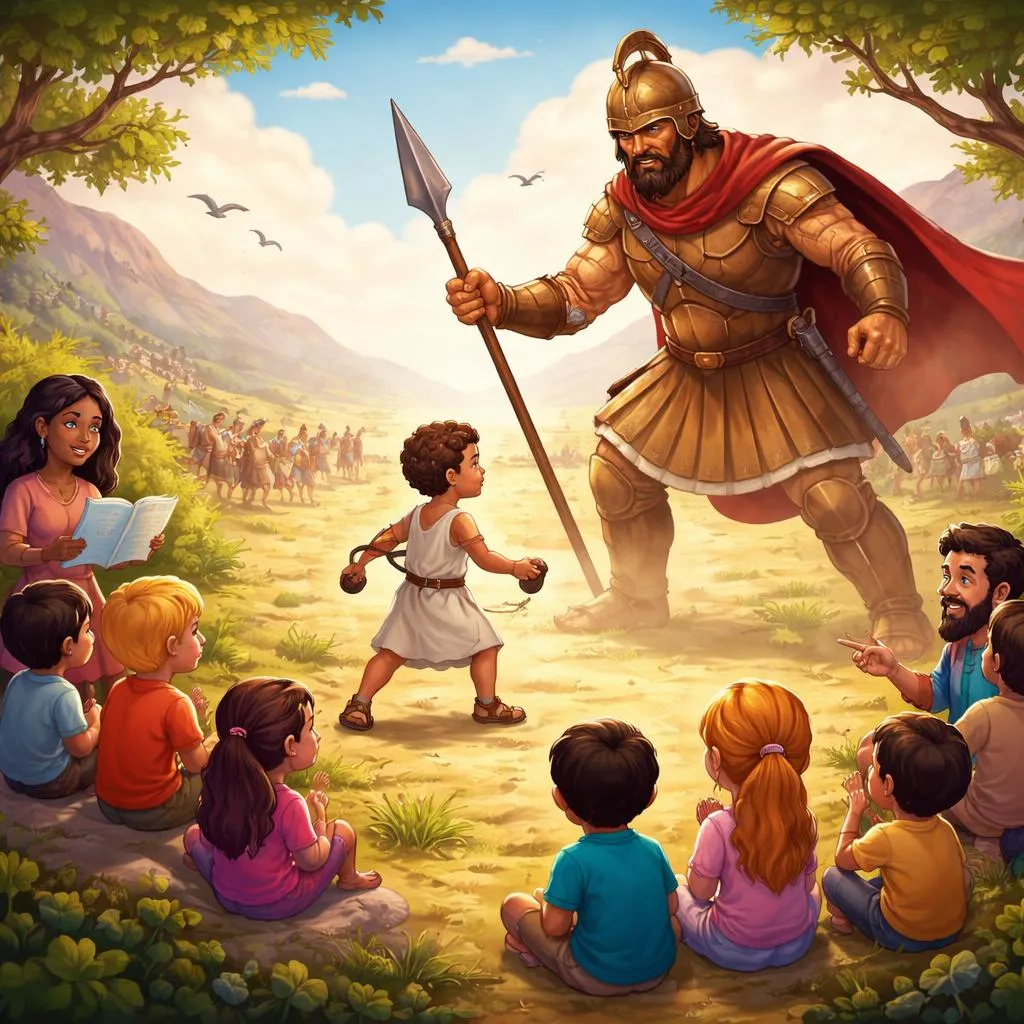

Some stories capture the imagination immediately. A young boy faces a giant. Everyone expects him to lose. He wins through courage and faith. The children's bible story david and goliath offers this dramatic arc. The plot is clear. The characters are sharply drawn. The language is action-filled. Children understand the problem immediately. They root for the underdog. They celebrate the victory. This engagement makes the story perfect for language learning. Vocabulary sticks because it connects to strong emotions. Grammar patterns become memorable through repeated telling. Let us explore how this classic tale supports language development and character education.
What Is the Children's Bible Story David and Goliath?
This is a simplified retelling of the biblical account from 1 Samuel. The story takes place during a war between the Israelites and the Philistines. The Philistine army has a champion named Goliath. He is a giant, over nine feet tall. He wears heavy armor and carries a huge spear. Every day he challenges the Israelites to send someone to fight him. The Israelite soldiers are terrified. No one volunteers. David is a young shepherd boy. He brings food to his older brothers in the army. He hears Goliath's taunts. He volunteers to fight. King Saul tries to give David his armor. It is too heavy. David takes only his shepherd's staff, his sling, and five smooth stones. He faces Goliath. He puts a stone in his sling and swings it. The stone hits Goliath in the forehead. The giant falls. David wins. The Philistine army runs away. The story teaches that courage and faith matter more than size and strength.
Vocabulary Learning from the David and Goliath Story
This narrative introduces vocabulary across multiple domains. Words connect to battle, size, weapons, and emotions.
Battle Words: army, soldier, warrior, champion, battle, fight, enemy, victory, defeat, retreat, camp. Size Words: giant, huge, tall, strong, big, little, small, young, mighty, powerful, weak. Weapon Words: sword, spear, shield, armor, helmet, sling, stone, staff, knife, bow, arrow. Emotion Words: afraid, scared, terrified, brave, courageous, confident, proud, angry, surprised, joyful. People Words: king, shepherd, brother, father, soldier, champion, Israelite, Philistine, boy, man. Action Words: fight, challenge, taunt, volunteer, trust, hit, fall, win, run, celebrate.
Each story element introduces connected vocabulary. The giant introduces size words. The weapons introduce battle vocabulary. David's feelings introduce emotion words.
Phonics Points in the David and Goliath Story
Specific sound patterns emerge through key vocabulary. Identifying these helps build decoding skills.
The /d/ sound: David, giant, God, stone, strong. The hero's name starts with this sound. Practice saying David words together.
The /g/ sound: Goliath, giant, God, good, great. The giant's name starts with this sound. The contrast with David is clear.
The /s/ sound: stone, sling, soldier, strong, spear, sword. Stones and slings are key. Soldiers appear. The sound appears frequently.
The /f/ sound: fight, fall, face, forehead, faith. Fighting is central. Goliath falls. Faith wins. The sound carries meaning.
Rhyming words: stone/alone, fight/might, strong/long, win/begin. Simple rhymes help children remember key elements.
Grammar Patterns in the David and Goliath Story
The children's bible story david and goliath models various grammatical structures within its action-filled narrative.
Past Tense Narrative: The story uses simple past tense throughout. "Goliath shouted at the Israelites." "David volunteered to fight." "The stone hit the giant." This provides extensive past tense modeling.
Dialogue Patterns: Characters speak dramatically. "Come and fight me!" Goliath yelled. "I will fight him," David said. "The battle is the Lord's." Dialogue models strong conversational language.
Comparative Language: The story constantly compares. "Goliath was bigger than David." "David was younger than the soldiers." "The sling was lighter than the sword." Comparatives appear naturally.
Questions and Challenges: Characters ask questions. "Who is this Philistine?" David asked. "Am I a dog?" Goliath challenged. Questions model conversational patterns.
Because Sentences: Causal language explains events. "The soldiers were afraid because Goliath was huge." "David volunteered because he had faith." "Goliath fell because the stone hit him." This builds causal understanding.
Learning Activities for the David and Goliath Story
Active engagement helps children internalize vocabulary and themes through hands-on learning.
Stone Collection: Go outside and collect five smooth stones like David. Count them. Describe them. "This stone is smooth." "This stone is small." "This stone is round." Use descriptive vocabulary. Paint or draw on them later.
Sling Practice: Make simple slings from fabric and string (safe for classroom use). Practice swinging them gently (without stones). Use action vocabulary. Swing, aim, throw, hit. Discuss how David practiced with his sling.
Size Comparison Chart: Create a chart comparing David and Goliath. Draw both. Label measurements. Use comparative language. "Goliath is tall. David is short." "Goliath is big. David is small."
Armor Exploration: Discuss the armor King Saul offered David. Helmet, coat, sword. Why was it too heavy? Try on heavy backpacks or coats to feel weight. Use descriptive language. Heavy, big, uncomfortable.
Crown Craft: David became king later. Create simple paper crowns. Decorate with words describing David. Brave. Faithful. Courageous. Strong. Kind. This builds character trait vocabulary.
Learning Activities for Group Settings
Collaborative learning builds language through interaction and shared experiences.
Story Sequencing with Pictures: Create picture cards showing main events. Goliath challenges. Soldiers are afraid. David volunteers. Saul offers armor. David picks stones. David fights Goliath. Goliath falls. Israelites win. Groups arrange in order and retell the story.
Character Interviews: Students take turns playing David, Goliath, or King Saul. Classmates interview them. "David, weren't you scared?" "Goliath, how did you feel when you saw the boy?" "Saul, why did you let David fight?" This builds question formation and perspective.
Two Lines Battle: Divide class into two lines facing each other. One side chants Goliath's challenge. The other responds with David's answer. This builds dramatic language and confidence.
Courage Discussion: David showed courage. When do students need courage? First day of school. Trying something new. Standing up for someone. Share stories using past tense. "I was brave when..."
Educational Games for the David and Goliath Story
Games make learning playful and memorable.
Stone Toss Game: Create a target representing Goliath. Students stand at a line and toss beanbags (stones). Before each toss, they must say a word from the story. This builds vocabulary recall.
Memory Match with Story Cards: Create pairs of cards with story pictures. David/David. Goliath/Goliath. Stone/stone. Sling/sling. Place face down. Students flip two looking for matches. Name pictures when flipping.
Who Said It? Game: Read quotes from the story. Students guess which character spoke. "Come and fight me!" (Goliath). "The battle is the Lord's!" (David). "You are only a boy!" (Saul). This builds listening and character knowledge.
Giant Steps Game: Play "Giant Steps" where students take huge steps like Goliath, then tiny steps like David. Call out "Goliath steps" or "David steps." This builds kinesthetic learning and size vocabulary.
Printable Materials for the David and Goliath Story
Ready-to-use printables extend learning beyond story time.
Story Vocabulary Flashcards: Create cards with story pictures on one side and words on the other. David, Goliath, giant, soldier, king, stone, sling, spear, shield, armor, shepherd, sheep. Use for matching games or quick review.
Story Sequencing Cards: Create cards showing main events in order. Students arrange and retell using complete sentences. This builds narrative skills.
David and Goliath Coloring Pages: Print outline drawings of story scenes. Goliath towering. David with sling. Stone hitting giant. Goliath falling. Israelites celebrating. Students color while discussing with partners.
Size Comparison Worksheet: Create a simple worksheet comparing David and Goliath. Draw both. Fill in blanks. "Goliath is ___. David is ___." "Goliath has a ___. David has a ___." This builds comparative language.
Five Stones Activity Page: Print a page with five stone outlines. Students write one word about David on each stone. Brave, faithful, young, shepherd, winner. This builds character trait vocabulary.
Daily Life Connections to the David and Goliath Story
Linking story themes to daily experiences makes learning relevant and personal.
Facing Giants: Discuss "giants" in our lives. Things that seem big and scary. A hard test. A new situation. A problem with a friend. How can we be brave like David? Use problem-solving language.
Using What We Have: David used what he knew. His sling. His stones. His faith. What skills do students have? What are they good at? How can those skills help with challenges? This builds self-awareness vocabulary.
Encouraging Others: David encouraged the soldiers. Who encourages students? Who can they encourage? Practice encouragement phrases. "You can do it!" "I believe in you!" "Be brave!" This builds social language.
Celebrating Victory: The Israelites celebrated. How do we celebrate when we overcome something hard? A cheer. A special treat. Telling someone. Use celebration vocabulary.
Printable Flashcards from the David and Goliath Story
Effective flashcards support multiple learning styles.
Picture-Word Cards: Front shows simple story drawing or printed image. Back shows word in English. David, Goliath, giant, soldier, king, stone, sling, spear, shield, armor, shepherd, sheep.
Character Cards: Create cards for each character with simple descriptions. "David: a brave shepherd boy." "Goliath: a giant soldier." "Saul: the king of Israel." "Soldiers: afraid of Goliath." Students match characters to descriptions.
Size Word Cards: Create cards with size words. Giant, huge, tall, big, little, small, young. Students sort words by whether they describe David or Goliath.
Sequence Cards: Create cards showing main events. Students arrange in order and retell using complete sentences. "First, Goliath challenged the Israelites. Then..."
Phonics Practice from Story Words
Use story vocabulary for targeted phonics instruction.
Initial Sound Sort: Provide story picture cards. David, Goliath, soldier, stone, sling, spear, shield, shepherd. Students sort by beginning sound. D words. G words. S words. This builds phonemic awareness.
Syllable Clapping: Clap syllables in story vocabulary. Da-vid (2). Go-li-ath (3). Sol-dier (2). Gi-ant (2). Shep-herd (2). Phil-is-tine (3). Is-ra-el-ite (4). This builds phonological awareness.
Rhyming Word Hunt: Find words that rhyme with story words. Stone/alone/bone/phone. Fight/might/light/right. Tall/small/ball/all. Brave/cave/save/gave. Create rhyming pairs and use in sentences.
Vowel Sound Sort: Sort story words by vowel sounds. David has short /a/ in first syllable, short /i/ in second. Goliath has long /o/ in first, short /i/ in second. Stone has long /o/. This builds vowel discrimination.
Grammar Patterns Practice
Use story sentences to practice specific grammar structures.
Past Tense Practice: Write sentences with missing verbs. "Goliath ___ at the Israelites." Students choose from "shout" or "shouted." "David ___ to fight." Choose from "volunteer" or "volunteered." "The stone ___ Goliath." Choose from "hit" or "hitted" (discuss irregular). Discuss correct choices.
Comparative Practice: Practice comparative language using story characters. "Goliath was taller than David." "David was smaller than the soldiers." "The sling was lighter than the sword." Students create their own comparisons.
Question Formation: Practice asking questions about the story. "Who was the giant?" "What did David use?" "Where did the stone hit?" "Why was Goliath angry?" "How did David win?" Students ask and answer with partners.
Because Sentences: Practice causal sentences using "because." "The soldiers were afraid because Goliath was huge." "David volunteered because he had faith." "Goliath fell because the stone hit him." Students create because sentences about story events and personal experiences.
The Courage to Teach This Story
The children's bible story david and goliath offers unique value in language classrooms. Its dramatic plot engages children immediately. Its clear characters support comprehension. Its action vocabulary builds word power. Its themes of courage and faith inspire discussion. Children learn that size does not determine victory. They learn that skills matter more than weapons. They learn that faith gives courage. For language educators, this story provides rich material across multiple domains. Vocabulary builds through meaningful action. Grammar models appear in dramatic dialogue. Phonics practice emerges from distinctive names. Discussions explore deep themes in age-appropriate ways. The story proves that the smallest person can make the biggest difference. That message resonates with every child who has ever felt small.