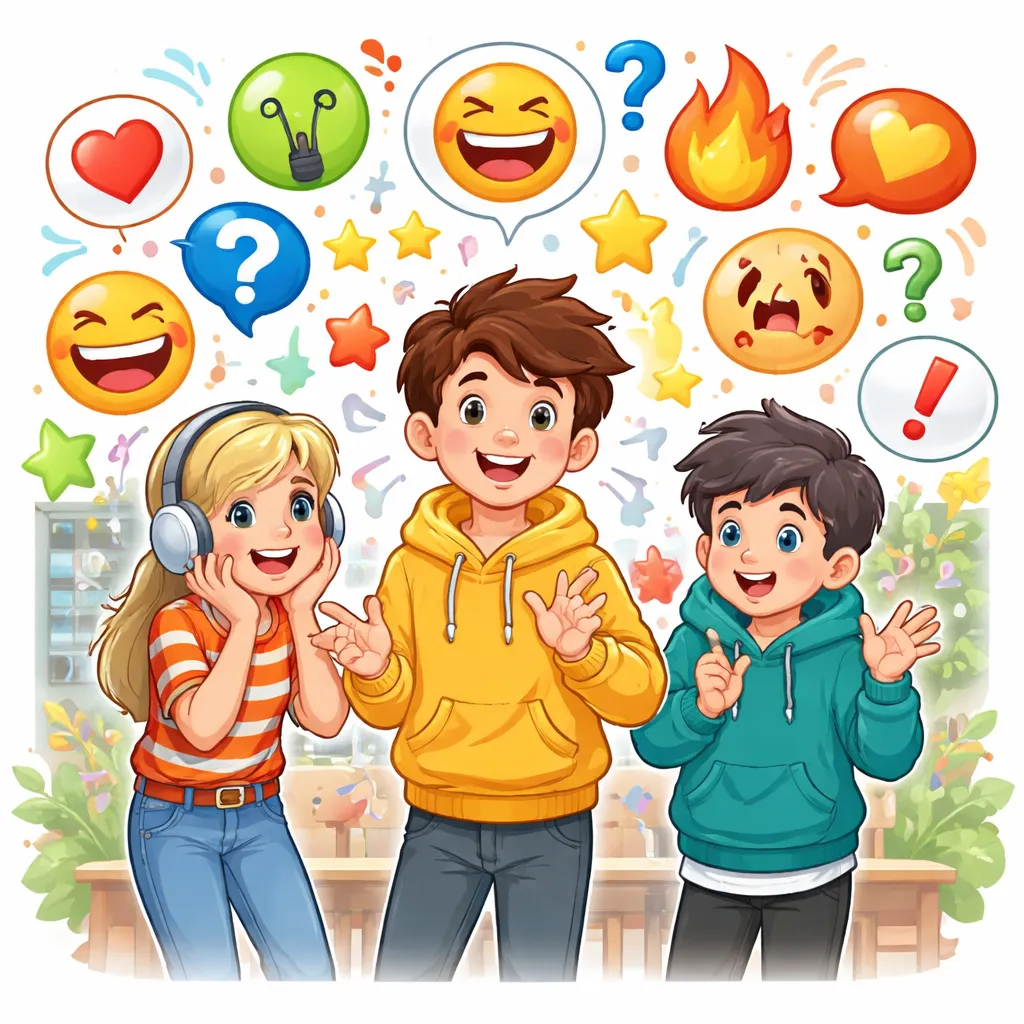

Think of a text message or a group chat. You can write a plain sentence, but it’s the emojis, GIFs, and reaction stickers—that instantly convey your real, unfiltered feelings. In spoken and written English, interjections are exactly that: the verbal emojis. An interjection is a word or short phrase that expresses sudden emotion, reaction, or demand. It’s a spontaneous burst of feeling, not grammatically connected to the rest of the sentence. Reading “I got the last ticket for the concert” is fine. Reading “Woah! I got the last ticket for the concert!” or “Yikes, I got the last ticket for the concert…” tells you exactly how the person feels—thrilled or guilty. Words like “Woah!”, “Yikes,” “Oops,” and “Hey!” are pure emotion in word form. For any student aiming to sound natural and express themselves fully, knowing a key set of the 100 most important interjections for junior high school students is crucial for moving from textbook English to lively, authentic, and emotionally intelligent communication.
Why should you care about these emotional outbursts? Because they are the heartbeat of real conversation. In listening and comprehension, understanding interjections helps you catch the true tone in movies, YouTube videos, and songs—is that “Wow!” genuine amazement or sarcasm? In speaking, they make you sound more fluent and engaged, letting you react naturally (“Really?”, “No way!”, “Seriously?”) instead of staying silent. For social media and informal writing (comments, captions, chats), they add personality and emphasis, just like emojis do. In creative writing or presentations, a well-placed interjection can grab attention or convey a character’s personality instantly. Mastering this toolkit of the 100 most important interjections for junior high school students bridges the gap between knowing the language and feeling the language, allowing you to participate in conversations with genuine reaction, not just delayed translation.
Interjections cover a whole spectrum of human reactions. Let’s categorize them by the emotion or function they serve.
The Reactors (Surprise, Shock, Amazement): These are your instant, unfiltered responses. Wow! Whoa! Oh! Oh my gosh! Oh my God! OMG! Geez! Jeez! Holy cow! No way! What! Really?! Incredible! Unbelievable! Example: “No way! You got tickets to the festival? Oh my gosh!”
The Evaluators (Joy, Approval, Disappointment, Disgust): These judge a situation. Yay! Yes! Awesome! Cool! Nice! Sweet! Excellent! Ooh! Aah! Ugh! Ew! Yuck! Oops! Bummer! Darn! Shoot! Dang! Example: “Sweet! We won! ...Ugh, I’ve got homework though. Bummer.”
The Attention-Grabbers & Greetings: Used to start communication or call someone. Hey! Yo! Hi! Hello! Psst! Look! Listen! See? Example: “Hey! Over here! Look at this video.”
The Verbal Pauses & Hesitators: Fillers that buy you time to think. Well… Um… Uh… Hmm… Like… You know… I mean… Example: “So, what’s the answer? Well… it’s uh… complicated.”
The Imperatives (Commands, Calls for Quiet/Action): Express a strong desire for something to happen or stop. Shh! Hush! Stop! Go! Hurry! Quick! Please! Thanks! Cheers! Congratulations! Example: “Shh! The movie’s starting. Quick, sit down!”
How do you spot an interjection? It’s easier than other parts of speech. Use these two instant checks.
The “Stand-Alone Sentence” Test. Can the word or phrase function as a complete sentence all by itself, often followed by an exclamation point or comma? If yes, it’s likely an interjection. “Oops!” “Hey.” “Wow.” “Thanks.” They stand alone, packed with meaning.
The “Emotion/Reaction Signal” Test. Does the word express a sudden feeling, physical reaction, or demand, and is it grammatically unconnected to the sentences around it? You can usually remove it without breaking the core grammar of the sentence. “(Wow), that’s a high score.” The sentence “That’s a high score” is still complete; “Wow” is just the emotional overlay.
While interjections are free spirits, some simple conventions make their use clearer.
Punctuation is Key. Strong emotion gets an exclamation mark (!). “Yes!” “Stop!” “Awesome!” A milder reaction or a thoughtful pause is often followed by a comma (,). “Well, I’m not sure.” “Oh, I see.” Sometimes a period (.) is used for a flat, subdued effect. “Great. My phone died.”
The Independent Position. Interjections are usually set apart from the main sentence. They can be at the beginning, middle, or end. Beginning: “Oops, I dropped it.” Middle: “I, uh, think I forgot my password.” End: “We won the championship, yay!”
Mild vs. Strong. Know the intensity. “Oh my gosh” is common and fairly mild. “Oh my God” is stronger and some consider it casual; “OMG” is its common text form. “Holy cow/moly” is a mild, old-fashioned exclamation; “Holy crap” is stronger and more casual slang. Choose based on the situation and audience.
The Sound Mimics. Many interjections mimic actual sounds: Phew! (sound of relief), Ow! (pain), Aah! (surprise/fear), Ugh! (disgust/effort), Shh! (sound for quiet). Their spelling tries to capture the sound.
The biggest mistakes with interjections come from overuse or wrong context, not grammar.
Overusing Fillers in Formal Settings. While “um,” “like,” and “you know” are natural in chat, overusing them in a presentation or interview can make you sound unsure. Practice pausing silently instead. Informal/Casual: “The project was, like, really challenging, you know?” Formal/Optimized: “The project was particularly challenging.”
Using Casual/Strong Interjections in Formal Writing. Avoid text-style or strong emotional interjections in essays, reports, or formal emails. Incorrect (in an essay): “OMG! The Treaty of Versailles was so harsh!” Correct: “Notably, the Treaty of Versailles was particularly harsh.”
Misplaced Punctuation. Using a comma for a strong exclamation weakens it. Using an exclamation point for a mild filler looks strange. Incorrect: “Yes, I aced the test.” (If you’re truly excited). Correct: “Yes! I aced the test!” Incorrect: “Well! I’m not sure.” (Sounds oddly aggressive). Correct: “Well, I’m not sure.”
Confusing “Hey!” (interjection) with “Hey” (informal greeting). In writing, “Hey” as a greeting often doesn’t need an exclamation point unless it’s meant to be loud or attention-grabbing. “Hey, can you pass the notes?” is fine. “Hey! Watch out!” needs the exclamation.
Ready to play with these verbal emojis? Here’s a challenge. First, become an Interjection Anthropologist. Watch a 2-minute clip from a sitcom, cartoon, or vlog you like (with English audio). Listen closely and write down every interjection you hear. Categorize them: Was it a Reactor (Whoa!), an Evaluator (Nice!), or a Filler (Um…)? How did the actor’s tone of voice change the meaning? This tunes your ear to the how as much as the what.
Second, launch the “Silent Scene to Script” mission. Imagine a short, silent scene: a character is about to take a bite of food, sees something strange in it, and reacts. Or, a character thinks they’ve lost their phone, frantically searches, and then finds it in their own pocket. Write the script for this 20-second scene, using ONLY interjections, sounds, and maybe one or two full sentences. Examples: “Hmm, this looks good. [Bite.] ...Huh? Ew! Yuck! OMG! Ugh!” This forces you to think of interjections as core tools for storytelling.
Now, let’s expand your emotional vocabulary toolkit. Here is a curated, highly practical list of the 100 most important interjections for junior high school students, ready for authentic use.
High-Energy Reactors: Aha! Ahem! Ah! Ahh! Alas! Awesome! Bah! Boo! Boo-yah! Bravo! Brilliant! Cheers! Congrats! Cool! Dang! Darn! Dear me! Egads! Eek! Eh! Eureka! Fancy that! Fantastic! Fie! Gadzooks! Gee! Gee whiz! Golly! Good grief! Goodness! Good heavens! Gosh! Great! Ha! Ha-ha! Hah! Hallelujah! Heavens! Heck! Hee-hee! Hey! Hi! Hmm! Ho-ho! Hooray! Huh! Humph! Hurray! I say! Indeed! Jeez! Just kidding! Look! Look out! Marvelous! My! Nah! No! No way! Nope! Now! Oh! Oh boy! Oh dear! Oh my! Oh no! Okay! Ooh! Oops! Ouch! Ow! Oy! Please! Pooh! Pshaw! Rah! Really? Right! Right on! See? Shh! Shoo! Shoot! Shucks! Super! Sure! Swell! Thanks! Tsk-tsk! Tut-tut! Uh-huh! Uh-oh! Uh-uh! Well! Whoa! Whoopee! Whoops! Wow! Yay! Yes! Yikes! Yippee! Yo! Yoo-hoo! Yuck! Yummy!
By now, you should see interjections as the essential spice of language, not the main course. They are the instant emojis of speech, the unfiltered reactions that make dialogue real, texts lively, and your spoken English sound connected and authentic. Moving from a flat “I’m surprised” to a genuine “Whoa!” or from a simple “That’s bad” to a visceral “Yikes!” shows you’re not just constructing sentences, you’re participating in the human moment. This playful mastery of the 100 most important interjections for junior high school students equips you to add color, tone, and genuine feeling to every interaction.
Your Core Takeaways You now understand that an interjection is a word or phrase that expresses sudden emotion or reaction, standing apart from the grammatical structure of a sentence. It’s the verbal equivalent of an emoji or a reaction GIF. You know the main types: the Reactors (Wow!, No way!), the Evaluators (Yay!, Ugh!), the Attention-Grabbers (Hey!, Psst!), the Fillers (Um, Like), and the Imperatives (Shh!, Thanks!). You can spot them because they often work as stand-alone sentences and express raw emotion. You’ve learned the key conventions: using exclamation points for strong feeling and commas for mild ones, and understanding that they are set apart from the main sentence. You’re aware of common pitfalls like overusing fillers in formal speech or using overly casual interjections in academic writing. Most importantly, you have a rich, practical list of 100 essential interjections to make your English sound more natural, expressive, and alive.
Your Practice Missions First, execute the “Real-World Interjection Log.” For one day, be hyper-aware of the interjections you hear or read in English—in videos, games, songs, or conversations. Carry a small note or use your phone. Jot down at least five different ones. Next to each, note the context and the speaker’s probable emotion. Was that “Phew!” relief after a close call? Was that “Hmm…” thoughtful or doubtful? This builds your sense of context.
Second, conduct the “Tone Shift Experiment.” Take a simple, neutral sentence like: “She finished the project.” Now, write this sentence three times, each time adding a different interjection at the start to radically change the implied story and tone. For example: 1) “Wow, she finished the project!” (Impressed). 2) “Finally, she finished the project.” (Relieved/Annoyed). 3) “Ugh, she finished the project…” (Jealous/Disappointed). See how one tiny word shifts the entire meaning.