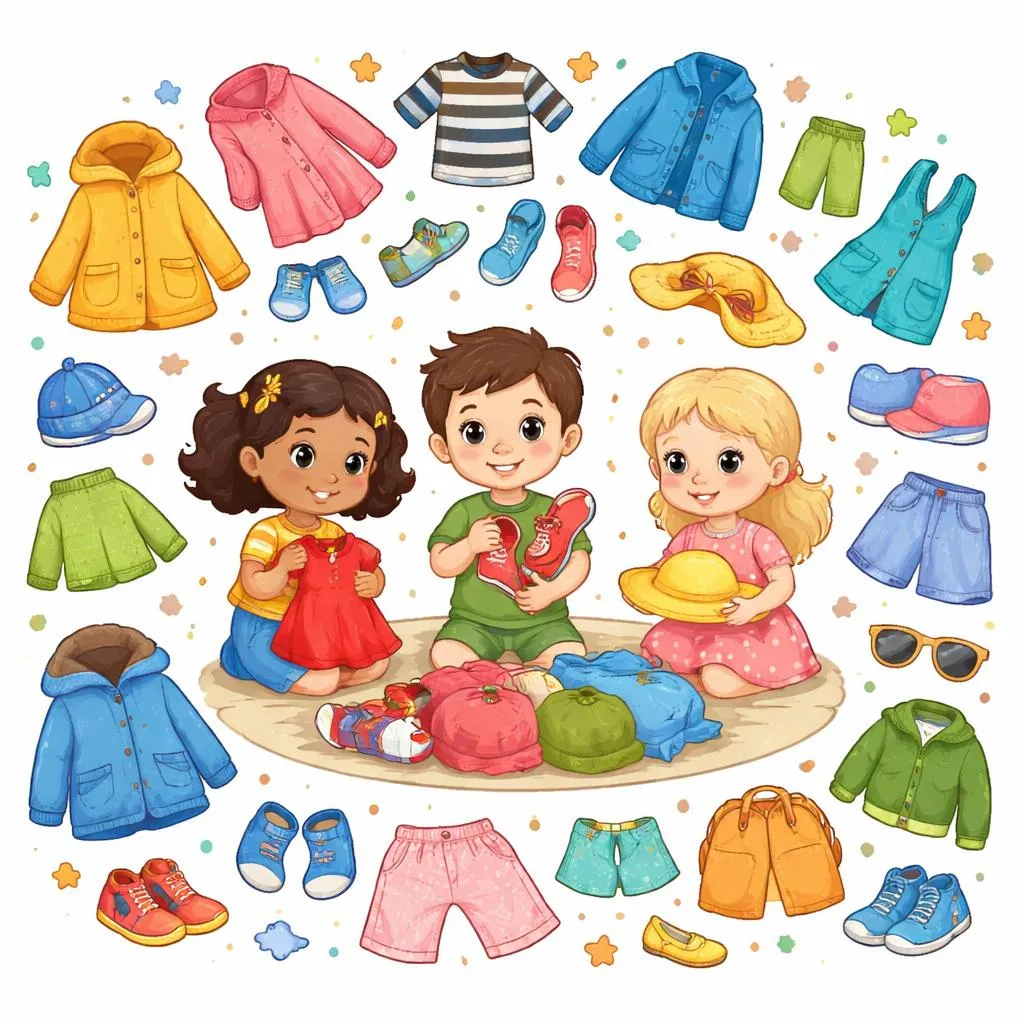

Hello, young learners! Welcome to our special lesson today. We explore the wonderful world of fashion. We learn vocabulary for clothing. This helps us talk about what we wear every day.
Clothes are things we put on our bodies. They keep us warm and comfortable. They help us look nice. They also tell others about who we are.
Let us open our closets. Let us discover the names of everything we wear. By the end of this lesson, describing outfits in English will feel natural and easy.
What is Clothing Vocabulary? Clothing vocabulary means all the words we use for items we wear. These words help us talk about getting dressed, shopping for clothes, and describing what people have on.
Learning vocabulary for clothing helps children in many situations. They can tell a parent what they want to wear. They can describe a lost item. They can talk about their favorite outfit.
Clothing words are used every single day. From the moment we get dressed in the morning until we put on pajamas at night, we use these words. Knowing them well is very important.
Meaning and Explanation When we talk about vocabulary for clothing, we mean the names for everything people wear. Each piece has its own special name. Some names are easy like shirt. Some are harder like cardigan.
Clothes can be grouped by where we wear them. Things for the top half of the body. Things for the bottom half. Things for feet and head. Things for special occasions.
Clothes can also be grouped by when we wear them. Summer clothes are light and cool. Winter clothes are warm and heavy. Sleepwear is soft and comfortable.
Knowing these groups helps children learn related words together. This makes remembering easier and faster.
Categories or Lists Let us look at a complete vocabulary for clothing organized by category. This makes learning systematic.
Clothes for the Top Half These are worn on the upper body. Shirt - a garment with sleeves and a collar T-shirt - a casual shirt with short sleeves Blouse - a woman's dressy shirt Sweater - a knitted, warm top Hoodie - a sweater with a hood Jacket - a short coat for mild weather Coat - a long, warm outer garment Vest - a sleeveless top worn over a shirt Tank top - a sleeveless undershirt Cardigan - a button-up sweater Pullover - a sweater pulled over the head Uniform - special clothes for work or school Turtleneck - a sweater with a high, folded collar
Clothes for the Bottom Half These are worn on the lower body. Pants - a garment covering both legs Jeans - casual pants made of denim Shorts - short pants for warm weather Skirt - a garment hanging from the waist Dress - a one-piece garment for women Leggings - tight, stretchy pants Trousers - another word for pants Sweatpants - soft pants for relaxing Overalls - pants with a bib and straps Cargo pants - pants with many pockets Capris - pants that end below the knee
Footwear These are worn on feet. Shoes - a general term for foot coverings Sneakers - casual shoes for sports and play Boots - high shoes that cover the ankles Sandals - open shoes for warm weather Slippers - soft shoes for indoors Flip-flops - casual sandals with a thong Loafers - comfortable slip-on shoes High heels - shoes with tall heels Rain boots - waterproof boots for rain Snow boots - warm boots for snow Ballet flats - flat, simple shoes for women
Headwear These are worn on the head. Hat - a general term for head coverings Cap - a hat with a visor Baseball cap - a casual cap with a curved brim Winter hat - a warm hat for cold weather Sun hat - a wide hat for sun protection Helmet - protective head gear for sports Beanie - a small, close-fitting hat Beret - a soft, round, flat hat Visor - a hat with only a brim, no top
Accessories These are extra items worn with clothes. Scarf - a long piece of fabric worn around the neck Gloves - hand coverings with separate fingers Mittens - hand coverings without separate fingers Belt - a strap worn around the waist Tie - a long piece of fabric worn under a collar Bow tie - a decorative necktie in a bow shape Socks - foot coverings worn inside shoes Stockings - long socks for women Tights - tight coverings for the legs Watch - a time-telling device worn on the wrist Jewelry - decorative items like rings and necklaces Hat pin - a pin to hold a hat in place Suspenders - straps that hold up pants
Sleepwear These are worn for sleeping. Pajamas - a matching top and bottom set Nightgown - a long dress for sleeping Robe - a loose garment worn after a bath Slippers - soft shoes for indoors Nightshirt - a long shirt for sleeping
Swimwear These are worn for swimming. Swimsuit - clothing for swimming Bathing suit - another word for swimsuit Swim trunks - shorts for men and boys Bikini - a two-piece swimsuit for women One-piece - a single-piece swimsuit Swim cap - a cap worn while swimming Rash guard - a protective shirt for water sports
Underwear These are worn under other clothes. Underwear - a general term Undershirt - a shirt worn under another shirt Briefs - tight, short underwear Boxers - loose, short underwear Boxer briefs - a mix of boxers and briefs Bra - worn by women and girls Panties - women's underwear Long johns - warm underwear for cold weather Thermal underwear - insulating underwear for cold
Traditional and Special Occasion Clothes These are worn for special events or cultural celebrations. Suit - a matching jacket and pants Tuxedo - a formal suit for men Gown - a long, formal dress Uniform - special clothes for work or school Costume - clothes for dressing up or pretending Wedding dress - a special dress for a bride Kimono - a traditional Japanese garment Sari - a traditional Indian garment Dashiki - a colorful West African garment Poncho - a South American cape-like garment
Daily Life Examples Let us see how vocabulary for clothing appears in daily life. These examples show real moments.
In the morning, a child gets dressed for school. They put on underwear first. Then a t-shirt and jeans. Socks go on feet. Sneakers go on last. They grab a jacket if it is cold.
On a winter day, someone wears many layers. A long-sleeve shirt under a sweater. A warm coat over everything. A hat on the head. Gloves on hands. Boots on feet. A scarf around the neck.
For a party, people dress up. A girl might wear a dress and shiny shoes. A boy might wear a shirt with a tie and nice pants. Everyone looks special and fancy.
At the swimming pool, swimwear is needed. A swimsuit or swim trunks. Maybe a swim cap for long hair. Flip-flops for walking to the water. A towel to dry off after.
Before bed, pajamas go on. Soft and comfortable pajamas. Slippers on feet. A robe if it is cold. Time to sleep and rest.
When shopping for clothes, people use many words. "I need a new shirt." "These pants are too big." "Do you have this dress in blue?" "The shoes are on sale."
Printable Flashcards Flashcards are a wonderful way to learn vocabulary for clothing. Here are ideas for making them.
Make a card for each clothing item. On one side, write the name. Shirt, pants, shoes, hat, socks, dress, coat.
On the other side, draw a simple picture or print one. For shirt, draw a simple shirt shape. For pants, draw two legs. For shoes, draw a shoe outline.
Make another set of cards with categories. Tops, Bottoms, Footwear, Headwear, Accessories. Children sort clothing cards into the correct category.
Make cards with weather words. Hot, Cold, Rainy, Snowy. Match clothes to weather. Swimsuit goes with Hot. Coat goes with Cold. Rain boots go with Rainy.
Make cards with colors. Red, Blue, Green, Yellow, Purple. Practice putting color words with clothing words. Red shirt, blue pants, yellow socks.
Use these cards for practice. Look at the picture and say the clothing name. Look at the word and imagine what it looks like. Practice until you know them all.
Learning Activities or Games Let us play some games to learn vocabulary for clothing. These activities make vocabulary stick in memory.
Activity 1: Dress the Doll Provide paper dolls and paper clothes. Children choose clothes for different weather or occasions. They name each piece as they put it on the doll. "She needs a coat. It is cold outside."
Activity 2: Clothing Relay Race Divide into teams. Place a pile of clothes at one end. Call out an item. "Find a hat!" One player runs, finds a hat, puts it on, and runs back. First team to finish wins.
Activity 3: What Am I Wearing? Describe what someone is wearing without naming them. "This person has a red shirt and blue jeans." Children guess who it is. This builds observation and vocabulary.
Activity 4: Clothing Sort Make signs for different categories. Summer, Winter, Party, Sleep. Give children clothing pictures. They sort each item into the correct category. Swimsuit goes with Summer. Coat goes with Winter.
Activity 5: Fashion Show Children choose outfits and walk in a fashion show. As they walk, they describe what they are wearing. "I am wearing a purple dress and white shoes." This builds speaking confidence.
Activity 6: Clothing Bingo Make bingo cards with pictures of clothes. Call out the clothing names. Players cover the matching picture. The first to cover a row shouts "Clothes!" This builds listening and recognition.
Activity 7: Memory Match Make pairs of cards with clothing pictures. Lay them face down. Players take turns flipping two cards. If they match, they keep the pair and say the clothing name. If not, they flip them back.
Activity 8: What's Missing? Place several clothing items on a table. Let children look for one minute. Cover and remove one. Uncover and ask what is missing. This builds memory skills.
Activity 9: Clothing Store Play Set up a pretend clothing store. Have clothes or pictures. Children take turns being shoppers and store clerks. "How much is this shirt?" "I want to buy these shoes." This builds conversation skills.
Activity 10: Color and Clothing Game Call out combinations of color and clothing. "Find something red." Children point to something red. "Find a blue shirt." Children find a blue shirt. This combines colors with clothing vocabulary.
Activity 11: Clothing Charades Act out putting on different clothes without speaking. Pretend to put on a shirt, pants, shoes, hat. Others guess what you are putting on.
Activity 12: Clothing Song Sing a simple song about clothes to a familiar tune. "This is the way we put on our shirt, put on our shirt, put on our shirt. This is the way we put on our shirt, early in the morning." Add verses for each clothing item.
Activity 13: Weather Dressing Game Describe the weather. "It is cold and snowy outside." Children choose appropriate clothes from pictures or real items. "I need a coat, hat, and boots." This builds reasoning skills.
Activity 14: Clothing Pictionary One child draws a clothing item on the board. Others guess what it is. The drawer cannot speak or write words.
Activity 15: Laundry Sorting Set up a laundry sorting activity. Mix up different clothing items. Children sort them into piles. Shirts here, pants there, socks together. Name each item as they sort.
Activity 16: What Doesn't Belong? Show a group of clothing items with one that doesn't belong. Shirt, pants, shoes, hat, and a banana. Children identify the item that is not clothing and explain why.
Activity 17: Clothing Word Search Create a word search with clothing names hidden in a grid. Children find and circle the words. This builds reading and spelling skills.
Activity 18: Describe Your Outfit Each day, have children describe what they are wearing. "Today I have a blue shirt, gray pants, and white sneakers." This builds daily speaking practice.
Activity 19: Clothing Bingo with Descriptions Call out descriptions instead of names. "This keeps your feet warm and goes inside shoes." Children cover socks. "This goes on your head when it is cold." Children cover hat.
Activity 20: Dress for the Season Divide paper into four sections. Label them Spring, Summer, Fall, Winter. Children draw appropriate clothes for each season. This connects clothing to weather and seasons.
Activity 21: Clothing Alphabet Game Go through the alphabet and name a clothing item for each letter. A is for apron. B is for boots. C is for coat. See how many letters the class can complete.
Activity 22: Paper Doll Craft Make paper dolls and paper clothes with tabs. Children cut out clothes and dress the dolls. They name each piece of clothing as they use it.
Activity 23: Clothing Scavenger Hunt Give children a list of clothing items. Find something with buttons. Find something with a zipper. Find something red. Children search and share what they found.
Activity 24: Story Time with Clothes Read a story about getting dressed or buying clothes. Pause to name the clothes in the illustrations. "Look at his red shirt." "She has purple socks."
Activity 25: Clothing Memory Game Lay out several clothing items. Let children look for one minute. Cover them. Children try to remember and name all the items they saw.
Activity 26: Size Comparison Talk about sizes of clothes. Small, medium, large. Compare different items. "My shirt is small. His shirt is large." This builds comparative language.
Activity 27: Pattern Recognition Talk about patterns on clothes. Stripes, dots, checks, flowers. Children find clothes with different patterns and describe them. "I have a striped shirt."
Activity 28: Clothing Categories Game Call out a category like "things you wear on your feet" or "things you wear in winter." Children take turns naming items in that category.
Activity 29: Design an Outfit Give children paper and crayons. They design an outfit for a specific occasion. A party, a rainy day, a trip to the beach. They label each piece of clothing.
Activity 30: Clothing I Spy Play I Spy using clothing vocabulary. "I spy something blue that someone is wearing." Children look around and guess. "Is it Maria's shirt?" This builds observation and vocabulary.
Learning vocabulary for clothing gives children words they use every single day. Getting dressed in the morning, shopping for new clothes, describing what others wear. These words are essential.
Every piece of clothing has a name. From the hat on your head to the shoes on your feet. From the socks hidden inside to the coat worn outside. Knowing these names helps children describe their world accurately.
Keep noticing what people wear. Keep learning new clothing words. The world of fashion and clothing is full of vocabulary to discover.
Happy dressing and learning, everyone