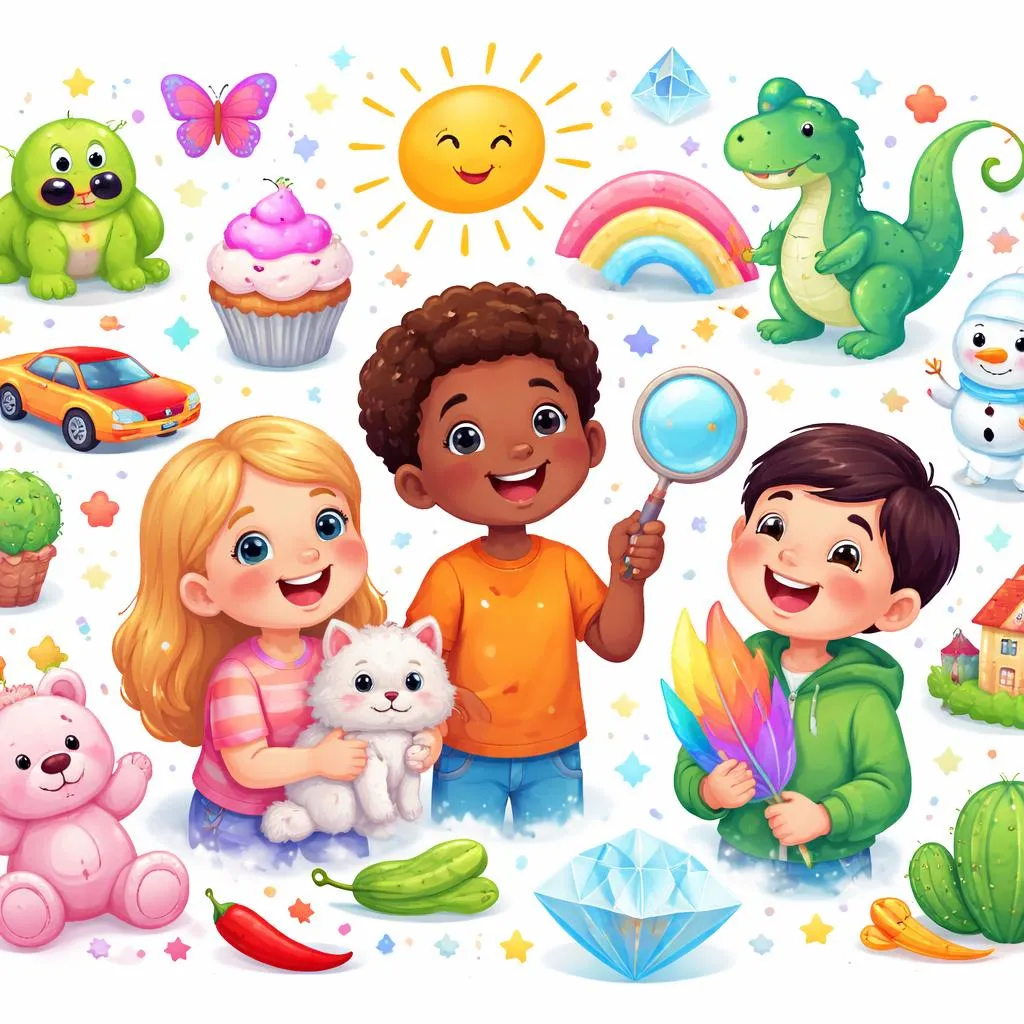

Hello, young language learners! Welcome to our special grammar lesson. Today we explore describing words. We create an adjective list for kids. These words help us describe the world around us.
Adjectives make sentences more interesting. They tell us how things look, feel, sound, taste, and smell. A big dog, a red apple, a happy girl. Without adjectives, language would be very plain.
Let us open our word books. Let us discover words that describe. By the end of this lesson, using adjectives will make stories and conversations more colorful.
What are Adjectives? Adjectives are describing words. They tell us more about nouns. Nouns are people, places, or things. Adjectives answer questions like what kind, which one, or how many.
The blue sky. Blue tells what kind of sky. Three cats. Three tells how many cats. That house. That tells which house.
Adjectives usually come before the noun. A soft pillow. A tall building. A funny clown. Sometimes they come after the verb be. The pillow is soft. The building is tall. The clown is funny.
Learning adjectives helps children express themselves clearly. They can say exactly how they feel or what they see. Their descriptions become rich and detailed.
Meaning and Explanation When we talk about an adjective list for kids, we mean a collection of describing words that children can learn and use. These words are organized by category to make them easier to remember.
Adjectives can describe many different things. They describe how things look. Colors, sizes, shapes. They describe how things feel. Textures, temperatures. They describe how things sound. Noises, volumes. They describe how things taste and smell. Flavors, scents.
Adjectives also describe feelings and personalities. Happy, sad, kind, funny. These words help children talk about emotions and character.
Having a list helps children build vocabulary step by step. They can start with basic words like big and small. Then they add more specific words like enormous and tiny.
Categories or Lists Let us look at an adjective list for kids organized by category. This makes learning easier.
Color Adjectives Red - like an apple Blue - like the sky Yellow - like the sun Green - like grass Orange - like a pumpkin Purple - like grapes Pink - like cotton candy Brown - like chocolate Black - like night White - like snow Gray - like an elephant
Size Adjectives Big - a big house Small - a small mouse Tiny - a tiny ant Huge - a huge whale Giant - a giant dinosaur Little - a little bird Large - a large pizza Long - a long snake Short - a short pencil Tall - a tall building
Shape Adjectives Round - a round ball Square - a square box Triangle - a triangle shape Circle - a circle cookie Oval - an oval egg Flat - a flat pancake Curvy - a curvy road Straight - a straight line
Texture Adjectives Soft - a soft blanket Hard - a hard rock Smooth - a smooth stone Rough - rough sandpaper Fluffy - a fluffy pillow Fuzzy - a fuzzy caterpillar Slick - a slick slide Sticky - sticky honey Wet - wet water Dry - dry sand
Taste Adjectives Sweet - sweet candy Sour - sour lemon Salty - salty pretzel Bitter - bitter chocolate Yummy - yummy pizza Delicious - delicious cake Juicy - juicy orange Creamy - creamy ice cream
Sound Adjectives Loud - loud music Quiet - quiet whisper Noisy - noisy children Soft - soft music High - high sound Low - low sound
Temperature Adjectives Hot - hot soup Cold - cold ice cream Warm - warm milk Cool - cool water Freezing - freezing weather
Feelings and Emotions Happy - a happy girl Sad - a sad boy Angry - an angry dog Scared - a scared mouse Excited - an excited child Tired - a tired baby Silly - a silly clown Funny - a funny joke Kind - a kind friend Brave - a brave firefighter
Quantity Adjectives One - one apple Two - two cats Many - many stars Few - few cookies Some - some milk All - all children No - no noise
Opinion Adjectives Good - a good book Bad - a bad dream Nice - a nice day Pretty - a pretty flower Beautiful - a beautiful sunset Ugly - an ugly monster Wonderful - wonderful news Terrible - terrible weather
Daily Life Examples Let us see how an adjective list for kids appears in daily life. These examples show real moments.
In the morning, a child wakes up. The sun is bright. The pillow is soft. The milk is warm. The cereal is crunchy. Using adjectives makes the description come alive.
At school, children see many things. The classroom is big. The chairs are blue. The teacher is kind. The book is interesting. The test is hard. Adjectives help describe the school day.
At the park, children play. The grass is green. The slide is tall. The swing is fun. The ice cream is cold and sweet. The day is sunny and hot. Adjectives make the park visit more vivid.
At home, children talk about their day. "I saw a big dog." "I ate a yummy snack." "I felt tired." "My friend was happy." Adjectives add detail to conversations.
Printable Flashcards Flashcards are wonderful for learning an adjective list for kids. Here are ideas for making them.
Make a card for each adjective. On one side, write the word. Big, small, red, blue, happy, sad.
On the other side, draw a simple picture or use a magazine cutout. For big, draw a big elephant. For small, draw a small mouse. For happy, draw a smiling face.
Make another set of cards with nouns. Apple, dog, house, flower, child. Practice putting adjectives with nouns. Red apple. Happy dog. Big house.
Use these cards for practice. Look at the picture and say the adjective. Look at the word and imagine what it describes. Practice until you know them all.
Learning Activities or Games Let us play some games to learn an adjective list for kids. These activities make vocabulary stick in memory.
Activity 1: Adjective Charades Act out an adjective without speaking. Be happy by smiling and jumping. Be sad by frowning and drooping shoulders. Be tall by stretching up high. Others guess the adjective.
Activity 2: I Spy with Adjectives Play I Spy using adjectives. "I spy something blue." Children guess objects that are blue. "I spy something soft." Children look for soft things. This builds observation and vocabulary.
Activity 3: Adjective Bingo Make bingo cards with adjectives in the squares. Call out nouns. "Apple." Players cover an adjective that could describe an apple. Red, round, sweet, yummy. Multiple answers possible.
Activity 4: Describe the Object Hold up an object. A toy, a fruit, a book. Children take turns saying adjectives that describe it. For an apple: red, round, smooth, sweet, shiny. See how many they can name.
Activity 5: Adjective Sort Make signs for different categories. Color, Size, Shape, Feeling. Give children adjective cards. They sort each card into the correct category. Red goes with Color. Big goes with Size. Happy goes with Feeling.
Activity 6: Opposite Match Make pairs of opposite adjectives. Big and small. Hot and cold. Happy and sad. Fast and slow. Children match the opposites. This builds understanding of word relationships.
Activity 7: Adjective Scavenger Hunt Give children a list of adjectives. Find something soft. Find something round. Find something blue. Find something shiny. Children search and share what they found.
Activity 8: Sentence Building Give children noun cards and adjective cards. They put them together to make phrases. Big dog. Red apple. Happy girl. Then they can make sentences. "I see a big dog." "She has a red apple."
Activity 9: Adjective Memory Game Make pairs of cards. One card has an adjective. One card has a picture that shows that adjective. Big with a big elephant. Small with a small mouse. Players match adjectives to pictures.
Activity 10: What's Missing? Place several objects on a tray. Describe one using adjectives without naming it. "I see something red, round, and sweet." Children guess apple. Take turns giving clues.
Activity 11: Adjective Art Give children paper and crayons. Call out adjectives. "Draw something big and blue." "Draw something small and red." "Draw something happy and yellow." Compare drawings at the end.
Activity 12: Feelings Check-In Each day, ask children how they feel. Use adjectives. "I am happy." "I am tired." "I am excited." This builds emotional vocabulary and self-expression.
Activity 13: Adjective Song Sing a simple song about adjectives to a familiar tune. "Big, small, red, blue, happy, sad, and new. Adjectives describe the things we see. Adjectives are fun for you and me!"
Activity 14: Adjective Story Read a story and pause to identify adjectives. "The big, brown bear..." What words describe the bear? Big and brown. This builds reading comprehension.
Activity 15: Adjective Collage Give children magazines. They cut out pictures and glue them on paper. Next to each picture, they write adjectives that describe it. This combines art with vocabulary.
Activity 16: Temperature Touch Prepare bowls of water at different temperatures. Warm, cool, cold. Children touch and say how it feels. "The water is warm." This builds sensory vocabulary.
Activity 17: Taste Test Party Provide small samples of different foods. Sweet, sour, salty, bitter. Children taste and describe. "The lemon is sour." "The cookie is sweet." This builds taste vocabulary.
Activity 18: Texture Touch Create a texture board with different materials. Soft fabric, rough sandpaper, smooth foil, fuzzy fur. Children feel and describe. "The fur is fuzzy." "The sandpaper is rough."
Activity 19: Adjective Race Call out a category. "Color words!" Children take turns naming color adjectives. See how many they can name in one minute. Then try size words, feeling words, etc.
Activity 20: Adjective Pictionary One child draws something that shows an adjective. A very big circle for big. A very tiny circle for small. A smiling face for happy. Others guess the adjective.
Activity 21: Describe a Friend Children work in pairs. They take turns describing each other using adjectives. "You have brown eyes. You are kind. You are funny." This builds positive social skills.
Activity 22: Adjective Flower Draw a flower center with a noun. "Dog." On each petal, write an adjective that describes dog. Fuzzy, friendly, furry, fast, brown. This builds word association.
Activity 23: Weather Report Each day, describe the weather using adjectives. "Today is sunny and hot." "Yesterday was cloudy and cool." This connects adjectives to real life.
Activity 24: Adjective Hop Place adjective cards on the floor. Call out a noun. Children hop to an adjective that could describe it. For "apple," they might hop to red, round, or sweet.
Activity 25: Adjective Quiz Create simple questions. "What color is the sky?" "How does ice cream taste?" "How do you feel on your birthday?" Children answer using adjectives.
An adjective list for kids opens up a world of description. Children learn to express exactly what they see, feel, and experience. Their language becomes richer and more precise.
Every day offers chances to use adjectives. At breakfast, food can be hot, cold, sweet, or salty. Outside, weather can be sunny, rainy, windy, or cloudy. With friends, feelings can be happy, excited, or tired.
Keep collecting adjectives like treasures. Use them in conversations. Notice them in books. Soon describing things in English will feel natural and fun.
Happy describing, everyone