
Opening Introduction
Leo is in the garden. He sees a small, green creature. It has many legs. It is crawling on a leaf. "What is that?" Leo asks his dad. Dad looks closely. "That is a caterpillar," he says. "It will turn into a butterfly." Leo is amazed. He wants to know more words. He wants to talk about bugs, plants, and stars.
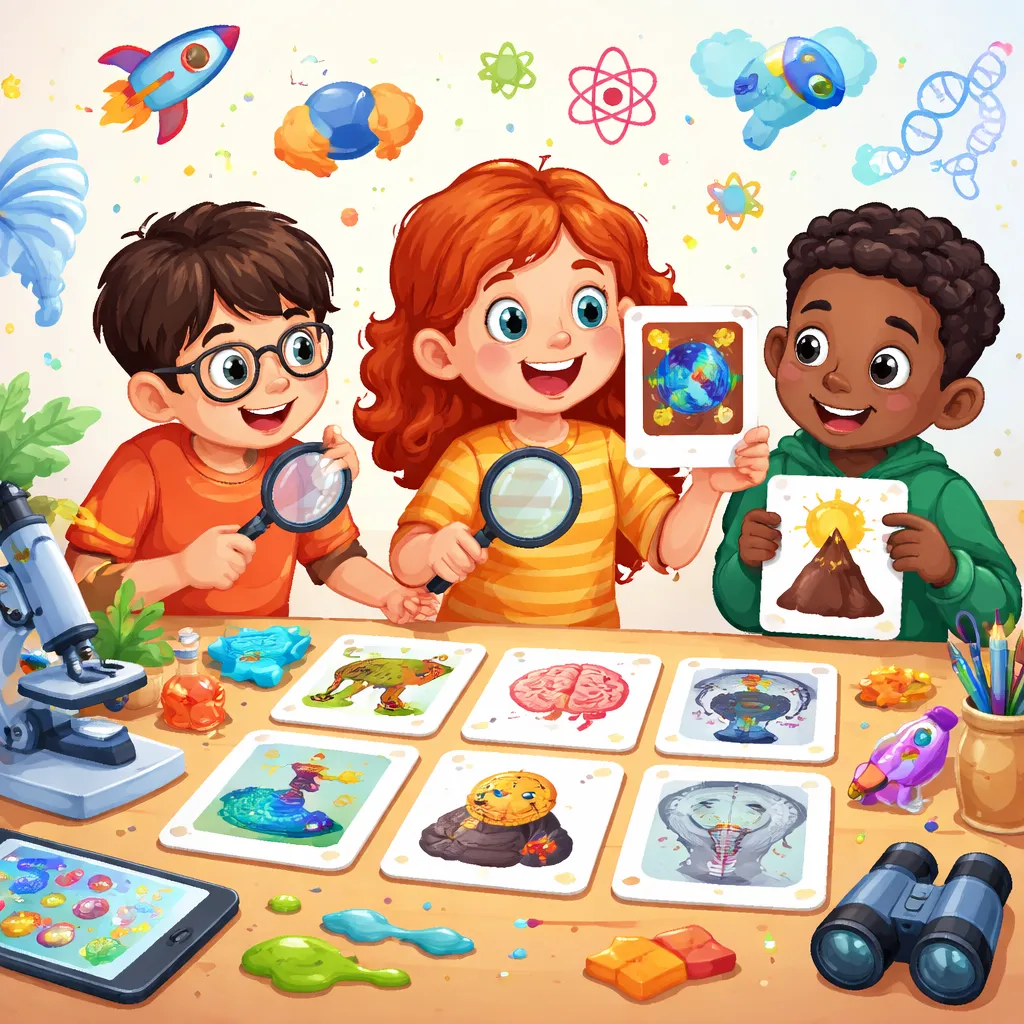
Dad has a great tool. He shows Leo some cards. On one side is a picture of a caterpillar. On the other side is the word: CATERPILLAR. "These are free science vocabulary flashcards," Dad explains. "They are like little teachers. Each card teaches you one science word. We can play games with them. We can learn about the whole world." Leo is excited. A game that makes you smarter. Let's start our discovery.
Core Knowledge Explanation
What is science? Science is the study of our world. It is the study of everything. It is the study of animals. It is the study of plants. It is the study of space, weather, and our own bodies. Science is about asking questions. "Why is the sky blue?" "How do plants grow?" "What are stars made of?" Scientists are people who look for answers. They use special words. These are science words.
Vocabulary means a collection of words. Science vocabulary is the special words scientists use. Words like "habitat", "experiment", "temperature", and "gravity". These words help us describe what we see. They help us share our ideas. Your free science vocabulary flashcards are a set of these special words. Each card holds one piece of the world's puzzle.
What is a flashcard? A flashcard is a small card. It is a learning tool. One side has a clue. The clue is often a picture. The other side has the answer. The answer is the word. You look at the picture. You try to say the word. Then you flip the card. You check if you are right. It is a simple and powerful way to learn.
Your science flashcards are free. You can find them online and print them. You can have a whole set. You can have cards about animals. You can have cards about weather. You can have cards about space. Each set opens a new door. A door to a part of our amazing world.
Let's look at a card. Take a weather card. One side shows a picture of a cloud with a lightning bolt. What is that? It is a storm. The other side of the card says the word: THUNDERSTORM. It might also have a simple meaning. "A storm with thunder and lightning." Now you know a new word. You can use it. "Look, a thunderstorm is coming!"
These cards are for you. They are made for kids. The pictures are clear. The words are big. The meanings are simple. You can hold them in your hand. You can spread them on the floor. You are in control of your learning. You can go as fast or as slow as you want.
Why are these cards so good? They use your eyes and your brain. You see the picture. Your brain connects the picture to the word. This connection becomes strong. Soon, when you see lightning, you will think "thunderstorm". You are building a network of knowledge in your mind. A network is like a spider web of ideas. Every new word is a new connection.
Your free science vocabulary flashcards cover many topics. Let's name some. For plants, you have: seed, root, stem, leaf, flower, fruit. For animals, you have: mammal, bird, fish, insect, reptile, amphibian. For space, you have: sun, moon, star, planet, rocket, astronaut. For the human body, you have: heart, lungs, bones, muscles, brain, stomach. So many words. So many things to learn.
These cards are not just for reading. They are for playing. They are for talking. They make science friendly. Science is not a scary, hard subject. It is the story of everything around you. And you are the main character in the story. You are the explorer. The flashcards are your map.
Fun Interactive Learning
Let's play some games. First, print your free science vocabulary flashcards. Choose a set. Let's choose "Ocean Animals". You will have cards for whale, shark, dolphin, octopus, jellyfish, and sea turtle. Now, cut them out. Ask a grown-up to help.
Game one: Memory Match. Make two copies of each card. Now you have two whale cards, two shark cards, and so on. Mix all the cards. Lay them face down on the table. Take turns flipping two cards. Try to find a match. When you flip a card, say the word. "Dolphin." If you find two dolphins, you keep the pair. The player with the most pairs wins. This game is fun and helps your memory.
Game two: Sorting Game. Take all your animal cards. Sort them into groups. How do you want to sort them? You can sort by color. Put all the blue animals together. You can sort by size. Put the big animals here and the small animals there. You can sort by how they move. Animals that swim, animals that fly. This game teaches you to classify. Classify means to put things into groups. Scientists classify things all the time.
Game three: Act It Out. Put all the cards in a bag. One player picks a card without looking. The player must act out the word. For example, if the card says "volcano", the player can pretend to erupt. They can make a sound: "Boom!" The other players must guess the word. "Volcano!" This game is silly and fun. It makes the words come alive.
You can also play "Flashcard Detective". Lay all the cards face up. One player is the detective. The detective closes their eyes. Another player takes away one card. The detective opens their eyes. Which card is missing? The detective must say the missing word. "The octopus card is gone!" This game makes you look very carefully.
Expanded Learning
Science words are like keys. They unlock understanding. Many science words come from old languages. The word "astronaut" comes from Greek. "Astro" means star. "Naut" means sailor. An astronaut is a star sailor. The word "biology" comes from Greek too. "Bio" means life. "Logy" means study. Biology is the study of life. Isn't that cool?
Scientists all over the world use similar words. This helps them work together. A scientist in Japan and a scientist in Brazil can talk about "gravity". They both know what it means. Your free science vocabulary flashcards are teaching you the language of global friendship and discovery.
Let's make a science word chant. Chants are fun to say. Clap your hands while you say this.
Seed, root, stem, and leaf! Flower, fruit, and chlorophyll! (clap, clap) Sun, moon, star, and planet! Rocket, launch, and astronaut! (clap, clap) Heart, lungs, bones, and brain! These are words I can explain! (clap, clap)
You can make your own chant for any set of cards. It helps the words stick in your head.
What You Will Learn
You are learning the language of discovery. You are learning nature words: habitat, ecosystem, predator, prey, camouflage. You are learning space words: solar system, orbit, galaxy, constellation, telescope. You are learning weather words: atmosphere, precipitation, evaporation, temperature, climate. You are learning body words: skeleton, organ, digest, breathe, pulse.
You are learning useful sentences. You can now say, "A dolphin is a mammal." You can ask, "What is the habitat of a frog?" You can describe, "The sun is a star." You can explain, "Plants need sunlight and water." Your English is becoming precise and powerful.
You are building wonderful skills. You are building observation skills. You look at details. You are building classification skills. You sort and group information. You are building memory skills. You remember new words. You are building communication skills. You can talk about what you see.
You are forming a fantastic habit. The habit of curiosity. You see something new. You want to know its name. You learn the word. You understand the world a little better. This habit makes you a lifelong learner. Your free science vocabulary flashcards are the training wheels for this habit. Soon, you will be exploring on your own.
Using What You Learned in Life
Take your new words outside. In the park, look at a tree. Point to its parts. "This is the trunk. These are the leaves." Look for insects. "I see an ant. An ant is an insect." You are a scientist in the field.
At the grocery store, look in the produce section. "These are fruits. Apples, bananas, and oranges. These are vegetables. Carrots, celery, and broccoli." You are using your plant vocabulary in a real place.
When you watch a nature show on TV, listen for your words. "The documentary is about the ocean habitat." When you hear a word you know, say it out loud. "That's a predator! That's its prey!" You are connecting your learning to the media you watch.
At school, be the science helper. If your class is learning about weather, you can share. "I know what 'precipitation' means. It is rain, snow, or hail." Your teacher will be so impressed. You can even bring your flashcards to share with friends. You are a vocabulary ambassador.
Closing Encouragement
You have done an incredible thing. You are a word collector. You are a science explorer. You are a curious mind. I am so very proud of you. Your flashcards are more than paper. They are tickets to understanding the universe.
Keep your cards. Review them often. Make new cards for new words you love. Your collection will grow. Your knowledge will grow. Your confidence will grow.
Remember, every great scientist started by learning words. Words for the things they saw. Words for the things they wondered about. You are on that same path. Keep asking questions. Keep learning words. Keep discovering. You are brilliant, capable, and full of wonder. Excellent work, my amazing young scientist.