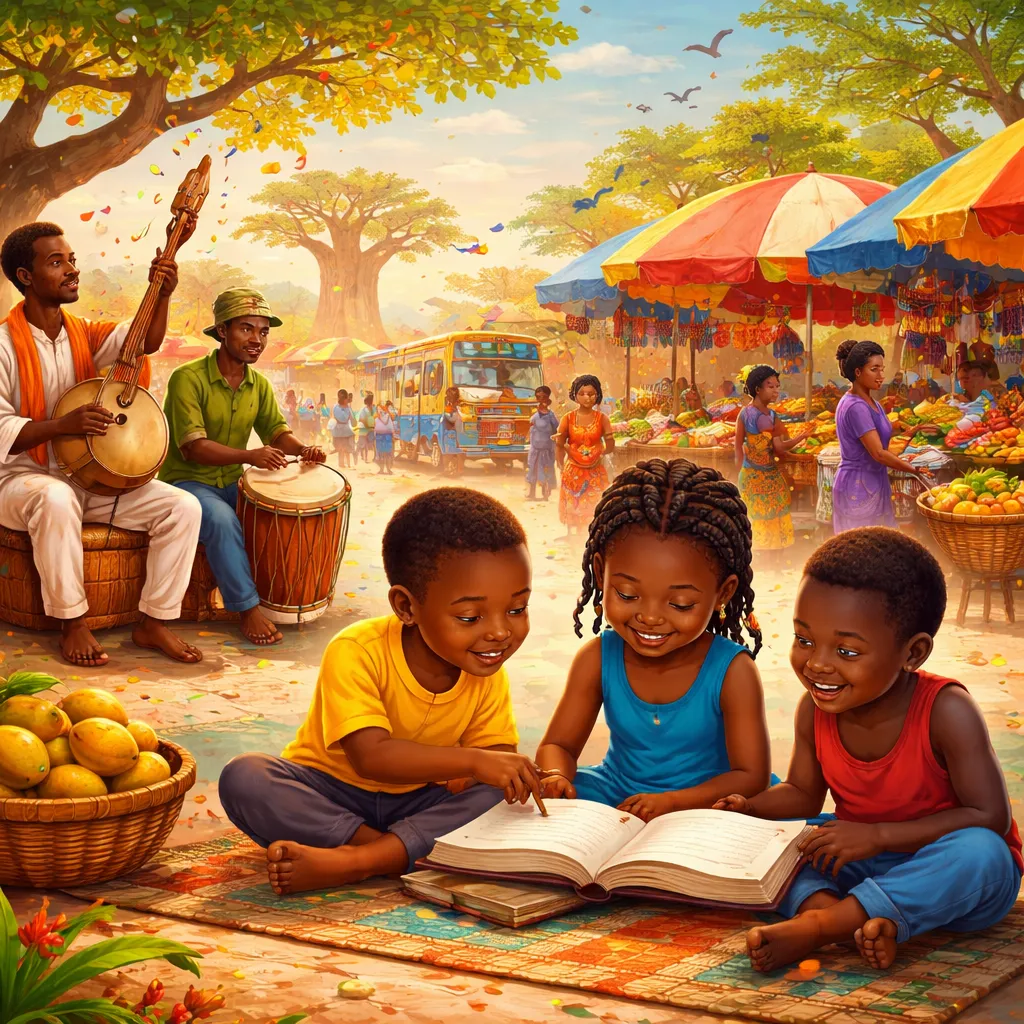

Introduction to Senegal Senegal is a country on the west coast of Africa. It has golden beaches and busy markets. Children there learn French in school. They also speak local languages like Wolof at home. Learning reading: Senegal offers a vibrant mix of sounds, colors, and words. Kids in this country read stories about the ocean and the savanna. They also hear tales of brave lions and clever rabbits. Reading about Senegal feels like dancing to a lively drumbeat. Your child can explore this energetic nation from your reading corner. Each new word becomes a note in a happy song. Let us start the music.
Where Is Senegal? Senegal sits on the far west edge of Africa. It is the westernmost country on the continent. The Atlantic Ocean touches its entire west side. Mauritania lies to the north. Mali lies to the east. Guinea and Guinea-Bissau lie to the south. The Gambia forms a small country inside Senegal. You cannot see The Gambia unless you look closely. The capital city is Dakar. Dakar sits on a peninsula that sticks out into the Atlantic. The whole country covers 196,000 square kilometers. That is about the size of South Dakota. Learning reading: Senegal becomes real when you look at a map of Africa. Find the far left side of the continent. Look for a country that sticks out into the ocean like a pointing finger. That is Senegal. Point to Dakar on the tip of the finger. Say the name. "Se-ne-gal." You just found the gateway to West Africa.
Interesting Facts About Senegal Senegal has many wonderful facts. First, the country has a pink lake. It is called Lake Retba. The water looks like strawberry milkshake. Second, Senegal is famous for wrestling. Wrestling is the national sport. Men train for years to become champions. Third, the country grows huge baobab trees. These trees can live for 1,000 years. Their trunks are wider than a car. Fourth, Senegal has a special island called Goree Island. This island has colorful buildings and no cars. Fifth, the country makes beautiful music. The drum called the djembe comes from this region. Sixth, Senegalese people love to drink tea. They make a special mint tea and pour it from high above the cup. Learning reading: Senegal teaches words like "baobab," "djembe," and "wrestling." Each fact gives your child a new picture. Imagine a pink lake that looks like dessert. Imagine a tree so wide that five children cannot hug it. Imagine a drum that makes your whole body want to dance. These pictures make words stay in your mind. Parents can ask: "Would you swim in a pink lake?" "What sound does a djembe make?" Your child will smile thinking about wrestling champions and tall tea pours.
Key Vocabulary About Senegal Let us learn six important words from Senegal.
First is "baobab." A baobab is a very large tree with a thick trunk. It stores water inside.
Second is "djembe." A djembe is a drum shaped like a goblet. People play it with their hands.
Third is "wrestling." Wrestling is a sport where two people try to throw each other to the ground.
Fourth is "savanna." A savanna is a grassy plain with few trees. Animals like lions live there.
Fifth is "market." A market is a place where people buy and sell food and clothes.
Sixth is "peninsula." A peninsula is land with water on three sides. Dakar sits on a peninsula.
Learning reading: Senegal gives you these six words. Make a sound for each word. For baobab, stretch your arms wide like big branches. For djembe, pat your legs like a drum. For wrestling, pretend to push someone gently. For savanna, make a whooshing wind sound. For market, say "buy, sell, buy, sell" in a fast voice. For peninsula, draw three sides of a square in the air. Say each word while you make the sound or movement. Your child will remember because their whole body joins the lesson. Practice these during breakfast. Practice them in the car. Soon your child will say "baobab" and stretch their arms wide without thinking.
The Famous People About Senegal Senegal has produced many famous people. One is Leopold Sedar Senghor. He became the first president of Senegal. He was also a poet. He wrote beautiful poems about Africa. Another famous person is Youssou N'Dour. He is a singer. People around the world know his music. He won a Grammy award. There is also a famous wrestler named Yekini. He became a champion in Senegalese wrestling. Another important person is Ousmane Sembene. He made movies. Many people call him the father of African film. There is also a scientist named Awa Marie Coll-Seck. She works to make people healthy. These people show that Senegal has poets, singers, wrestlers, filmmakers, and scientists. Learning reading: Senegal becomes inspiring through these names. Say each name. "Le-o-pold Se-dar Sen-ghor." "You-sou N'Dour." "Ye-ki-ni." "Ous-mane Sem-be-ne." "A-wa Ma-rie Coll-Seck." Talk about what each person did. "What did Leopold do?" "He wrote poems and led the country." "What does Youssou do?" "He sings." "What does Ousmane do?" "He makes movies." Your child can imagine writing a poem or singing on a big stage. These famous people prove that Senegal shines brightly.
Simple Sentences for Reading Practice Here are easy sentences about Senegal. Read each one aloud.
Senegal sits on the west coast of Africa with the Atlantic Ocean to its west.
The capital city Dakar lies on a peninsula called the Cap-Vert.
Lake Retba looks pink because of special tiny living things in the water.
A baobab tree can live for one thousand years and store water in its trunk.
People play the djembe drum with their hands at festivals and celebrations.
Wrestling is the national sport of Senegal.
The savanna of eastern Senegal has tall grass and scattered trees.
A busy market sells fish, fruit, cloth, and carved wooden animals.
Youssou N'Dour sings music that people dance to all over the world.
Goree Island has no cars and very colorful old buildings.
Learning reading: Senegal makes these sentences fun to practice. Read a sentence. Then ask your child to draw a quick sketch. For sentence three, draw a pink lake. For sentence four, draw a fat tree. For sentence five, draw a drum. For sentence nine, draw a person singing. After drawing, read the sentence again. The picture helps the words stay. You can also make a clapping game. Clap once for each word in a sentence. Sentence one has fourteen words. Clap fourteen times. Your child will feel the rhythm of the language. Clapping builds a sense of how English sentences flow.
Short Reading Passage About Senegal Read this passage together. It uses all the words we learned.
Senegal greets you with warm sun and lively music. The capital Dakar sits on a peninsula that reaches into the Atlantic Ocean. Fishermen pull colorful boats onto the beach each morning. Not far from Dakar, Lake Retba glows pink. The water looks like a giant smoothie. In the countryside, giant baobab trees rise from the savanna. Their thick trunks store water through the dry season. People gather under the branches to rest and talk. At festivals, drummers play the djembe. The sound travels far across the village. Two wrestlers enter a ring of sand. The crowd cheers as they push and pull. The winner lifts his arms in victory. In the market, women sell fish, mangoes, and cloth. Children run between the stalls. On Goree Island, no cars honk. Visitors walk past old buildings painted yellow and blue. Famous Senegalese include Youssou N'Dour the singer and Leopold Senghor the poet. Their names live on in songs and books. Learning reading: Senegal invites you to a place full of life. Pink water. Fat trees. Drum beats. Wrestling cheers. Now close your eyes. Imagine you stand in a Senegalese market. You hear people calling out prices. You smell fish and ripe mangoes. A drum starts to play in the distance. What do you buy at the market? What does the drum make you want to do?
This passage has 190 words. Read it once for the pictures. Read it again to find your favorite sentence. Ask your child to point to the sentence that makes them happy. Maybe it is the pink lake. Maybe it is the wrestling crowd. Maybe it is the drum. Read that sentence again together. Then ask "Why do you like that part?" Listen to their answer. Their answer tells you what excites them about the world.
Fun Questions About Senegal Use these questions to talk about this lively country.
Would you swim in a pink lake like Lake Retba? Why or why not?
What would you do under a giant baobab tree on a hot day?
Can you make the sound of a djembe drum using your hands on a table?
Would you rather be a wrestler or a drummer in a festival? Why?
What would you buy at a market in Senegal? Fish? Mangoes? Cloth?
Why do you think Goree Island has no cars? Would you like that?
If you met Youssou N'Dour, what song would you ask him to sing?
What would you name a new type of dance from Senegal?
Why do baobab trees need to store water inside their trunks?
Would you like to live on a peninsula with water on three sides? Why?
Learning reading: Senegal turns every question into a celebration. Parents answer first. "I would buy a wooden carved animal at the market because I want to remember my trip." Then your child answers. Let them be silly. If they say "I would buy one hundred mangoes and eat them all," say "That is a lot of mangoes! How would you carry them?" Keep the conversation going. You can also act out the answers. Pretend to play a djembe. Pretend to wrestle gently. Pretend to pour tea from high up. Ask one question during dinner. Ask another question while folding laundry. Senegal will become a joyful topic in your home.
Tips for Learning English with This Topic Now let us bring Senegal into your home. First, make a drum. Use an empty can and a balloon. Stretch the balloon over the top. Tap it with your fingers. Say "djembe" as you play. Second, draw a baobab tree. Make the trunk very wide. Draw small branches at the top. Say "baobab" when you finish. Third, taste a new fruit. Mangoes grow in Senegal. Eat a slice. Say "mango" with each bite. Fourth, watch a video of Senegalese wrestling. See the sand ring. Say "wrestling" when they lock arms. Fifth, make pink playdough. Add red food coloring to white dough. Shape it into a lake. Say "pink lake" as you play. Sixth, listen to Youssou N'Dour's music. Dance together. Say "Senegalese music" while you dance. Learning reading: Senegal gives you these six tips. Do one tip each day. Do not rush. Let the sounds and colors soak in. Learning English is like learning a drumbeat. You start slow. You miss some beats. Then one day, you find the rhythm. So find your rhythm. One tip. One word. One dance at a time.
Your child will remember Senegal. They will remember the pink lake and the baobab trees and the drum beats. But most of all, they will remember reading with you. That quiet time together builds a rhythm of its own. A rhythm of love and learning. So keep this article close. Read one sentence tonight. Ask one question tomorrow. Try one tip this weekend. Senegal is not a faraway land. It is right here every time you learn a new word together. Say one now. "Djembe." Wonderful. Say another. "Baobab." Beautiful. You are already dancing to the rhythm. Keep dancing. The music never stops.