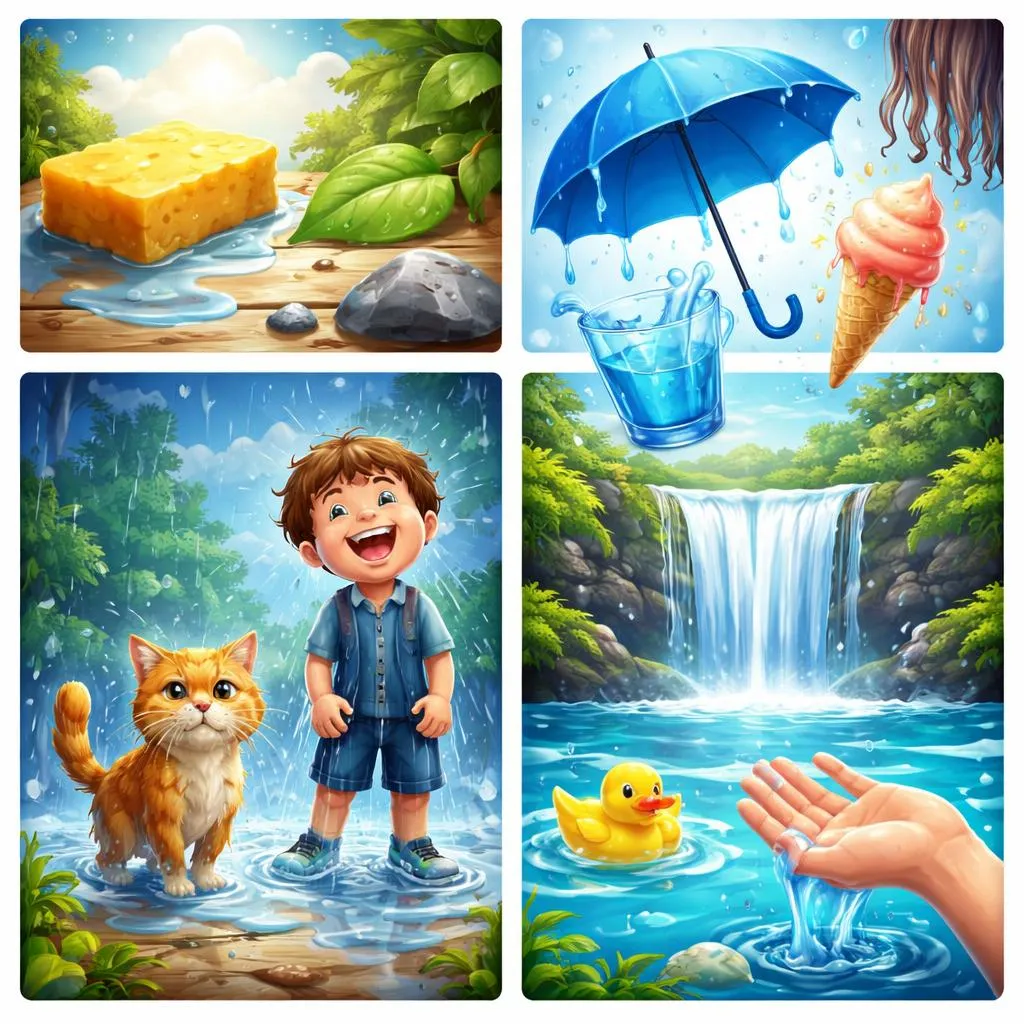

A wet towel needs to be dried. Rain makes the grass wetter than dew does. The words “wet, wetter, wettest, wetness, wetting” all come from one family. Each word talks about water or liquid on a surface. But each one has a different job in a sentence. Learning this family helps children describe moisture and compare things. Let us explore these five words together.
What Does “Same Word, Different Forms” Mean? One core idea can grow into many word shapes. The meaning stays the same at the heart. But the word changes its ending for a new role. For example, “wet” is an adjective or a verb. “Wetter” is a comparative adjective. “Wettest” is a superlative adjective. “Wetness” is a noun. “Wetting” is a noun or a verb form. Knowing these five forms helps a child talk about water and moisture.
Personal Pronouns Change Their Form Pronouns change from “he” to “him” or “his”. Our word family changes by adding suffixes, not by changing person. Think of “wet” as the quality of being covered with liquid. “Wetter” compares two things. “Wettest” compares three or more. “Wetness” names the quality as a thing. “Wetting” turns the quality into an action. Each form answers a simple question. What quality? Wet. What is more wet? Wetter. What is the most wet? Wettest. What is the state of being wet? Wetness. What action causes wetness? Wetting.
From Verb to Noun to Adjective to Adverb – One Family, Many Words This family has an adjective, comparative, superlative, noun, and verb form. Let us start with the adjective “wet”. Adjective: Your hair is still wet from the shower. “Wet” means covered with water or other liquid.
“Wet” can also be a verb. Verb: Please wet the sponge before cleaning.
Next is the comparative adjective “wetter”. Adjective: Today is wetter than yesterday. “Wetter” means more wet.
Then the superlative adjective “wettest”. Adjective: This is the wettest summer on record. “Wettest” means most wet.
Then the noun “wetness”. Noun: The wetness of the ground showed it rained last night. “Wetness” means the state of being wet.
Finally “wetting” as a noun. Noun: Wetting the paintbrush helps the paint spread. “Wetting” can also be a verb form. Verb (ongoing): She is wetting the clay to shape it.
One Root, Many Roles – How Words Grow from Actions to Qualities The Old English word “w?t” meant moist or liquid. From this root, we built a family about moisture. “Wet” kept the main adjective and verb meanings. Adding -er made “wetter” (more wet). Adding -est made “wettest” (most wet). Adding -ness made “wetness” (the state). Adding -ing made “wetting” (the action). Children can see the same pattern in other families. For example, “dry, drier, driest, dryness, drying”. Learning the -ness suffix helps kids talk about conditions.
Same Meaning, Different Jobs – Is It a Verb or a Noun? Look at each word’s job carefully. “Wet” can be an adjective or a verb. Adjective example: The wet paint is still sticky. Verb example: Wet the paper so it folds easily.
“Wetter” is a comparative adjective. Example: The towel is wetter after dunking it in water.
“Wettest” is a superlative adjective. Example: The rainforest is the wettest biome.
“Wetness” is a noun. Example: The wetness of the towel made me shiver.
“Wetting” is a noun or a verb form. Noun example: Wetting the soil helps seeds germinate. Verb example: He is wetting his hair in the sink. Each form has a clear job.
Adjectives and Adverbs – When Do We Add -ly? We can make an adverb from “wet”. Add -ly to get “wetly”. Example: The dog shook itself wetly. But “wetly” is rare. For young learners, focus on the adjectives and the noun “wetness.” A simple reminder: “Wet is the quality. Wetter compares two. Wettest compares many. Wetness is the noun. Wetting is the action.”
Watch Out for Tricky Spelling Changes (Double Letters, y to i, and More) “Wet” has no double letters. Add -er to make “wetter”. Wet + t + er? No, “wet” has one t. But when adding -er, we double the final consonant if the word ends with vowel+consonant and the stress is on the first syllable. “Wet” ends with a short vowel and one consonant, so we double the t: wet → wetter. Add -est to make “wettest”. Wet → wettest (double the t). Add -ness to make “wetness”. Wet + ness = wetness (no double t because -ness starts with a consonant? No double t for -ness. Keep one t.) Add -ing to make “wetting”. Wet → wetting (double the t). A common mistake is writing “wetter” as “weter” (one t). Say “Wetter has double t. Wet + t + er.” Another mistake is “wettest” as “wetest” (one t). Say “Wettest has double t.” Another mistake is “wetness” as “wetness” (correct) but some write “wetness” (same). Good. Another mistake is “wetting” as “weting” (one t). Say “Wetting has double t.”
Let’s Practice – Can You Choose the Right Form? Try these sentences with your child. Read each one aloud. Pick the correct word from the family.
The grass is ______ after the rain. Answer: wet (adjective)
A sponge can get even ______ if you dip it again. Answer: wetter (adjective)
The Amazon rainforest is one of the ______ places on Earth. Answer: wettest (adjective)
The ______ of the towel made it heavy. Answer: wetness (noun)
______ the cloth before wiping the table. Answer: wet (verb)
The cat shook its paw to remove the ______. Answer: wetness (noun)
Of all the days this month, Monday was the ______. Answer: wettest (adjective)
She is ______ her brush before painting. Answer: wetting (verb form)
This paper is ______ than that one because it fell in the puddle. Answer: wetter (adjective)
The ______ of the paintbrush helped the color glide on. Answer: wetting (noun)
After the practice, ask your child one question. Is this word a moist description, a more moist comparison, a most moist comparison, a moisture state, or a moistening action? That simple question teaches grammar through water.
Tips for Parents – Help Your Child Learn Word Families in a Fun Way Use a paper towel to teach “wet”. Say “This paper towel is wet from the spill.”
Use two towels to teach “wetter”. Say “This towel is wetter than that damp one.”
Use a weather report to teach “wettest”. Say “April was the wettest month of the year.”
Use a puddle to teach “wetness”. Say “The wetness of the ground shows it rained.”
Use a paintbrush to teach “wetting”. Say “Wetting the brush helps the paint stick.”
Play “fill in the blank” during car rides. Say “Don’t sit on the ______ bench.” (wet) Say “This sponge is ______ than that one.” (wetter) Say “The ______ day of the week was Thursday.” (wettest) Say “The ______ of the dog’s nose felt cold.” (wetness) Say “______ the soil before planting seeds.” (wet)
Read a story about a rainy day or a water fight. Ask “What is wet in the story?” Ask “Who gets the wettest?”
Turn a drawing activity into a word lesson. Draw a raindrop on a leaf. Label “wet”. Draw two puddles, one bigger. Label “wetter”. Draw a cloud with many raindrops. Label “wettest day”. Draw a wet handprint. Label “wetness”. Draw a hand under a faucet. Label “wetting hands”.
When your child makes a mistake, stay calm. If they say “It is more wetter,” say “Wetter already means more wet. You can say wetter or more wet.” If they say “The wet of the towel,” say “Close. The wetness of the towel. Wetness is the noun.”
Write the five words on sticky notes. Put them on a sink or a bathtub. Each time you wash hands, point to “wet”.
Remember that wet is not bad. Use these words to teach play and cleaning. “It is fun to get wet on a hot day.” “Wetting the sponge helps you clean faster.” Soon your child will describe wet surfaces. They will compare a wetter towel. They will remember the wettest day. They will measure wetness in the garden. And they will be careful when wetting delicate things. That is the moist power of learning one small word family together.