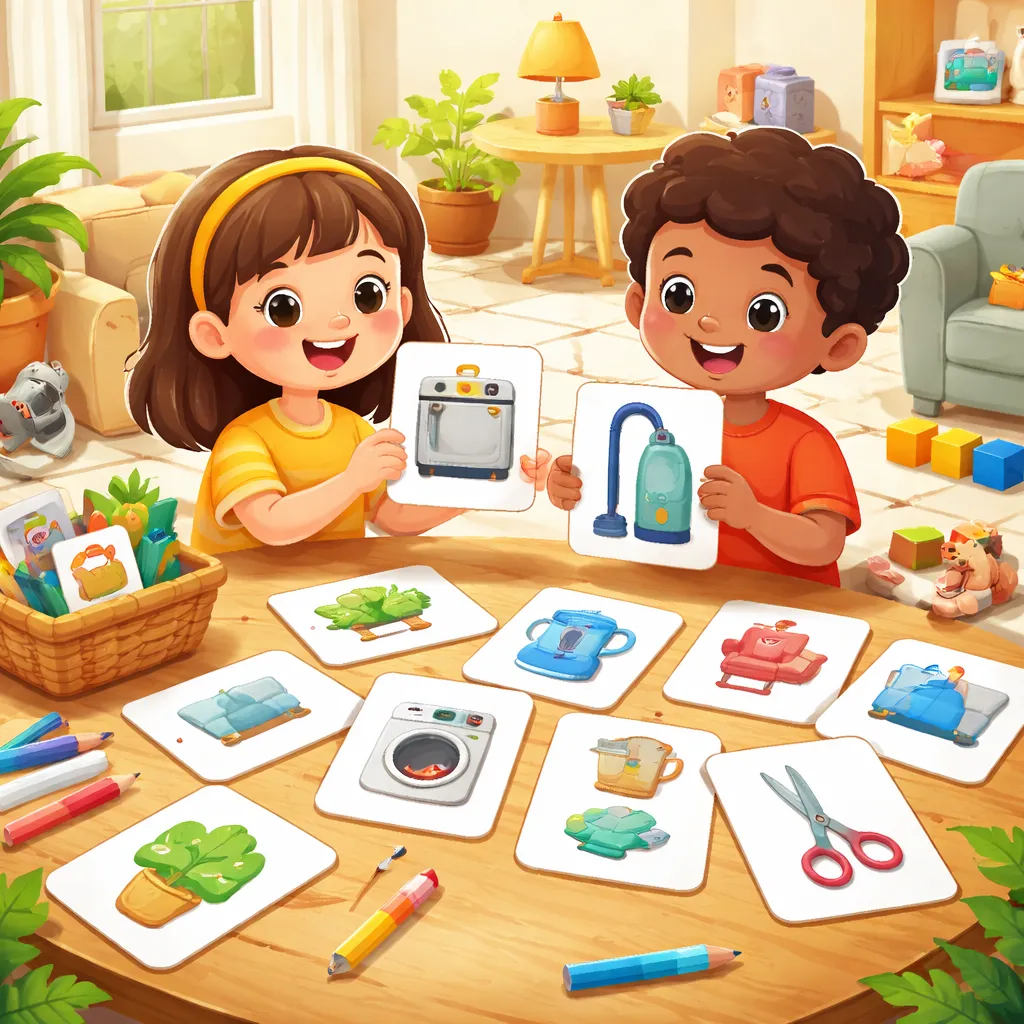

What Is This Situation? Your home is full of objects your child sees every day. There is the chair they sit on, the cup they drink from, and the lamp that lights their room. These items are familiar. They are part of your child's daily world.
Using printable flashcards for household items brings these everyday objects into focused learning moments. A flashcard shows a picture of a spoon. Your child sees the picture, hears the word, and connects it to the spoon in their kitchen drawer.
This learning can happen at the kitchen table, on the living room floor, or during quiet play. The flashcards travel with you. They fit into a bag for visits to a café or a relative's house. They are a simple tool that turns ordinary moments into language opportunities.
The words on these cards are high-frequency words. Your child hears them all day long. The flashcards simply give these words a picture and a moment of attention. This helps your child remember them more easily.
Key English Phrases for This Situation Use phrases that introduce the card. "Look, this is a spoon" names the object. "What is this?" invites your child to answer. "Can you find the spoon in the kitchen?" connects the card to the real world.
Use phrases for matching. "Find the card that shows the cup" builds recognition. "Let us put the spoon card next to the real spoon" makes a physical connection. This helps your child understand that the card represents a real object.
Use phrases for describing. "The cup is blue. What color is your cup?" adds details. "The spoon is for eating. What do you eat with a spoon?" builds understanding of function.
Use phrases for games. "I spy something that is on this card" turns flashcards into a scavenger hunt. "Let us see who can find the lamp first" adds friendly competition.
Use phrases for review. "Do you remember this one?" gently checks memory. "You knew that one. Good job" celebrates success. Simple praise encourages more attempts.
Simple Conversations for Kids Dialogue 1: Introducing a New Card Parent shows a card with a picture of a chair. Parent: "What is this?" Child: "Chair." Parent: "Yes, a chair. Where do we sit on a chair?" Child: "At the table." Parent: "That is right. You sit on a chair at the table."
This conversation names the object. The parent asks a follow-up question. The child connects the word to a real context. The learning goes beyond the card.
Dialogue 2: Matching Game Parent lays out three cards: cup, spoon, bowl. Parent: "Can you give me the cup card?" Child picks up the cup card. Parent: "Good. Now can you find the real cup?" Child goes to the kitchen and points to a cup. Parent: "You found it. The cup card matches the real cup."
This dialogue moves from the card to the real object. The child practices matching. The parent uses clear, short instructions.
Dialogue 3: Playing a Game Parent: "Let us play I Spy. I spy something in this room that is on a card." Child looks at the cards. Child: "Lamp." Parent: "Yes. Where is the lamp?" Child points to the lamp. Parent: "Good job. Now you spy something."
Here, the conversation becomes a game. The child uses the cards as clues. The parent follows the child's lead. The learning feels like play.
Vocabulary You Should Know Spoon is what you use to eat soup or cereal. You can say "We eat yogurt with a spoon." This is a common object your child uses daily.
Cup is what you drink from. You can say "Please put your cup on the table." This word appears many times during meals.
Chair is where you sit. You can say "Sit on your chair for dinner." This is a word for both action and object.
Lamp gives light in a room. You can say "We turn on the lamp when it is dark." This word connects to bedtime routines.
Sink is where you wash hands and dishes. You can say "Wash your hands in the sink." This word is part of daily hygiene.
Refrigerator is where food stays cold. You can say "The milk is in the refrigerator." This is a longer word, but children learn it because they use it daily.
How to Use These Phrases Naturally Use a calm and friendly tone. Flashcards should not feel like a test. They are tools for play. Your voice should invite, not demand. Smile as you show each card.
Say the phrases when your child is relaxed. After a meal or during quiet play works well. Avoid times when your child is tired or hungry. A calm child is a learning child.
Use the cards in short bursts. Five minutes is plenty. You can use them several times a day. Short, frequent sessions build memory better than one long session.
Connect the cards to real life immediately. Do not just look at cards. After showing the spoon card, go to the kitchen. Find the spoon. This connection makes the word stick.
Let your child hold the cards. Children learn through touch and control. When your child holds the card, they feel ownership. They are more likely to remember the word.
Common Mistakes to Avoid One mistake is using the cards too quickly. Show one card at a time. Give your child time to look and think. Rushing through a stack creates confusion, not learning.
Another mistake is asking "What is this?" for every card. This can feel like a drill. Mix it up. Sometimes you name the card. Sometimes you ask a question. Keep the mood playful.
Some parents use only the cards and forget real objects. The cards are a bridge. The real objects are the destination. Always connect the card to the actual item in your home.
Avoid correcting pronunciation harshly. If your child says "frigerator" instead of "refrigerator," do not interrupt. Simply say "Yes, refrigerator" with a gentle emphasis on the full word.
Tips for Parents and Practice Ideas Print your flashcards on sturdy paper or glue them onto cardboard. Thicker cards last longer. Children handle them often. Durable cards survive small hands.
Laminate your cards if you can. Laminated cards wipe clean. They survive spills and sticky fingers. They become a resource you use for years.
Start with five to ten cards. Too many cards overwhelm a young child. Master a small set first. Then add new cards slowly. Building vocabulary is a marathon, not a sprint.
Use the same cards in different rooms. Take the spoon card to the kitchen. Take the towel card to the bathroom. Seeing the card in different places reinforces the word.
Let your child choose which cards to use. Choice builds engagement. If your child picks the cup card five times, that is fine. Repetition is how they learn.
Fun Practice Activities Play a matching game. Place three cards on the floor. Ask your child to find the matching real object in the room. Then bring the object to the card. This connects picture to reality.
Play a hiding game. Hide a few cards around the room. Your child finds them and names them. The surprise of discovery makes the learning exciting.
Create a household items bingo board. Use your flashcards as calling cards. Your child covers the matching picture. Bingo turns vocabulary practice into a family game.
Sort cards by room. Put the kitchen cards together. Put the bathroom cards together. As you sort, name each item. Your child learns categories as well as words.
Make a story with the cards. Lay out several cards. Tell a simple story. "The spoon is eating soup. The cup is drinking milk. The chair is sitting." This adds creativity to vocabulary practice.
Printable flashcards for household items turn your home into a language-rich environment. They take the objects your child already knows and give them names in English. With these cards, learning happens in the spaces where you live. In the kitchen, in the bathroom, in the bedroom—your child builds vocabulary in the place that matters most: home. Every card becomes a small window into the English language, opened together with you.