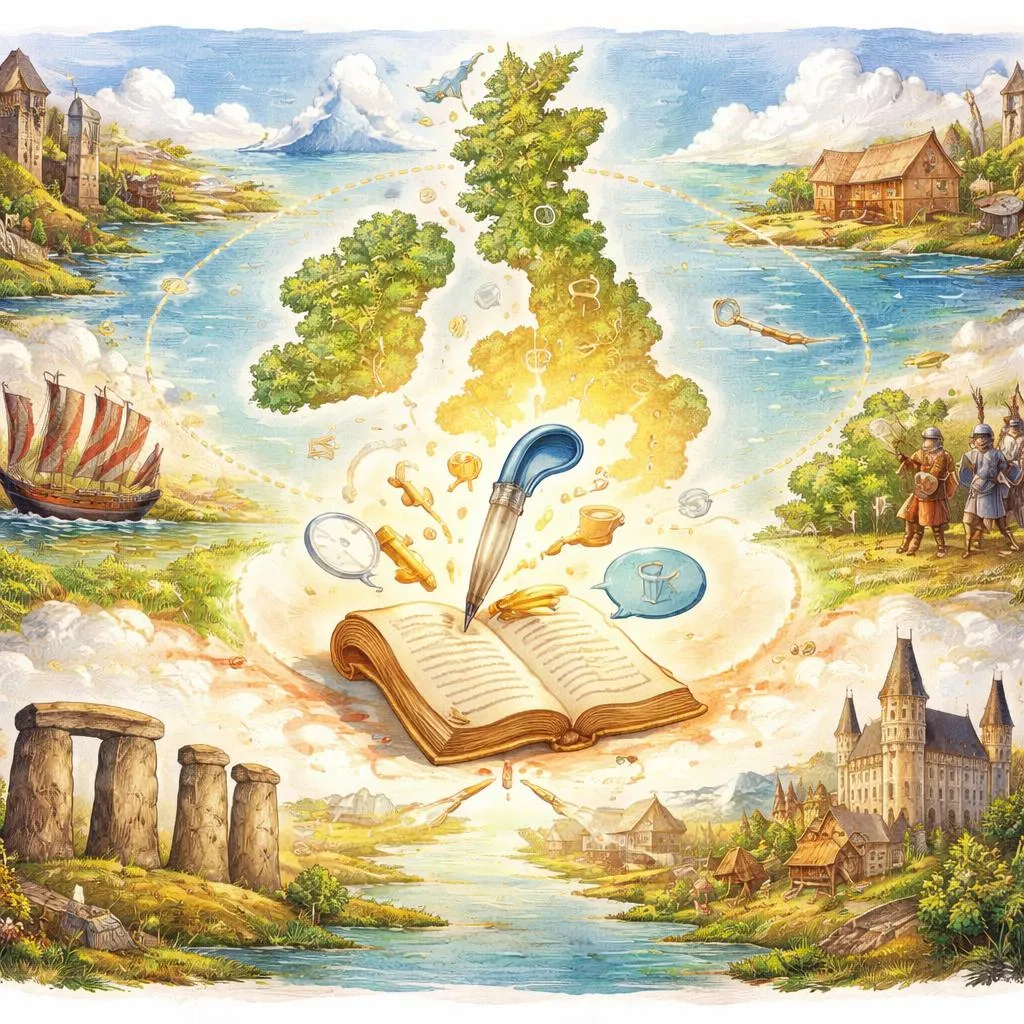

The Early Beginnings of English The English language originated in Britain more than 1,500 years ago. Its story begins in the 5th century. During this time, groups of Germanic tribes moved to Britain. These tribes included the Angles, Saxons, and Jutes. They came from areas that are now part of Germany and Denmark. Their languages formed the foundation of English. English belongs to the Indo-European language family. Within this large family, it is part of the Germanic branch. Because of this origin, English shares similarities with German and Dutch. Basic words such as mother, father, house, and water have Germanic roots. Simple beginnings. Strong foundation.
Old English: The First Stage The earliest form of English is called Old English. It was spoken from around 450 AD to 1150 AD. Old English looked and sounded very different from modern English. Many modern speakers would not understand it. Old English grammar was complex. Nouns changed form depending on their role in the sentence. Verbs also had many endings. Word order was more flexible than it is today. Viking invasions brought new influence. Norse-speaking Vikings settled in parts of Britain during the 8th and 9th centuries. As a result, Old Norse words entered English. Words such as sky, egg, knife, and window come from this period. Language contact changes vocabulary. Contact shapes grammar.
Middle English and the Norman Conquest In 1066, a major event changed English history. The Norman Conquest brought French-speaking rulers to England. For several centuries, French was used in government and law. Latin was used in religion and education. English continued as the language of ordinary people. During this time, thousands of French words entered English. Words such as government, court, judge, army, and beauty come from French. English vocabulary expanded rapidly. Grammar also became simpler. Many Old English endings disappeared. Word order became more fixed. Subject, verb, object became the normal pattern. Middle English developed between 1150 and 1500. The language began to look more familiar. Spelling was not standardized yet. Pronunciation was changing. Change never stops.
Early Modern English Around 1500, English entered a new stage called Early Modern English. This period includes the time of William Shakespeare. His writing introduced many new words and expressions. Literature helped shape the language. The invention of the printing press also played an important role. Printed books spread consistent spelling patterns. Standard forms became more common. During this time, pronunciation shifted in a major way. This change is known as the Great Vowel Shift. Long vowel sounds changed gradually over several generations. Spelling stayed similar, but pronunciation evolved. Written form stayed. Sound changed.
The Global Spread of English From the 17th century onward, English spread beyond Britain. Exploration, trade, and colonization carried the language to North America, Africa, Asia, and Oceania. English developed regional varieties in different places. In the 20th century, the rise of the United States increased global use of English. International business, science, aviation, and technology often use English as a common language. Media and film also support its spread. Today, English is spoken as a first language in countries such as United Kingdom, United States, Canada, and Australia. It is also widely learned as a second language around the world. Global language. Shared communication tool.
Why English Looks the Way It Does English vocabulary is mixed. Germanic roots form the core. French and Latin added many formal words. Norse contributed everyday terms. Over time, English borrowed words from many other languages as well. This long history explains why English spelling can be complex. It also explains why many words have similar meanings but different origins. Language grows through contact. History shapes grammar. Migration shapes vocabulary. Understanding where English originated from reveals a story of movement, contact, and constant change. The language did not appear suddenly. It developed step by step across centuries, shaped by people, culture, and communication.
Where Does the English Language Originate From? Origin of the English Language, History of English, Old English, Middle English, Language Evolution, ESL Learning The Early Beginnings of English The English language originated in Britain more than 1,500 years ago. Its story begins in the 5th century. During this time, groups of Germanic tribes moved to Britain. These tribes included the Angles, Saxons, and Jutes. They came from areas that are now part of Germany and Denmark. Their languages formed the foundation of English. English belongs to the Indo-European language family. Within this large family, it is part of the Germanic branch. Because of this origin, English shares similarities with German and Dutch. Basic words such as mother, father, house, and water have Germanic roots. Simple beginnings. Strong foundation.
Old English: The First Stage The earliest form of English is called Old English. It was spoken from around 450 AD to 1150 AD. Old English looked and sounded very different from modern English. Many modern speakers would not understand it. Old English grammar was complex. Nouns changed form depending on their role in the sentence. Verbs also had many endings. Word order was more flexible than it is today. Viking invasions brought new influence. Norse-speaking Vikings settled in parts of Britain during the 8th and 9th centuries. As a result, Old Norse words entered English. Words such as sky, egg, knife, and window come from this period. Language contact changes vocabulary. Contact shapes grammar.
Middle English and the Norman Conquest In 1066, a major event changed English history. The Norman Conquest brought French-speaking rulers to England. For several centuries, French was used in government and law. Latin was used in religion and education. English continued as the language of ordinary people. During this time, thousands of French words entered English. Words such as government, court, judge, army, and beauty come from French. English vocabulary expanded rapidly. Grammar also became simpler. Many Old English endings disappeared. Word order became more fixed. Subject, verb, object became the normal pattern. Middle English developed between 1150 and 1500. The language began to look more familiar. Spelling was not standardized yet. Pronunciation was changing. Change never stops.
Early Modern English Around 1500, English entered a new stage called Early Modern English. This period includes the time of William Shakespeare. His writing introduced many new words and expressions. Literature helped shape the language. The invention of the printing press also played an important role. Printed books spread consistent spelling patterns. Standard forms became more common. During this time, pronunciation shifted in a major way. This change is known as the Great Vowel Shift. Long vowel sounds changed gradually over several generations. Spelling stayed similar, but pronunciation evolved. Written form stayed. Sound changed.
The Global Spread of English From the 17th century onward, English spread beyond Britain. Exploration, trade, and colonization carried the language to North America, Africa, Asia, and Oceania. English developed regional varieties in different places. In the 20th century, the rise of the United States increased global use of English. International business, science, aviation, and technology often use English as a common language. Media and film also support its spread. Today, English is spoken as a first language in countries such as United Kingdom, United States, Canada, and Australia. It is also widely learned as a second language around the world. Global language. Shared communication tool.
Why English Looks the Way It Does English vocabulary is mixed. Germanic roots form the core. French and Latin added many formal words. Norse contributed everyday terms. Over time, English borrowed words from many other languages as well. This long history explains why English spelling can be complex. It also explains why many words have similar meanings but different origins. Language grows through contact. History shapes grammar. Migration shapes vocabulary. Understanding where English originated from reveals a story of movement, contact, and constant change. The language did not appear suddenly. It developed step by step across centuries, shaped by people, culture, and communication.
The Role of Globalization in English’s Evolution Globalization in the 20th and 21st centuries has further accelerated the spread of English. As a global lingua franca, English is often used in international business, education, technology, and entertainment. The rapid rise of the internet and social media platforms has made English even more widespread. Websites, social networks, and online resources are often in English, providing constant exposure to the language. English has become a global language, spoken by millions as a first language and even more as a second language. The ease of communication across borders and cultures has reinforced its role as the dominant language in many international fields. This global presence influences both the language itself and the people who use it.
Modern Variations of English As English continues to spread across the globe, it is evolving into different varieties. The English spoken in United States is different from the English spoken in India, and even more different from the English spoken in Australia. These regional variations develop unique vocabulary, spelling, pronunciation, and grammar. For instance, American English commonly uses the word "color" without the “u,” while British English uses “colour.” In India, English often includes local terms from Indian languages, creating what is called "Indian English." These variations reflect the cultural and historical influences on the language. Though these varieties are distinct, they share enough similarities that speakers of different types of English can generally understand each other. English’s adaptability has allowed it to thrive in diverse contexts, and it continues to evolve based on the needs and influences of its speakers.
The Future of English Looking ahead, English will likely continue to evolve. With more people learning English as a second language, new expressions, slang, and cultural references are constantly being added. Technology, particularly artificial intelligence and machine learning, may also affect the way we use language. Online communication, instant messaging, and social media may change the way people speak and write, creating even more variations of English. As English continues to grow and evolve, it remains a powerful tool for global communication. Whether through travel, education, business, or technology, English will likely continue to be an essential part of global interactions.