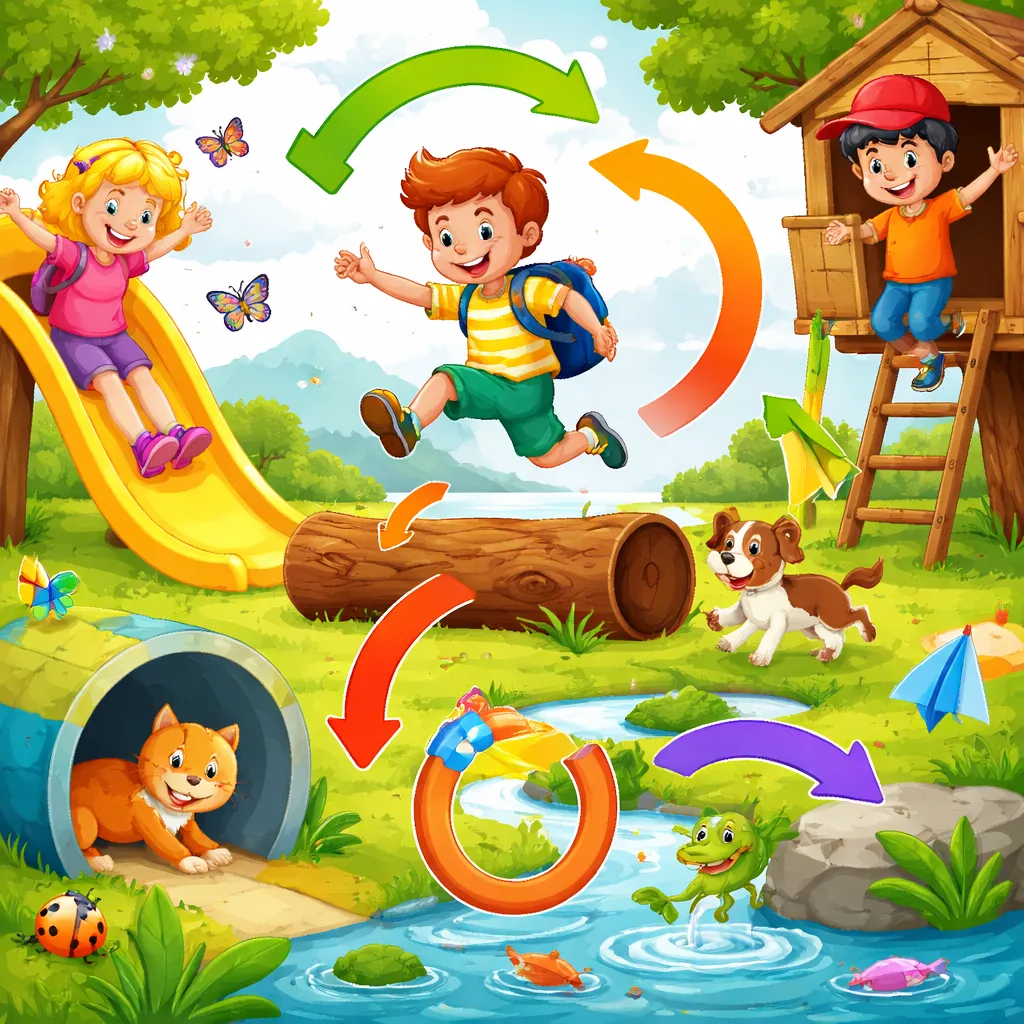

The ball rolls across the floor. The cat jumps onto the sofa. You walk into your classroom. The little words 'across', 'onto', and 'into' are super helpers. They are "Direction Guides." They show us how things move from one place to another. They are prepositions of movement. Let's learn how to use these tiny but mighty word guides.
What Are These 'Direction Guides'?
Prepositions of movement are like little arrows in a sentence. They tell you the path of an action. They answer the question "Where to?" or "Which way?" They are different from prepositions of place. Place prepositions tell you where something is. Movement prepositions tell you where it is going. At home, your toy car goes under the table. 'Under' shows the movement path. At the playground, you run around the tree. 'Around' shows the circular path. In school, you walk past the library. 'Past' shows the movement alongside it. In nature, a bird flies over the house. 'Over' shows the path above. These guides make stories of motion clear and exciting.
Why Are These Guides So Useful?
Knowing these direction words makes you a master storyteller. It helps your ears, your voice, your reading eyes, and your writing hand in amazing ways.
First, it helps your listening. You watch a cartoon. A hero yells, "Jump over the fence!" Now you understand the exact action needed. You catch the key movement instruction. Your coach might say, "Run to the finish line!" You know your target destination. You listen for these little words to know what to do.
Next, it makes your speaking super clear. You can give perfect directions. You can say, "Go through the tunnel and up the hill." This paints a clear path. You can describe an exciting play in a game. "He kicked the ball between the goalposts!" Your words create a movie in the listener's mind. Your stories become full of action.
Then, it gives you a reading superpower. You read an adventure book. It says, "She climbed down the rope and into the cave." You see 'down' and 'into'. You can picture every step of her journey. This helps you visualize the story. You feel like you are right there with the character. You understand the action sequence perfectly.
Finally, it makes your writing dynamic and fun. Your diary entries come to life. Instead of writing "I went to the park," you can write "I rode my bike along the path and into the park." This shows your journey. You can write an action story: "The spy slid under the laser and across the room." Using movement prepositions makes your writing pulse with energy.
Meet the Team of Direction Guides
Let's meet our team of tiny word guides. Each one has a special job showing a different kind of path.
First, the Up & Down Experts: UP and DOWN. 'Up' shows movement to a higher place. 'Down' shows movement to a lower place. At home: "The cat climbed up the curtains." At the playground: "Slide down the pole!" In school: "Please walk up the stairs quietly." In nature: "The squirrel ran down the tree trunk."
Next, the In & Out Experts: INTO and OUT OF. 'Into' shows movement from outside to inside. 'Out of' shows the opposite. At home: "Pour the juice into the glass." At the playground: "Get out of the swing, please." In school: "We marched into the hall." In nature: "The rabbit popped out of its hole."
Now, the Through & Across Experts: THROUGH and ACROSS. 'Through' shows movement in one side and out the other. 'Across' shows movement from one side to the other, on a surface. At home: "We drove through the car wash." At the playground: "Let's swim across the pool." In school: "The paper airplane flew across the classroom." In nature: "The path goes through the forest."
Then, the Around & Past Experts: AROUND and PAST. 'Around' shows movement in a circle or to the other side. 'Past' shows movement from one side to the other, going by something. At home: "We danced around the Christmas tree." At the playground: "I rode my scooter past the slide." In school: "Go past the office to find the gym." In nature: "We walked around the lake."
Also, the To & From Experts: TO and FROM. 'To' shows movement towards a place. 'From' shows the starting point of movement. At home: "I go to my room." At the playground: "Throw the ball to me." In school: "This letter is from the principal." In nature: "Birds fly from the north to the south."
And the On & Off Experts: ONTO and OFF. 'Onto' shows movement to the top of something. 'Off' shows movement away from the top. At home: "The dog jumped onto the bed." At the playground: "Be careful getting off the merry-go-round." In school: "Please put your book onto the shelf." In nature: "The leaf fell off the branch."
Your Detective Tool: How to Spot Them
Finding prepositions of movement is a fun game. Here is the secret. Look for a sentence with an action verb. Verbs like 'run', 'jump', 'walk', 'fly', 'throw'. Then, look for a little word right after that verb (or after the object). This little word often answers "where?". Ask yourself: "Is this word showing a path or a change of location?" If yes, you have found a Direction Guide! The pattern is often: [Action Verb] + [Preposition of Movement] + [Place].
How to Use Your Guides Correctly
Using these words is all about the pattern. Remember the main map: [Who] + [Action Verb] + [Preposition of Movement] + [Where/What]. "The boy (who) ran (verb) across (preposition) the street (where)." The preposition connects the action to the destination or path. For some verbs, the pattern is: [Who] + [Action Verb] + [Object] + [Preposition] + [Where]. "She threw (verb) the ball (object) to (preposition) me (where)." Think of the preposition as a bridge. It connects the moving thing to its path or goal.
Oops! Let's Fix Common Mistakes
Everyone makes mistakes. Let's learn from them. One common mistake is confusing 'in' and 'into'. 'In' is for place. 'Into' is for movement. Do not say, "She walked in the room." if you mean she entered. Say, "She walked into the room." 'In the room' means she is already inside, walking around.
Another mistake is using 'on' instead of 'onto'. 'On' is for place. 'Onto' is for movement to the top. Do not say, "The cat jumped on the table." This could mean it was already on the table and jumped there. Say, "The cat jumped onto the table." This clearly shows movement to the top.
A third mistake is forgetting 'to' after 'go'. Do not say, "Let's go the park." Say, "Let's go to the park." The word 'to' is essential to show direction towards the park.
Are You Ready for a Challenge?
Let's test your new skills. Describe how you get from your classroom to the playground. Use at least three different prepositions of movement. Now, imagine you are a drop of rain. Describe your journey from a cloud to a flower. Use 'from', 'down', 'onto', and 'into'. Think about your favorite animal. How does it move? Write two sentences using different movement prepositions. Finally, give directions from your front door to your bedroom. Use 'through', 'up', 'past', and 'into'. Be a great guide!
You Are Now a Direction Master
You have learned all about the tiny guides that show movement. You know they are like arrows in a sentence. You understand many of them: up, down, into, through, across, and more. You have the simple pattern to use them. You can spot them in action sentences. You can even fix common mistakes. You can now describe any journey vividly.
You can learn many things from this article. You now know that prepositions of movement are small words that show the direction or path of an action. You understand they are different from prepositions of place because they show where something is going, not where it is. You learned many common ones like 'into', 'through', 'across', 'around', 'up', and 'down'. You saw the important grammar pattern: subject + action verb + preposition of movement + place. You also know how to avoid confusing similar words like 'in' and 'into'.
Now, try using your new knowledge in real life. Here are two fun ideas. First, play the "Preposition Simon Says." Play with a friend. Give commands like "Simon says, jump up and down!" or "Simon says, run around the chair!" Use lots of action verbs and movement prepositions. Second, be a sports commentator for five minutes. Watch a pet, a sibling, or even a video game. Describe every move you see using prepositions of movement. "He's running towards the goal! He's kicking the ball around the defender!" Have fun guiding your words!