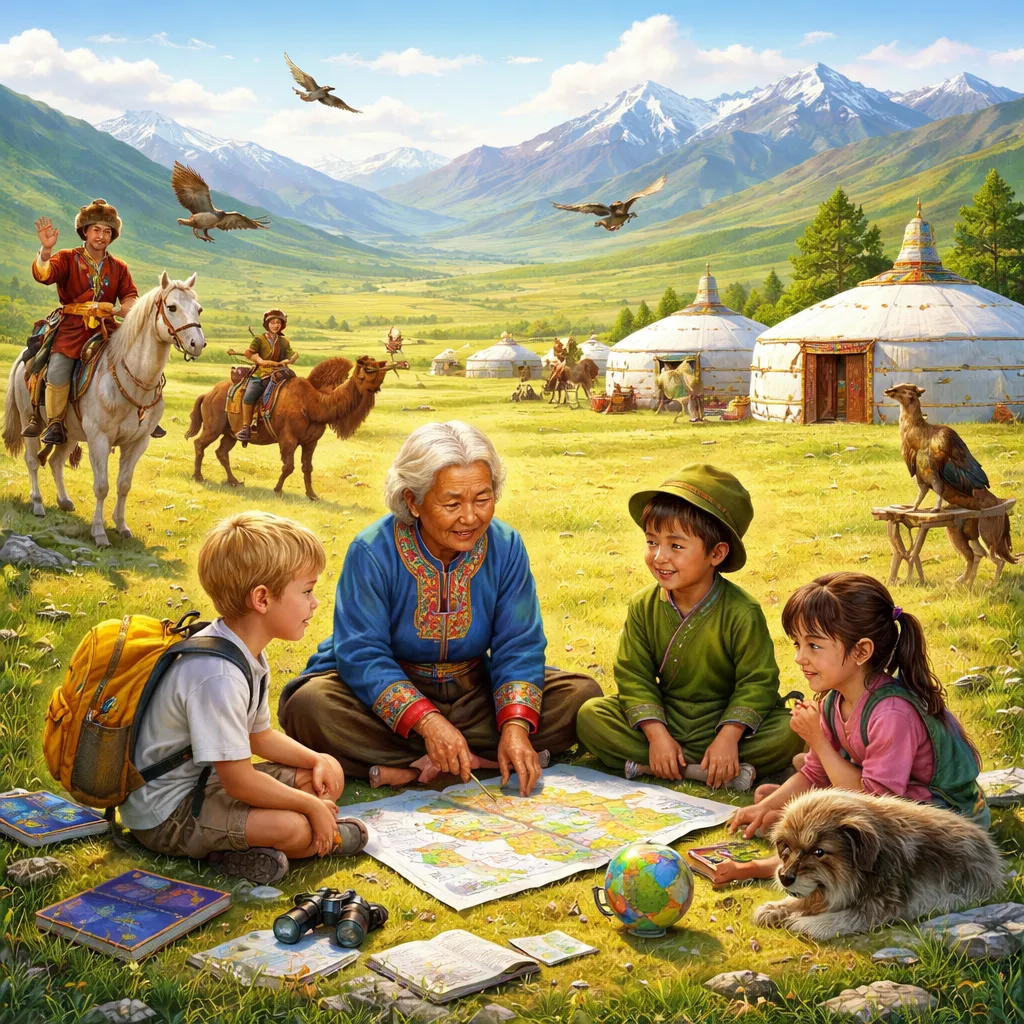

Introduction to Mongolia
Language learning transports us to vast open lands where the sky seems endless. Today we explore a country of sweeping steppes and nomadic traditions. This nation gave rise to one of history's greatest empires. Children will discover a land where people still live in felt tents called gers. They will learn about the mighty warrior Genghis Khan and his horse-riding warriors. Exploring Mongolia builds reading skills while revealing a culture deeply connected to the land. Every fact opens a window to a unique way of life. Every word invites young readers to imagine galloping across the endless steppe.
Where Is Mongolia?
Mongolia lies in Central Asia between Russia and China. It sits landlocked, with no coastline. Russia borders Mongolia to the north. China borders Mongolia to the south, east, and west. The capital city is Ulaanbaatar. Ulaanbaatar sits in the north-central part of the country. It holds nearly half of Mongolia's population. The country covers over six hundred thousand square miles. That makes it one of the largest landlocked countries in the world. Yet it has one of the lowest population densities. Vast stretches of grassland, desert, and mountains have very few people. Finding Mongolia on a map shows a large country sandwiched between Russia and China. Its location made it a crossroads for ancient trade routes.
Interesting Facts About Mongolia
Mongolia offers countless fascinating facts for young learners. It is the most sparsely populated country in the world. Vast areas have no permanent residents. Another interesting fact involves Genghis Khan. He united the Mongol tribes and built an empire that stretched across Asia and into Europe. His descendants ruled the largest land empire in history. Many Mongolians consider him the father of their nation.
Mongolia also has a unique traditional dwelling. The ger, also called a yurt, serves as a portable home. Families can set up and take down these felt-covered tents quickly. About half of Mongolians still live in gers, especially in rural areas. Another fun fact involves the Gobi Desert. This vast desert covers much of southern Mongolia. It holds dinosaur fossils, including the first dinosaur eggs ever discovered. Paleontologists continue to find new species in the Gobi.
Mongolia also has extreme weather. Winters drop below minus forty degrees. Summers can reach over one hundred degrees. The country experiences over two hundred sunny days each year. Another interesting fact involves horses. Mongolia has more horses than people. Children learn to ride at a very young age. Horses remain central to Mongolian culture and transportation in rural areas. These facts show children a country of extremes, tradition, and incredible history.
Key Vocabulary About Mongolia
Let us build vocabulary for this vast nation. These words help children describe what they learn.
Steppe: a large area of flat, grassy land.
Nomad: a person who moves from place to place with no permanent home.
Ger: a round, felt-covered tent used by Mongolian nomads.
Empire: a group of lands or nations ruled by one leader.
Fossil: the preserved remains of an ancient plant or animal.
Desert: a dry area with little rain and few plants.
Equestrian: relating to horse riding. Introduce these words with pictures and stories. Show a ger standing on the open steppe. Show dinosaur eggs found in the Gobi. Let children say each word aloud. These vocabulary words give children the language to explore Mongolia's unique culture and landscape.
Simple Sentences for Reading Practice
Short sentences help new readers build confidence. Use these sentences about Mongolia for practice.
Mongolia is a large country in Central Asia.
Russia and China border Mongolia.
The capital city is Ulaanbaatar.
The Gobi Desert covers the south.
Many people live as nomads in gers.
Genghis Khan built a great empire.
Mongolia has more horses than people. Read each sentence together. Let children point to the words. Encourage them to repeat after you. Use pictures to show each fact. These simple sentences prepare young readers for longer passages.
Short Reading Passage About Mongolia
Here is a short passage for children to read together.
“Mongolia stretches across Central Asia between Russia and China. Vast grasslands called steppes roll across the land. In the south, the Gobi Desert spreads its sandy and rocky terrain. The capital, Ulaanbaatar, sits in the north. Many Mongolians live as nomads. They move with their herds of horses, sheep, and goats. They live in gers—round tents made of felt. Families can pack up a ger in about an hour. Long ago, a warrior named Genghis Khan united the Mongol tribes. His empire became the largest land empire in history. Today, Mongolians remember him with great pride. The Gobi Desert holds secrets from the past. Paleontologists have found dinosaur eggs and skeletons there. These fossils teach us about life millions of years ago. Horses remain vital to Mongolian life. Children learn to ride almost as soon as they can walk. Mongolia is a land of open spaces, ancient history, and enduring traditions.”
Read this passage slowly together. Pause to talk about each idea. Ask children to find vocabulary words in the text. This activity builds reading fluency and deepens understanding.
Fun Questions About Mongolia
Questions make reading interactive and engaging. Use these to start conversations with young learners.
What two countries border Mongolia?
What is the capital city of Mongolia?
What is a ger and who lives in one?
Who united the Mongol tribes into a great empire?
What famous fossils have been found in the Gobi Desert?
Why does Mongolia have more horses than people? Let children answer in complete sentences. Encourage them to use new vocabulary. Ask them to imagine living in a ger on the open steppe. What would they see? What would they hear? Creative questions make the topic personal and exciting.
Tips for Learning English with This Topic
Use Mongolia to create rich English learning experiences. Start with a map activity. Let children find Mongolia between Russia and China. Point out its vast size and low population. Discuss why people might live as nomads in such a landscape. This connects geography to culture in a meaningful way.
Next, introduce the vocabulary through a hands-on activity. Let children build a model ger using felt, paper, or fabric draped over a round frame. Talk about how nomads can pack and move their homes. For the Gobi Desert, create a small fossil dig using sand and hidden dinosaur toys. Let children discover the "fossils" like paleontologists.
Read the passage aloud with a sense of vastness and adventure. Let your voice reflect the wide-open spaces. After reading, let children draw a scene from Mongolia. One child might draw a ger on the steppe with horses nearby. Another might draw dinosaur fossils in the Gobi Desert. Let them label their drawings with vocabulary words. Add blue for the endless sky and brown for the desert.
Incorporate a history connection. Talk about Genghis Khan and how he united the tribes. Discuss what an empire means. Compare to other empires children may have learned about. This shows children that language learning reading connects to world history.
Use music and movement to enhance the experience. Listen to traditional Mongolian throat singing or horse-head fiddle music. Let children move like galloping horses. Pretend to pack a ger and move across the steppe. Physical activity reinforces learning in joyful ways.
Encourage children to share their knowledge. Let them tell a family member about living in a ger or finding dinosaur eggs in the Gobi. They can explain why Mongolia has more horses than people. Teaching others builds confidence and deepens understanding.
Connect Mongolia to your child's world. Ask, “What animals live near us?” Compare to the horses of Mongolia. Ask about homes you have seen. Compare to gers. Talk about fossils or dinosaurs your child finds interesting. Compare to the Gobi Desert discoveries. These connections help children see that language learning reading is about understanding different ways of life. By exploring Mongolia together, you give children a rich experience. They learn new words, discover a land of nomads and dinosaurs, and grow their love for reading. This vast Central Asian nation becomes a meaningful part of their learning journey.