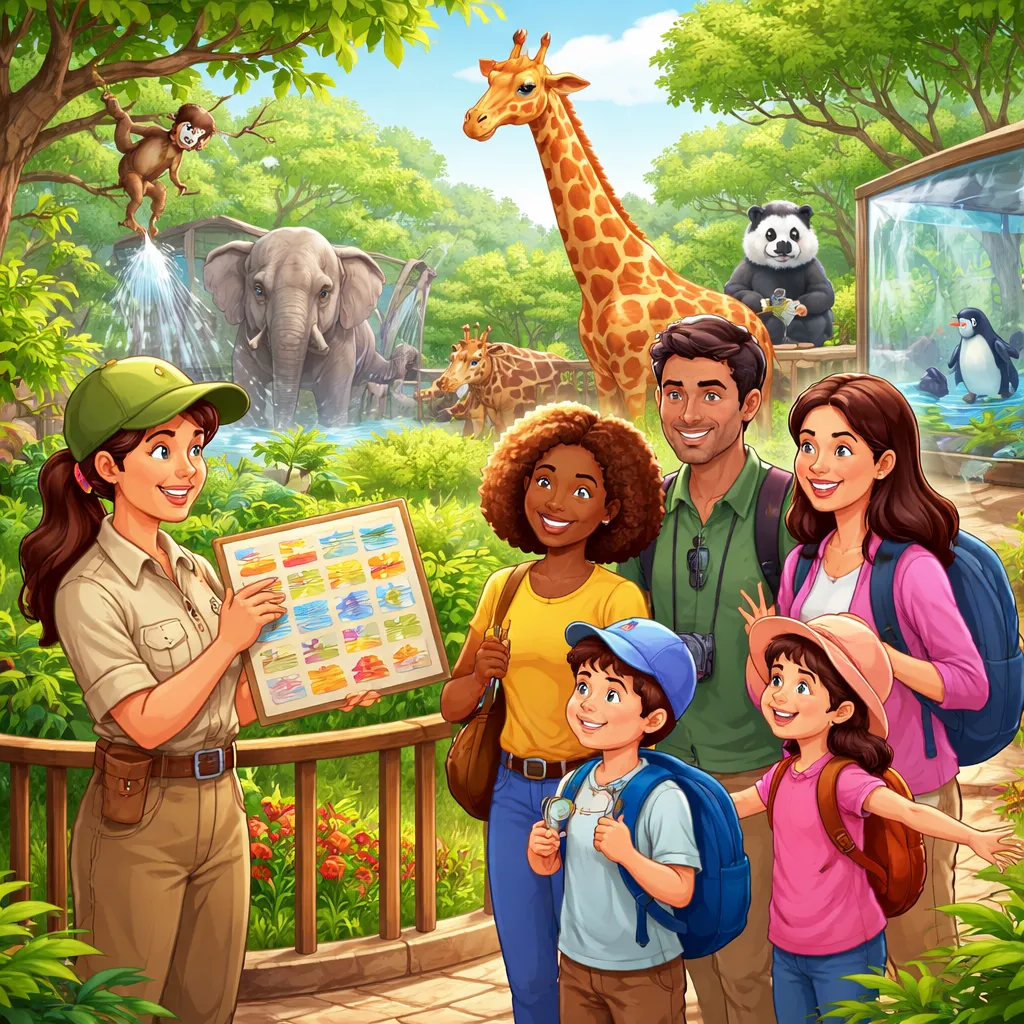

What Is This Situation? The zoo is a magical place. Lions roar. Monkeys swing. Elephants spray water. Giraffes reach high into the trees. Every animal is different. Every exhibit is a new discovery. A zoo visit is an adventure waiting to happen.
English conversation for visiting a zoo gives children the words to share this adventure. They learn to name the animals. They learn to describe what they see. They learn to ask questions. The words turn looking into talking, and talking into learning.
This situation happens at the zoo, of course. At the lion enclosure, at the monkey house, at the penguin pool. It happens while walking, while eating lunch, while looking at the map. The whole day is a conversation.
These phrases are curious and descriptive. They name animals. They describe actions. They ask questions. They share excitement. With these words, your child becomes an explorer, a scientist, a storyteller—all in one zoo visit.
Key English Phrases for This Situation Use phrases for naming animals. "Look, a lion!" points out an animal. "I see a monkey" describes observation. "What is that animal?" asks for the name.
Use phrases for describing actions. "The lion is sleeping" tells what the animal is doing. "The monkeys are climbing" describes movement. "The elephant is eating" names the action.
Use phrases for asking questions. "What do zebras eat?" asks about diet. "Where do penguins live?" asks about habitat. "Why is the tiger sleeping?" asks about behavior.
Use phrases for sharing excitement. "Wow, look at that!" expresses wonder. "This is my favorite animal" shares preference. "I have never seen one before" notes novelty.
Use phrases for planning. "What do you want to see next?" involves the child. "Let us go see the giraffes" makes a plan. "Where is the reptile house?" asks for direction.
Simple Conversations for Kids Dialogue 1: At the Lion Exhibit Child: "Look, a lion! He is sleeping." Parent: "Yes, lions sleep a lot. They are most active at night." Child: "Why is he sleeping during the day?" Parent: "Because lions hunt at night. So they rest in the day." Child: "That is interesting. Can we come back and see him later?" Parent: "Sure. Maybe he will be awake then."
This conversation starts with observation. The child notices the lion. The parent adds information. The child asks a question. The parent answers. The child makes a plan to return. Learning and curiosity flow.
Dialogue 2: At the Monkey House Child: "The monkeys are swinging. Look at that one!" Parent: "I see. They are so active. What are they doing now?" Child: "One is eating a banana. And two are playing." Parent: "You are a good observer. What sounds do monkeys make?" Child: "Ooh ooh ah ah!" makes monkey sounds. Parent laughs. "Yes, that is right. They talk to each other."
This conversation encourages observation. The child describes what they see. The parent asks for more. The child adds detail. The parent praises. The conversation becomes playful.
Dialogue 3: Choosing What to See Parent: "We have seen the lions, monkeys, and elephants. What do you want to see next?" Child: "Giraffes! I want to see the giraffes." Parent: "Okay. Where are the giraffes? Let us look at the map." Child looks at map. "Here. They are by the zebras." Parent: "Good reading. Let us go that way." Child: "I hope they are eating leaves. Giraffes eat leaves from tall trees."
This conversation involves planning. The child makes a choice. The child uses the map. The child shares what they know. The child is an active participant in the day.
Vocabulary You Should Know Lion is a big cat that lives in Africa. You can say "The lion is sleeping." This is a favorite zoo animal.
Monkey is an animal that swings in trees. You can say "The monkeys are playing." Children love watching monkeys.
Elephant is a huge animal with a long trunk. You can say "The elephant is spraying water." This animal always impresses.
Giraffe is a tall animal with a long neck. You can say "The giraffe eats leaves from high trees." This animal is unique.
Zebra is a horse-like animal with black and white stripes. You can say "Zebras live in groups." This animal is beautiful.
Penguin is a bird that swims and waddles. You can say "Penguins slide on their bellies." Children love penguins.
How to Use These Phrases Naturally Use an excited and curious tone. The zoo is exciting. Let your voice show it. "Look at that!" said with wonder makes the experience more magical.
Say the phrases when you are at each exhibit. Do not wait. When you see the animal, start talking. "What is that animal?" "What is it doing?" The moment is the time for words.
Ask open-ended questions. "What do you notice?" is better than "Do you see the lion?" Open questions invite more language.
Let your child lead. If they want to spend a long time at the monkey house, let them. Their interest is the best teacher. Follow their lead.
Share what you know, but keep it simple. "Giraffes have long necks to reach tall leaves." A short fact is enough. Too much information overwhelms.
Common Mistakes to Avoid One mistake is rushing. The zoo is not a checklist. Do not try to see everything. Let your child set the pace. A slow day with deep observation is better than a rushed day with everything.
Another mistake is reading all the signs. For young children, the signs are boring. Point to the animal. Talk about the animal. The signs are for adults.
Some parents forget to let the child speak. They describe everything. Leave space. Let your child say "Look, a monkey!" first. Their words matter.
Avoid correcting pronunciation at the zoo. If your child says "giraffe" with a funny sound, let it go. The joy of seeing the animal is more important than perfect pronunciation.
Tips for Parents and Practice Ideas Prepare before you go. Read zoo books. Talk about what animals you might see. Familiarity builds excitement.
Bring a camera. Let your child take pictures. They can show their pictures later and talk about what they saw. The pictures extend the language.
Get a map. Let your child help navigate. The map builds spatial language. "We go left. Then straight."
Take breaks. The zoo is big. Sit. Eat a snack. Talk about what you have seen. "What was your favorite animal so far?" Breaks build reflection.
Visit the zoo multiple times. Each visit, your child sees new things. Each visit, they have more words to share. The zoo becomes a familiar place for learning.
Fun Practice Activities Play I Spy at the zoo. "I spy something with a long neck." Your child guesses giraffe. The game builds observation and vocabulary.
Make a zoo book. Take photos. At home, your child writes or dictates captions. "The lion was sleeping. The monkeys were playing." The book becomes a memory and a language record.
Create a zoo scavenger hunt. Before you go, make a list of things to find. "Find an animal with stripes. Find an animal that swims." The hunt adds purpose.
Sing zoo songs. "We are going to the zoo, zoo, zoo. What will we see, see, see?" Music adds fun to the journey.
Bring animal toys. On the way home, your child plays with zoo animals. They reenact the day. They use the words again. Play extends learning.
English conversation for visiting a zoo turns a day out into a language adventure. Your child learns the names of animals. They learn to describe what they see. They learn to ask questions and share excitement. The zoo becomes more than a place to see animals. It becomes a place to talk about them, to wonder about them, to love them. And the words you share at the zoo will stay with your child long after the day is over. They will remember the lion sleeping, the monkeys swinging, the giraffe reaching high. And they will have the words to tell you all about it.