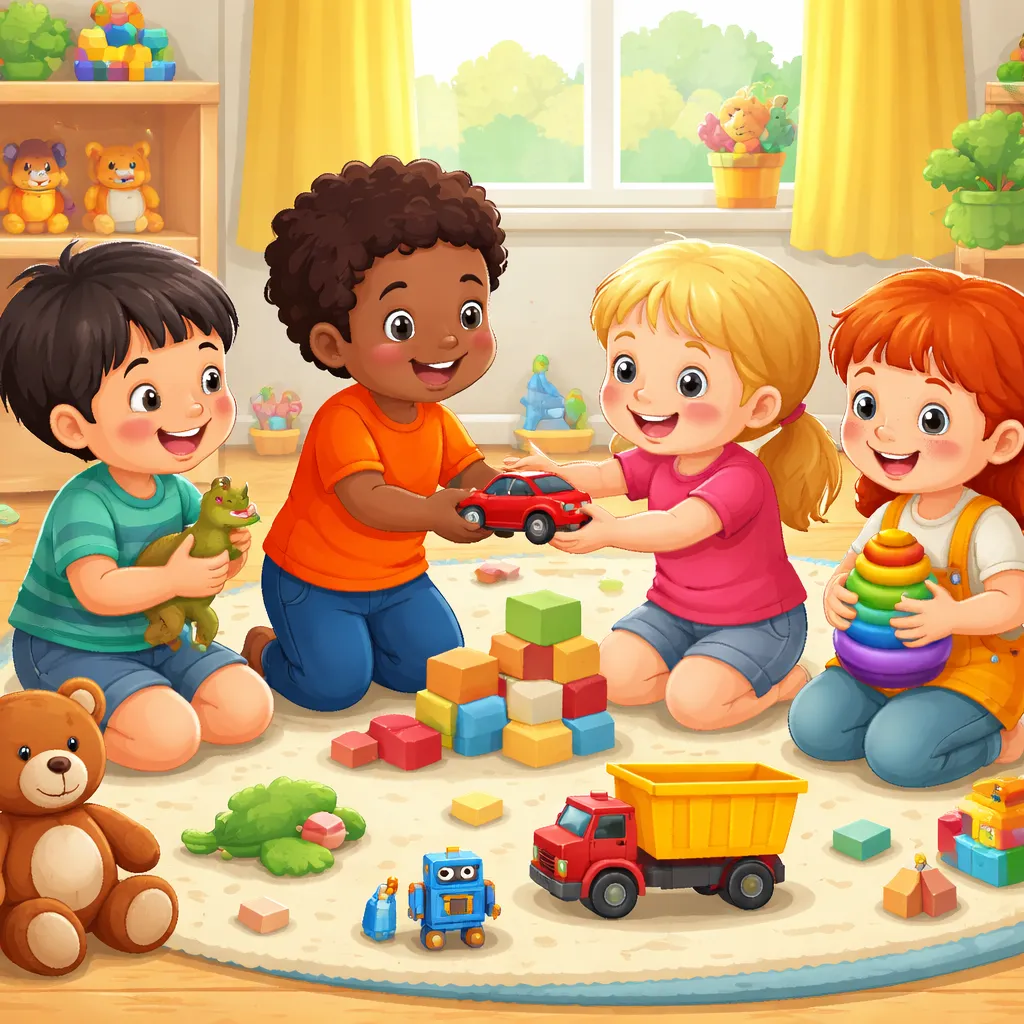

What Is This Situation? Sharing toys is one of the first social skills children learn. One child has a toy. Another child wants it. Feelings come up. Sometimes there is grabbing. Sometimes there are tears. Learning to share takes practice and gentle guidance.
This situation happens at home with siblings, at playdates with friends, at preschool, and on playgrounds. It happens whenever two children want the same thing at the same time. It is a moment of learning about fairness, patience, and kindness.
English dialogue for sharing toys with friends gives children the words they need in these moments. Instead of grabbing, they can say "Can I have a turn?" Instead of yelling, they can say "I am playing with this now." The words help them navigate the situation.
These conversations are short and simple. They give children tools to ask, to wait, and to negotiate. With practice, sharing becomes less stressful and more natural. The words become part of how they play together.
Key English Phrases for This Situation Use phrases for asking to share. "Can I play with that?" is a direct request. "Can I have a turn?" asks for time with the toy. "Will you share with me?" invites cooperation.
Use phrases for setting boundaries. "I am playing with this now" states the current situation. "You can have a turn when I am done" offers a future turn. "I will give it to you in a minute" sets a timeframe.
Use phrases for negotiating. "Let us take turns" suggests a solution. "You play with this. I play with that" offers an alternative. "We can play together" invites cooperative play.
Use phrases for accepting. "Okay, your turn" agrees to share. "Thank you" expresses gratitude. "You can have it" gives the toy willingly.
Use phrases for waiting. "I am waiting for my turn" states patience. "You can have it next" reminds of the agreement. "My turn soon" anticipates the turn.
Simple Conversations for Kids Dialogue 1: Asking for a Turn Friend is playing with a red car. Child: "Can I have a turn with the car?" Friend: "I am playing with it." Child: "Okay. I wait." Friend: "My turn done. Here you go." Child: "Thank you."
This conversation shows polite asking. The child accepts the answer. The friend finishes and shares. The child says thank you. The interaction is smooth and kind.
Dialogue 2: Setting a Timer Child has a toy truck. Friend: "Can I play with the truck?" Child: "I am using it. You can have it in two minutes." Friend: "Okay." Parent: "Let us use the timer. When it beeps, it is your turn." Timer beeps. Child: "Here is the truck. Your turn." Friend: "Thank you."
This conversation uses a timer to make waiting concrete. The child sets a clear boundary. The friend accepts. The timer signals the transition. The child shares willingly.
Dialogue 3: Playing Together Child: "I have blocks." Friend: "I want to play too." Child: "We can play together. You build with the red ones. I build with the blue ones." Friend: "Okay." Child: "Look, our tower is tall." Friend: "We did it together."
This conversation turns sharing into cooperative play. The child suggests playing together. They divide the blocks. They build together. The language focuses on joint effort.
Vocabulary You Should Know Share means to let someone use something you have. You can say "Let us share the toys." This word is the goal of these conversations.
Turn means your chance to use something. You can say "It is my turn now." This word helps children understand waiting.
Wait means to stay in one place until something happens. You can say "I can wait for my turn." This word builds patience.
Together means doing something with someone else. You can say "Let us play together." This word invites cooperation.
Mine means belonging to me. You can say "This is mine right now." This word helps children set boundaries politely.
Yours means belonging to you. You can say "This is yours now." This word helps children hand over a toy.
How to Use These Phrases Naturally Use a friendly and calm tone. Sharing can bring big emotions. Your voice helps keep the situation calm. Speak kindly to both children. Model the tone you want them to use.
Say the phrases when you see a sharing moment coming. Do not wait for a conflict. "Can you share the blocks?" asked early prevents grabbing. Timing helps prevent problems.
Use the phrases yourself. When you share something with your child, say "Here, I am sharing with you." When you take a turn, say "My turn. Now your turn." Your child learns by watching you.
Repeat the same phrases each time. Consistency helps children learn. They hear "Can I have a turn?" and they know what it means. They learn to use it themselves.
Let children practice with you. When you play together, model the dialogue. "Can I have a turn with the red block?" "Yes, here you go." Your child hears the words in a safe setting.
Common Mistakes to Avoid One mistake is forcing immediate sharing. "Give it to him now" does not teach sharing. It teaches that others' wants matter more than yours. Let the child finish their turn first. Then they can share willingly.
Another mistake is intervening too quickly. Give children a moment to work it out themselves. They may use the words you taught them. If they struggle, then step in.
Some parents use phrases like "You have to share" without teaching how. Children need the actual words. "Can I have a turn?" is a tool. Teach the tool, not just the concept.
Avoid taking sides. "You had it long enough" creates resentment. Focus on the process. "Let us see how we can both play" keeps the focus on the solution.
Tips for Parents and Practice Ideas Practice sharing during calm play. Use two toys. Take turns. "My turn. Your turn." The practice makes the real moments easier.
Use a timer. A visual timer helps children understand waiting. They can see the time passing. They learn that turns end and then they begin.
Praise sharing when you see it. "I saw you give your friend a turn. That was kind." Specific praise teaches what sharing looks like.
Read books about sharing. Many children's books show characters sharing and taking turns. Read them together. Talk about what the characters did.
Have enough toys for playdates. When children have options, sharing is easier. If they both want the same thing, help them take turns. If they have different toys, they may play side by side happily.
Fun Practice Activities Role-play sharing with toys. You hold a toy. Your child says "Can I have a turn?" You say "Yes, here you go." Then switch roles. Your child practices both asking and giving.
Make a sharing song. "Can I have a turn, please? Yes, here you go. Thank you very much. Now you share with me." Sing it during play. Music makes the words stick.
Create a turn-taking chart. Draw pictures of two children and a toy. Show the sequence: ask, wait, receive, thank you. Your child points to the steps as they happen.
Play with a doll who shares. Your child makes the doll ask for a turn. Another doll shares. Your child practices the dialogue through the toys.
Use a sharing basket. Put special toys in a basket. Children take turns choosing from the basket. Each child gets a turn to pick. This builds turn-taking skills.
English dialogue for sharing toys with friends gives children the words to navigate one of childhood's biggest social challenges. They learn to ask instead of grab. They learn to wait instead of whine. They learn to share instead of hoard. These words become tools they carry into preschool, kindergarten, and beyond. With each "Can I have a turn?" and each "Here you go," they build friendships based on kindness and respect. Sharing is hard. But with the right words, it gets easier. And with practice, it becomes second nature.