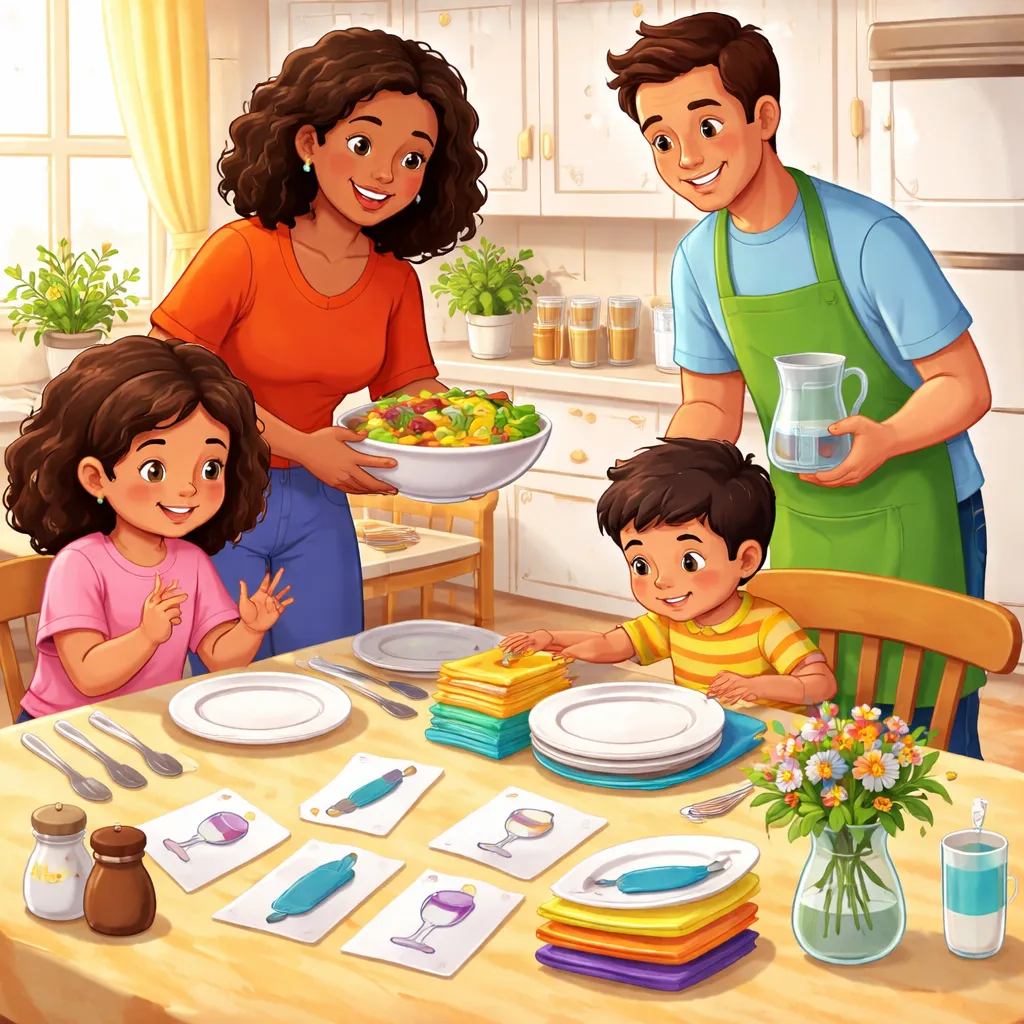

What Is This Situation? Mealtime is coming. The food is cooking. The family will sit together soon. Before that happens, the table needs to be ready. Plates go out. Forks and spoons are placed. Cups are filled. The table becomes a place of gathering.
English phrases for setting the table give children the words to help with this daily task. They learn the names of dishes and utensils. They learn where each item goes. They learn to work together to prepare for the meal.
This situation happens in kitchens and dining rooms, before breakfast, lunch, and dinner. It happens every day. The routine is familiar. The words are repeated often. Setting the table becomes a natural time for English practice.
These phrases are clear and instructional. They name objects. They give directions. They praise effort. With these words, your child learns responsibility, cooperation, and vocabulary all at once.
Key English Phrases for This Situation Use phrases for starting. "Let us set the table" invites participation. "Time to get the table ready" announces the task. "Can you help me?" asks for cooperation.
Use phrases for naming items. "Get the plates" names the first item. "We need forks" tells what comes next. "Where are the cups?" asks your child to find them.
Use phrases for placing items. "Put the plate here" shows where. "The fork goes on the left" gives a rule. "The spoon goes next to the fork" adds detail.
Use phrases for counting. "We need four plates" says how many. "One, two, three, four" counts together. "Did we get enough?" checks the count.
Use phrases for finishing. "The table looks nice" praises the result. "Good job setting the table" thanks your child. "We are ready to eat" marks the completion.
Simple Conversations for Kids Dialogue 1: Setting Together Parent: "Let us set the table. Can you get the plates?" Child: "How many plates?" Parent: "Three plates. One for Mama, one for Papa, one for you." Child counts plates. "One, two, three." Parent: "Good. Now put them on the table." Child places plates. Parent: "Now we need forks."
This conversation breaks the task into steps. The parent gives one direction at a time. The child asks a question. The parent answers. The child completes each step. The work is shared.
Dialogue 2: Learning Where Things Go Parent: "Put the fork here." Child puts fork in the wrong place. Parent: "The fork goes on the left side. See? Next to the plate." Child moves the fork. Parent: "Good. Now the spoon goes on the right." Child places spoon correctly. Parent: "You did it. Now we have forks and spoons."
This conversation teaches placement. The parent gives a direction. The child tries. The parent gently corrects. The child learns. The parent praises the success.
Dialogue 3: Counting Together Parent: "We need napkins. How many people are eating?" Child: "Mama, Papa, me." Parent: "That is three. Can you get three napkins?" Child counts: "One, two, three." Child brings napkins. Parent: "Good counting. Now put one at each plate." Child places napkins. Parent: "Now the table is ready."
This conversation uses counting. The parent asks how many. The child names the people. The parent connects that to the number. The child counts. The child places. The task is complete.
Vocabulary You Should Know Plate is the flat dish you put food on. You can say "Put the plate on the table." This is the first item for setting the table.
Fork is the tool with prongs for picking up food. You can say "The fork goes on the left." This word teaches utensil names.
Spoon is the round tool for scooping food. You can say "We need spoons for soup." This word names another common utensil.
Knife is the tool for cutting food. You can say "Put the knife next to the spoon." This word is for older children.
Cup is what you drink from. You can say "Fill the cups with water." This word completes the place setting.
Napkin is the cloth or paper for wiping hands. You can say "Put a napkin by each plate." This word adds a finishing touch.
How to Use These Phrases Naturally Use a calm and encouraging tone. Setting the table should feel like helping, not a chore. Your tone says "I appreciate your help." Your child feels valued.
Say the phrases one step at a time. "Get the plates." Wait. "Now get the forks." One direction at a time is easier for young children. Too many directions cause confusion.
Use the same words each day. Consistency builds learning. If you always say "plate" and "fork," your child learns those words. The routine makes the vocabulary familiar.
Let your child do the task themselves. Do not take over. If they put the fork in the wrong place, guide, but let them move it. Doing it themselves builds confidence.
Praise the effort, not just the result. "You worked so hard to help" values the contribution. "The table looks nice because you helped" connects effort to outcome.
Common Mistakes to Avoid One mistake is expecting perfection. A young child may put the fork on the right instead of the left. That is okay. The learning is in the trying. Perfection comes with time.
Another mistake is doing the task yourself because it is faster. Setting the table with a child takes longer. But the learning is worth the time. Let them help.
Some parents use baby words for items. "Put the plate" is clear. "Put the round thing" is confusing. Use the real words. Children learn them quickly.
Avoid making it a solo task. Set the table together. Your presence makes it a shared activity. Doing it alone feels like a chore. Doing it together feels like teamwork.
Tips for Parents and Practice Ideas Make it part of the routine. Set the table at the same time each day. Before dinner. Before lunch. Routine builds habit. Your child knows what to expect.
Use a child-sized table for practice. A small table at their height makes the task easier. They can reach everything. The activity feels like play.
Let your child set their own place first. "This is your plate. This is your fork." They learn their own setting. Then they can help with others.
Use a placemat with outlines. Draw the shapes of a plate, fork, and spoon. Your child matches the items to the outlines. This visual guide helps them learn placement.
Praise when they remember. "You remembered the napkins today. Good job." Specific praise reinforces learning.
Fun Practice Activities Play restaurant. Your child is the server. They set the table for you. They say "Here is your plate. Here is your fork." This playful practice makes the task fun.
Make a setting the table song. "Plates on the table, forks on the left. Spoons on the right, now we are set." Music helps remember the order.
Use toy dishes. A play kitchen with toy plates and forks lets your child practice. They set the table for dolls. Practice happens through play.
Draw a table setting. Your child draws a plate, fork, and spoon. They label the drawing. The drawing reinforces the words.
Take turns. One day you set the table together. The next day your child sets it alone while you watch. Independence grows with practice.
English phrases for setting the table turn a daily routine into a time of learning and connection. Your child learns the names of dishes and utensils. They learn to count. They learn to follow directions. They learn to work as part of a family team. And when the meal begins, they can look at the table they helped prepare and feel proud. That pride is a powerful teacher. It says "I helped. I can do it. I am part of this family." And those lessons stay long after the dishes are cleared.