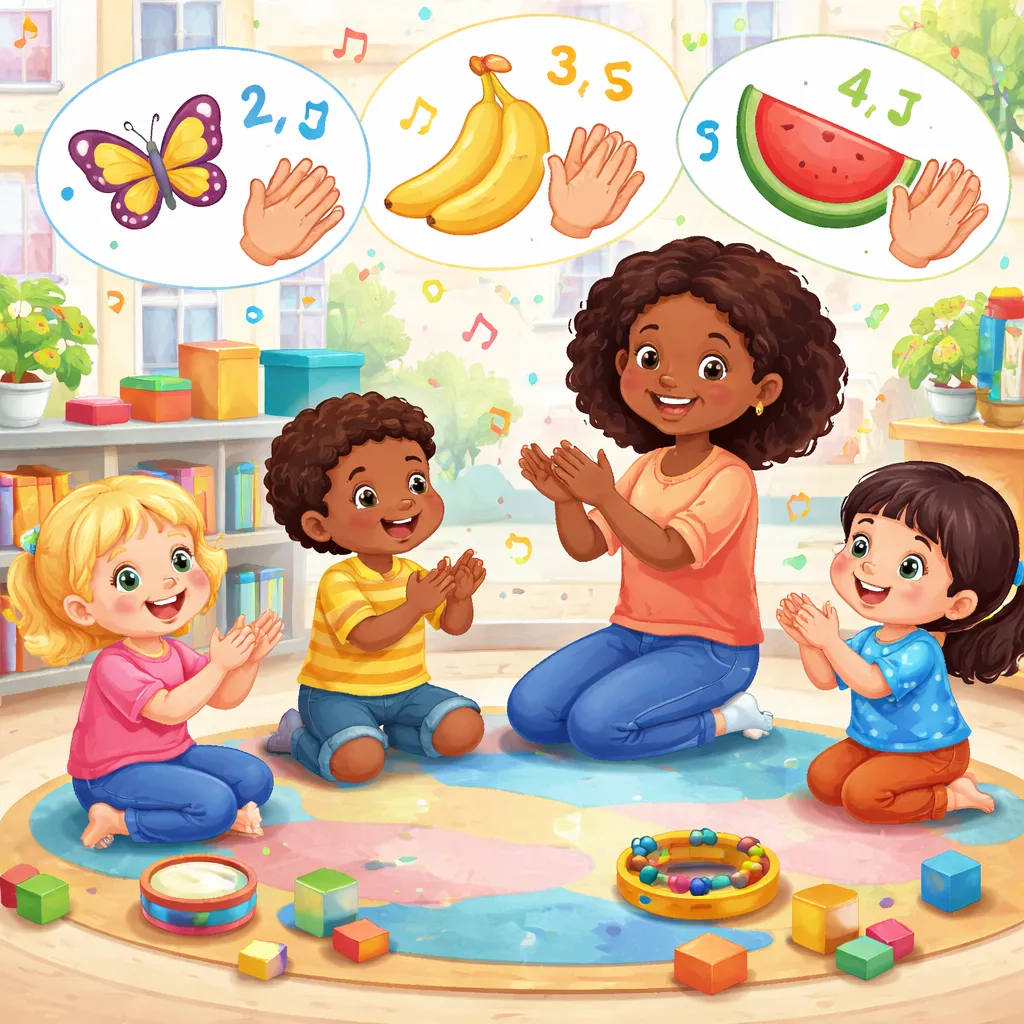

What Is This Situation? Words are made of parts called syllables. Cat has one part. Ap-ple has two. Ba-na-na has three. Clapping helps children hear the parts. When they clap, they feel the syllables. It makes learning active.
Syllable clapping activities for kids give children a fun way to break words into parts. Clap for each syllable. Cat: one clap. Apple: ap-ple, two claps. Banana: ba-na-na, three claps. The clapping makes the syllables clear.
This situation happens during reading time, during word games, during movement breaks. Children love to clap. They love to stomp. Syllable practice can be active and fun.
These activities are best learned through playful movement. Clapping, stomping, jumping—all help children hear syllables. With syllable clapping, your child learns that words have parts.
Key English Phrases for This Situation Use phrases for introducing syllables. "Words have parts called syllables. Cat has one syllable. Clap once." "Apple has two syllables. Ap-ple. Clap twice."
Use phrases for practicing. "Let us clap the syllables in your name. Mi-a. Two claps. Mia." "Let us clap banana. Ba-na-na. Three claps."
Use phrases for different movements. "Let us stomp the syllables. Cat. Stomp." "Let us jump the syllables. Ap-ple. Jump, jump."
Use phrases for counting. "How many syllables in cat? One." "How many in banana? Three." "Let us count the claps."
Use phrases for celebrating. "You clapped the syllables. Good job." "You heard the parts in the word."
Simple Conversations for Kids Dialogue 1: Learning Syllables with Claps Parent: "Let us learn about syllables. Syllables are the parts in a word. Cat. Let us clap it. Cat." Claps once. Child claps. "Cat." Parent: "Good. One clap. One syllable."
This conversation introduces syllables. The parent explains. The child claps. The concept becomes clear.
Dialogue 2: Clapping Two Syllables Parent: "Now let us clap a word with two syllables. Apple. Ap-ple." Claps twice. Child claps twice. "Apple." Parent: "Good. Two claps. Two syllables. Can you clap your name? Mi-a." Child claps twice. "Mia." Parent: "Yes. Two syllables."
This conversation practices two syllables. The child claps. The parent confirms. The skill builds.
Dialogue 3: Clapping Three Syllables Parent: "Now a word with three syllables. Banana. Ba-na-na." Claps three times. Child claps three times. "Banana." Parent: "Good. Three claps. Three syllables. Can you clap elephant? El-e-phant." Child claps three times. "Elephant." Parent: "Yes. You are a syllable expert."
This conversation practices three syllables. The child claps. The parent praises. The learning continues.
Vocabulary You Should Know Syllable is a part of a word. You can say "Cat has one syllable." This is the main concept.
Clap is hitting your hands together. You can say "Clap for each syllable." This is the action.
Count means to say how many. You can say "Count the syllables." This is the skill.
Stomp means to put your foot down hard. You can say "Stomp the syllables." This is another action.
Jump means to go up in the air. You can say "Jump for each syllable." This is active learning.
Name is what people call you. You can say "Clap your name." This makes learning personal.
How to Use These Phrases Naturally Use a rhythmic and active tone. Syllable practice is movement. Your voice should keep the beat. "Clap, clap, apple."
Say the phrases slowly. Say the word. Clap each part. "Ap-ple." Two claps. Let your child follow.
Start with one-syllable words. Cat, dog, sun. Master those. Then two syllables. Apple, tiger, happy. Then three.
Use your child's name. "Mi-a. Two claps." Personal words are meaningful.
Celebrate every clap. "You clapped banana. Good job." Celebration makes learning feel good.
Common Mistakes to Avoid One mistake is clapping letters, not syllables. "C-a-t" is three claps. "Cat" is one. Clap the word parts, not the letters.
Another mistake is adding extra claps. "Apple" is two claps. "Ap-pul" is wrong. Help your child hear the real word.
Some children clap too fast. Go slow. Say the word. Clap each part. Speed comes later.
Avoid frustration. If your child is confused, start with simple words. Cat, dog, sun. Keep it easy.
Tips for Parents and Practice Ideas Clap your child's name. "Mi-a. Two claps." Names are meaningful.
Clap while singing. "Twinkle, twinkle, little star." Clap the syllables. Songs make practice natural.
Use different movements. Clap. Stomp. Jump. Tap. Different movements keep it fun.
Play the syllable game. You say a word. Your child claps the syllables. "Apple." Clap, clap. The game builds skill.
Read books with rhythmic words. Point out words with one, two, three syllables. Clap them together.
Fun Practice Activities Play syllable walk. Take a step for each syllable. "Cat." Step. "Apple." Step, step. "Banana." Step, step, step. The walk makes learning active.
Make syllable cards. Write words with different syllable counts. Your child claps and sorts them. The cards build recognition.
Use syllable bingo. Make bingo cards with pictures. Call out a word. Your child claps and finds the picture. Bingo makes practice fun.
Create a syllable book. Your child draws pictures and writes the syllable count. "Cat: 1." The book is a reference.
Sing the syllable song. "Clap the parts, clap the parts. Cat is one, apple two. Banana is three, banana is three. Syllables are fun to do." Music makes learning fun.
Syllable clapping activities for kids build phonemic awareness through movement. Clapping, stomping, jumping help children hear the parts in words. Cat has one. Apple has two. Banana has three. With playful practice and patient guidance, your child will master syllables. They will clap their name. They will count the parts. They will become ready to read. That is the power of movement. One clap at a time, your child will learn. And you will be there to clap and celebrate together.