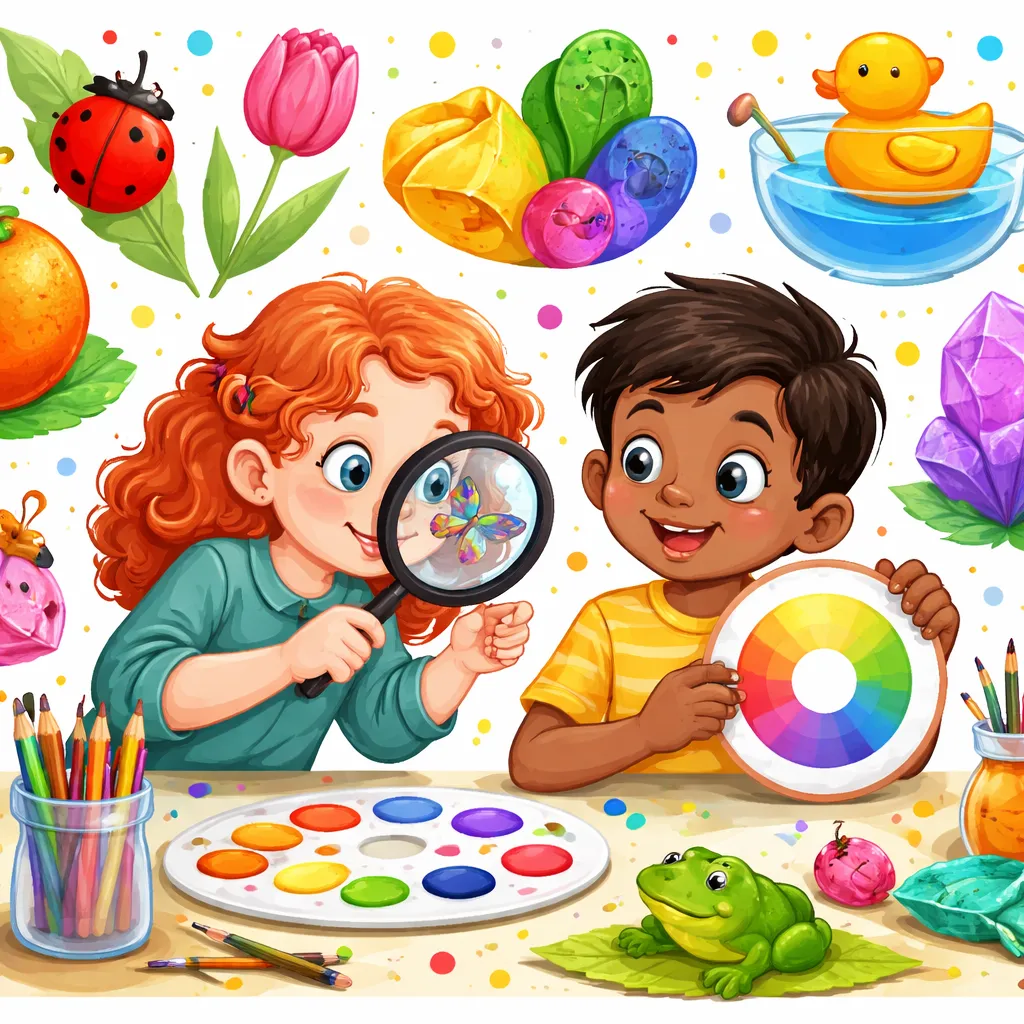

What Is This Situation? Colors are everywhere. The red apple on the table. The blue sky above. The green grass outside. The yellow sun. Colors are how children first learn to describe the world. Before they know shapes or sizes, they know colors.
Talking about colors of objects in English gives children the words to notice and name what they see. They learn to say "red car" instead of just "car." They learn to compare "blue like the sky." The words turn observation into language.
This situation happens all day, every day. At meals, during play, on walks, while reading. Any object can be described by its color. The world is full of opportunities to practice color words.
These phrases are simple and descriptive. They name the color. They name the object. They compare colors. With these words, your child learns to see the world in color and to talk about it.
Key English Phrases for This Situation Use phrases for naming color. "The apple is red" states the color. "This is a blue car" combines color and object. "What color is this?" asks for identification.
Use phrases for describing. "The sky is blue" describes nature. "My shirt is green" describes clothing. "Your shoes are yellow" describes what someone wears.
Use phrases for comparing. "This apple is redder than that one" compares shades. "The sky is the same blue as your shirt" finds matches. "Which one is darker?" asks about shade.
Use phrases for asking. "What color is your favorite?" asks preference. "Can you find something red?" invites search. "What color do you see?" opens observation.
Use phrases for playing. "I spy something blue" starts the game. "Let us find all the yellow things" makes a game. "How many green things can you count?" adds counting.
Simple Conversations for Kids Dialogue 1: At Mealtime Parent: "Look at your apple. What color is it?" Child: "Red." Parent: "Yes, the apple is red. What about your banana?" Child: "Yellow." Parent: "Good. Red apple, yellow banana. You have two colors on your plate."
This conversation names colors of food. The parent asks. The child answers. The parent adds a sentence. The child learns to connect color to object.
Dialogue 2: On a Walk Child: "Look at that car. It is blue." Parent: "Yes, a blue car. What color is that car?" Child: "Red." Parent: "Good. Blue car, red car. Which one do you like?" Child: "Blue." Parent: "Blue is a nice color."
This conversation observes colors outside. The child notices first. The parent adds another. The child compares. The parent asks preference. The observation becomes conversation.
Dialogue 3: Playing I Spy Parent: "I spy with my little eye, something green." Child: "The tree?" Parent: "Yes, the tree is green. Your turn." Child: "I spy something red." Parent: "The flower?" Child: "Yes. The red flower."
This conversation uses the classic game. The child practices color words. The child practices object names. The game makes color talk fun.
Vocabulary You Should Know Red is the color of apples and fire trucks. You can say "The apple is red." This is a common first color.
Blue is the color of the sky and the ocean. You can say "The sky is blue." Children learn this early.
Yellow is the color of the sun and bananas. You can say "The banana is yellow." This color is bright and easy.
Green is the color of grass and leaves. You can say "The grass is green." Children see green every day.
Orange is the color of pumpkins and oranges. You can say "The pumpkin is orange." This color name is also a fruit.
Purple is the color of grapes and some flowers. You can say "The grapes are purple." This is a favorite color.
How to Use These Phrases Naturally Use an observant and curious tone. Colors are interesting. Show your child that you notice them too. "Look at that blue bird" said with wonder invites your child to look and learn.
Say the phrases when you see colors. Do not make it a lesson. Just notice. "Your shirt is yellow today." The words are part of conversation.
Use color words in daily talk. "Please pass me the red cup." "Let us read the green book." Color words become part of instructions and requests.
Ask your child to find colors. "Can you find something purple?" The search makes the child active. They practice the word while looking.
Let your child correct you. "I think that car is blue." "No, it is green." Let them be right sometimes. Their confidence grows.
Common Mistakes to Avoid One mistake is teaching colors only with flashcards. Colors are everywhere. Point to real objects. "Red flower." "Blue sky." Real things are better than cards.
Another mistake is assuming a child knows a color because they can say it. Naming a color and matching a color are different skills. Let them practice matching. "Find the red one."
Some parents correct color mistakes harshly. If your child calls a blue car red, gently say "That car is blue. See?" Gentle correction works better than scolding.
Avoid using only basic colors. Teach light blue, dark green, pink, brown. The world has many colors. Your child can learn them.
Tips for Parents and Practice Ideas Sort laundry by color. "These are all white socks. These are blue shirts." Sorting builds color categories.
Use color books. Books with bright, clear pictures are great. Point to the colors. "Red flower. Green leaf."
Sing color songs. "Red and yellow and pink and green..." Music makes color words stick.
Talk about colors in art. "You used blue and yellow in your painting. Beautiful." Art is a natural place for color talk.
Point to colors in nature. The sky, leaves, flowers, birds. Nature has the best colors. Nature is free.
Fun Practice Activities Play the color hunt. "Let us find three red things in this room." Your child finds them. The hunt builds observation and vocabulary.
Make a color book. Use construction paper. Each page is a color. Your child glues things of that color on the page. "Red page. Apple, strawberry, fire truck."
Paint with colors. Give your child paint. Name the colors as they use them. "You are using blue." The words come while creating.
Play color matching. Use paint chips from the store. Your child matches the chip to objects in the room. "This matches the couch."
Create a color basket. Put objects of one color in a basket. "This is our blue basket. Blue car. Blue block. Blue ball." The basket collects the color.
Talking about colors of objects in English is one of the first and most joyful ways children learn to describe the world. Colors are bright and beautiful. They catch a child's eye. They stay in a child's memory. When you name a color, you are not just teaching a word. You are teaching your child to notice. To see the red in an apple, the blue in the sky, the green in the grass. You are teaching them that the world is full of color, and they have the words to talk about it. That is a gift that lasts forever. Every time they see a sunset, a flower, a favorite shirt, they will have the words to say what they see. And they will remember learning them with you.