
Opening Introduction
Mia visited her cousin Ben. Ben lived on a farm. Early in the morning, Mia heard a rooster crow. She saw Ben's dad driving a big green tractor. Ben's mom was collecting eggs from the chicken coop. Ben was feeding a baby goat with a bottle. "There is so much work to do!" Mia said. Ben nodded. "Yes, a farm is like a big, outdoor machine. Everyone has a job to make it work. My grandpa says knowing the jobs people do on a farm is knowing where our food comes from." Mia wanted to learn. She loved eggs and milk. Who made them appear? Let's walk through the farm with Mia and Ben and learn about all the important jobs.
Core Knowledge Explanation
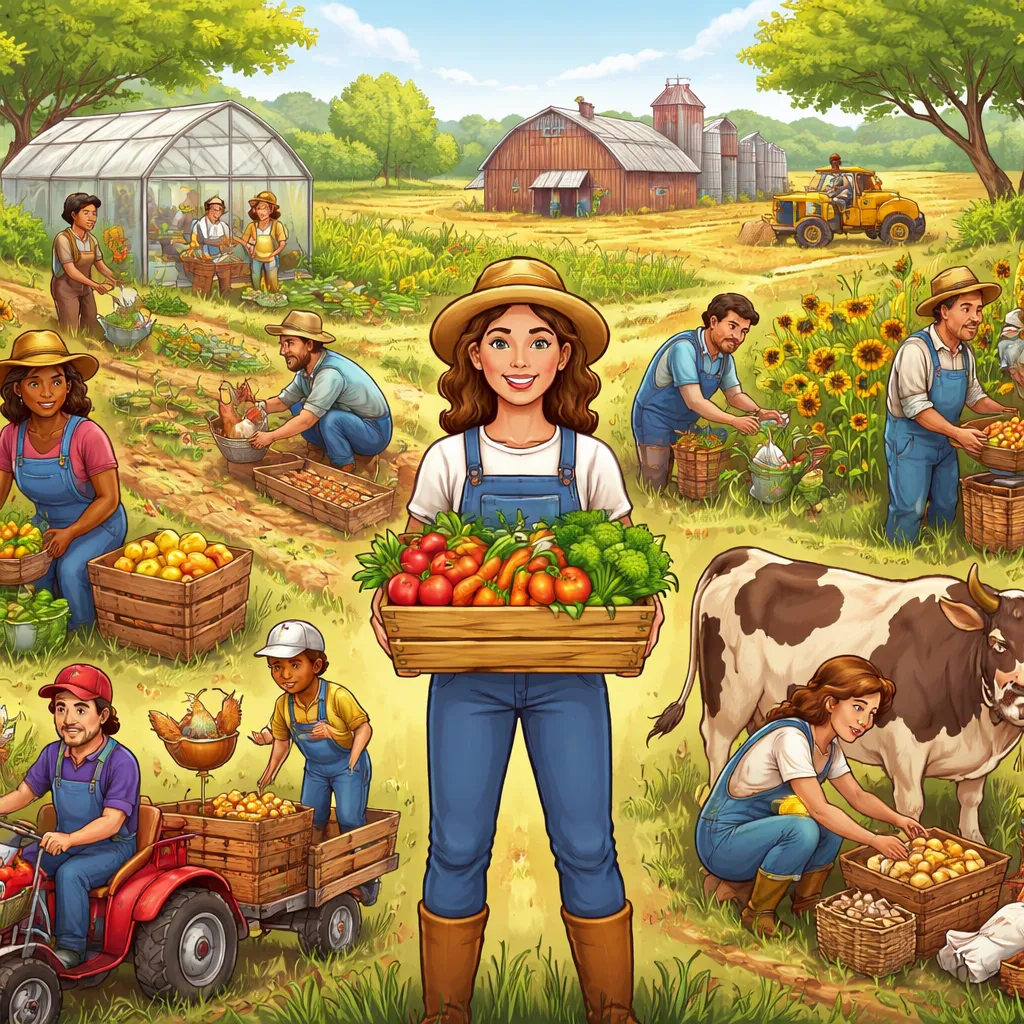
A farm is a piece of land where we grow food and raise animals. It provides us with vegetables, fruit, milk, eggs, and meat. Many different people work hard every day to make this happen. Learning about the jobs people do on a farm teaches us about hard work, nature, and our food. Let's start with the person in charge. This is the farmer. The farmer is the boss of the farm. They make the big plans. They decide what to grow and which animals to raise. They often drive the tractor and fix machines.
Farmers often have a family who helps. Everyone has tasks. But some farms are very big. They need more workers. A farmhand is a helper who does many jobs. A farmhand might feed the animals, clean the barns, or help harvest the crops. They are strong and know how to do many things. Then there is the shepherd. A shepherd takes care of sheep. They make sure the sheep have grass to eat and water to drink. They protect them from wild animals. Sometimes they use a friendly dog to help.
Another important job is the dairy farmer. This person takes care of cows that give milk. They milk the cows every morning and evening. They keep the milking machines very clean. The milk goes to the factory to become the milk in our fridge. What about chickens? A poultry farmer takes care of chickens. They collect eggs every day. They make sure the chickens have food and a safe house, called a coop.
Farms that grow plants need different workers. The fruit grower takes care of fruit trees and bushes. They plant the trees, watch for bugs, and pick the fruit when it is ripe. The vegetable grower does the same for plants like carrots, potatoes, and lettuce. They plant the seeds, water the plants, and pull out weeds. A new kind of farmer is the beekeeper. A beekeeper keeps bees. The bees make honey. They also help flowers grow by moving pollen from one flower to another. This is called pollination. It is very important. These are the main jobs people do on a farm. They all work with sun, soil, and animals to give us food.
Fun Interactive Learning
The best way to learn is to play. Let's play "Farm Role-Play." Set up a small farm. Use pillows for hay bales. Use toy animals or draw animals on paper. Now, assign jobs. One person is the farmer. They give orders. "Time to milk the cows!" One person is the dairy farmer. They pretend to milk a toy cow. One person is the shepherd. They move the sheep (cotton balls) from one side of the room to the other. One person is the fruit grower. They pick pretend apples (red balls) from a chair (the tree). Use English sentences. "I am feeding the chickens." "Look, I found an egg!" "The tractor needs fuel." This game makes the jobs people do on a farm real and fun.
Another activity is "Draw Your Farm Team." Take a big piece of paper. Draw a farm with fields, a barn, and a coop. Now, draw the workers. Draw a farmer on a tractor. Draw a shepherd with sheep. Draw a poultry farmer collecting eggs. Label each person. Write "This is the dairy farmer." Talk about your picture. "The dairy farmer is milking the brown cow. The milk goes to the city." This combines art, writing, and speaking.
You can also play "Guess My Job." One person thinks of a farm job. The others ask yes-or-no questions. "Do you work with animals?" "Yes." "Do you get milk?" "Yes." "Are you a dairy farmer?" "Yes!" This game makes you think about the different tasks for the jobs people do on a farm.
Expanded Learning
Farming is one of the oldest jobs in the world. Thousands of years ago, people stopped hunting and started farming. This changed everything. They built villages. The jobs people do on a farm have been around for a very long time. But today, farmers use technology. They have tractors, computers, and special machines. Yet, the main jobs are still the same: care for plants and animals.
In different parts of the world, farms look different. In some countries, rice is the main crop. A rice farmer works in flooded fields called paddies. In hot countries, a coffee grower tends to coffee plants. The jobs people do on a farm are similar everywhere, but the crops and animals change. This shows how farmers feed the whole world. Let's sing a farm job song. Sing to the tune of "Old MacDonald Had a Farm."
On a farm, there is a farmer, with a plan, plan here! And on this farm, there is a shepherd, with the sheep, sheep there! Here a job, there a job, everywhere a farm job! We grow the food for you and me, so we can all be fed, you see! On a farm, there is a dairy farmer, with the cows, cows here! And on this farm, a poultry farmer, with the hens, hens there! Here a job, there a job, everywhere a farm job! We work with land and sun and rain, to grow the fruit and grain!
What You Will Learn
You are learning about food production, nature, and important work. You are learning the names of the jobs people do on a farm: farmer, farmhand, shepherd, dairy farmer, poultry farmer, fruit grower, vegetable grower, beekeeper. You are also learning words like harvest, tractor, coop, pollinate, and crop.
You are learning descriptive sentences. You can say, "The farmer drives the tractor." You can explain, "A dairy farmer milks the cows twice a day." You can ask, "What does a shepherd do?" You are using English to talk about the vital work that feeds everyone. This builds knowledge and vocabulary.
You are building essential knowledge and skills. You are building vocabulary about professions and agriculture. You are building appreciation. You understand the hard work behind your food. You are building connection to nature. You learn about plants and animals. You are building conversation skills. You can discuss farms and food. You are building awareness. You know more about the world.
You are forming a grateful and curious habit. The habit of thinking about where things come from. You see that a slice of bread or a glass of milk starts with the jobs people do on a farm. This makes you a more thoughtful and informed person.
Using What You Learned in Life
Use this knowledge when you eat. When you drink milk, you can say, "A dairy farmer milked the cow for this." When you eat an apple, say, "A fruit grower picked this apple." Thank farmers if you meet them. When you visit a supermarket, look at the food. Think about the farm jobs that brought it there. You can also grow something small, like a bean in a cup. This makes you a tiny farmer!
At school, you can share what you learned. During a lesson on food, you can talk about the different jobs people do on a farm. You can draw a poster. When you read stories about the countryside, you will understand them better. The more you think and talk about these jobs, the more you will value your food and the people who grow it.
Closing Encouragement
You are a farm explorer. You are a food detective. You are a thoughtful and grateful learner. I am so proud of you. Learning about all the different farm jobs shows you have a curious mind and a kind heart.
Remember the farmers and their hard work. Be thankful for your food. You are learning how the earth feeds us, and that is a magical, important story.
You are smart, you are aware, and you are learning the language of the land and its caretakers. Great work, my wonderful farm helper.