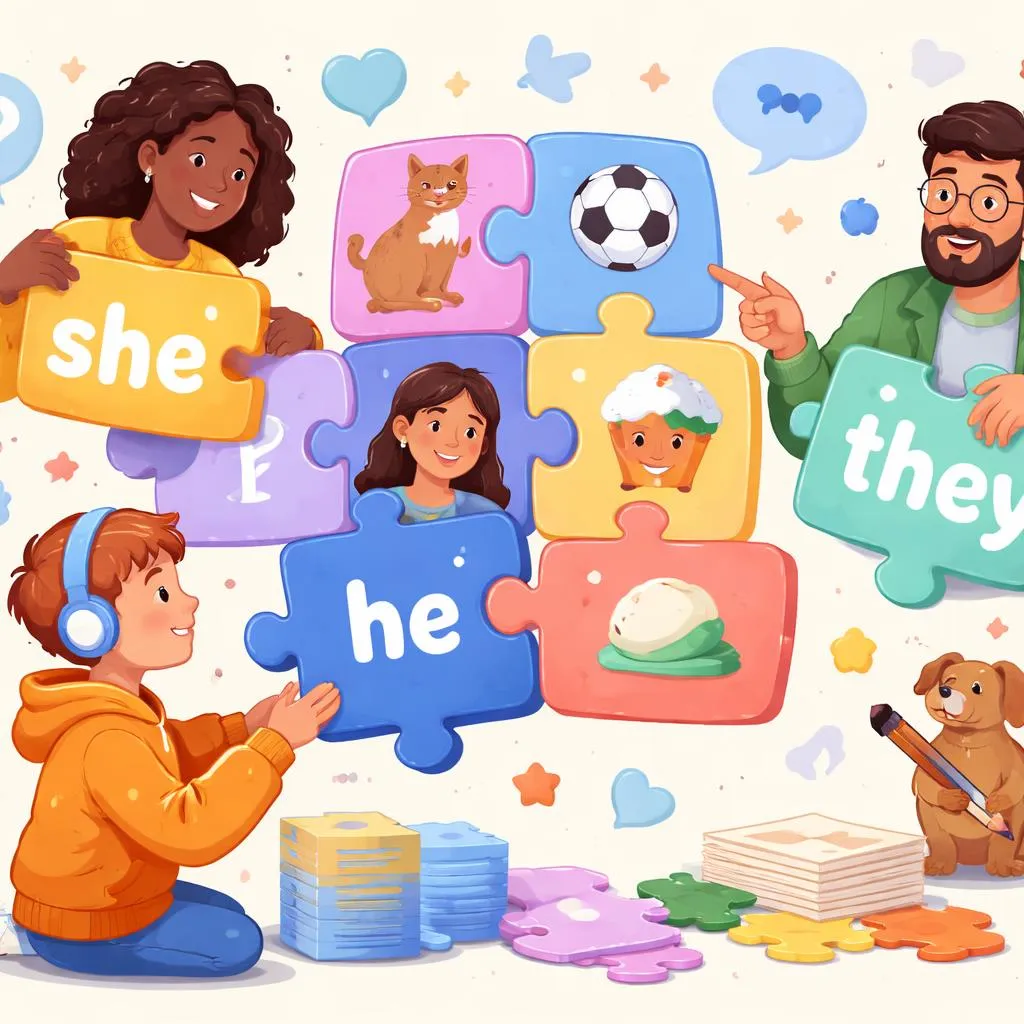

Hello, dedicated educators! Today we are exploring a fundamental part of English grammar. We will focus on "pronouns and examples." Pronouns are small words that do big jobs. They replace nouns in sentences. They make our speech smoother and clearer. Understanding pronouns is crucial for young learners. We will examine what pronouns are. We will explore different types and examples. We will share practical teaching strategies. We will provide engaging classroom activities. This guide will help you teach pronouns effectively. Let's begin this grammatical journey together.
What Are Pronouns?
Pronouns are words that take the place of nouns. Nouns name people, places, or things. Pronouns stand in for these nouns. They help us avoid repeating the same words over and over.
Imagine saying "Maria went to Maria's house because Maria was tired." That sounds strange. We use pronouns instead. "Maria went to her house because she was tired." Much better!
Pronouns make sentences shorter and clearer. They show who is doing what. They connect ideas smoothly. They are essential for natural communication.
There are several types of pronouns. Each type has a specific job. Understanding these types helps students use pronouns correctly.
Meaning and Explanation of Pronouns
Let us explore the meaning behind different pronoun types. Each serves a unique purpose in sentences.
Subject Pronouns: These replace the subject of the sentence. The subject is who or what does the action. I, you, he, she, it, we, they are subject pronouns. Maria sings becomes She sings.
Object Pronouns: These replace the object of the sentence. The object receives the action. Me, you, him, her, it, us, them are object pronouns. I see Maria becomes I see her.
Possessive Pronouns: These show ownership or belonging. Mine, yours, his, hers, its, ours, theirs are possessive pronouns. This book belongs to me becomes This book is mine.
Possessive Adjectives: These also show ownership but come before nouns. My, your, his, her, its, our, their are possessive adjectives. This is Maria's book becomes This is her book.
Reflexive Pronouns: These refer back to the subject. Myself, yourself, himself, herself, itself, ourselves, yourselves, themselves are reflexive pronouns. Maria looked at Maria becomes Maria looked at herself.
Demonstrative Pronouns: These point to specific things. This, that, these, those are demonstrative pronouns. I want this one. Look at those.
Interrogative Pronouns: These ask questions. Who, whom, whose, which, what are interrogative pronouns. Who is coming? Which do you want?
Indefinite Pronouns: These refer to nonspecific people or things. Someone, anyone, everyone, nobody, something, anything, everything, nothing are indefinite pronouns. Someone is at the door. I want nothing.
Categories or Lists of Pronouns with Examples
Let us explore each pronoun category with clear examples. This helps students see how they work.
Subject Pronouns:
I go to school. You are my friend. He plays soccer. She reads books. It is raining. We are happy. They are teachers.
Object Pronouns:
Call me later. I see you. Help him please. Give her the book. Put it down. Join us for lunch. Watch them play.
Possessive Pronouns:
The book is mine. The idea was yours. The jacket is his. The purse is hers. The color is its own. The house is ours. The toys are theirs.
Possessive Adjectives:
My name is Sam. Your shoes are blue. His hat is red. Her dress is pretty. Its tail is long. Our class is fun. Their car is new.
Reflexive Pronouns:
I made this myself. You can do it yourself. He hurt himself. She taught herself. The cat cleaned itself. We enjoyed ourselves. They built it themselves.
Demonstrative Pronouns:
This is my favorite. That is beautiful. These are fresh. Those belong to me.
Interrogative Pronouns:
Who is coming to the party? Whom did you see? Whose jacket is this? Which do you prefer? What happened next?
Indefinite Pronouns:
Someone left a note. Everyone is invited. Nobody knows the answer. Something smells good. Everything is ready. Nothing matters more.
Daily Life Examples with Pronouns
We can weave pronouns into everyday conversations. This makes learning natural and continuous.
During morning greetings, use pronouns. "Good morning, everyone. I hope you are all well. We will have a fun day together."
During classroom activities, model pronoun use. "Maria finished her work. She can help you with yours." "The boys are playing. They are having fun."
During story time, point out pronouns. "Look at the bear. He is eating honey." "The girls found a treasure. They were so excited!"
During transitions, give directions with pronouns. "Everyone line up. We are going outside. You will need your coats."
During sharing time, encourage pronoun use. "This is my toy. I brought it from home." "My grandmother gave it to me."
Printable Flashcards for Pronouns
Flashcards provide excellent visual support for grammar lessons. Here are some ideas for creating them.
Pronoun Type Cards: Create cards for each pronoun category. Subject, object, possessive, reflexive. Write the category name and show example pronouns.
Sentence Completion Cards: Create cards with sentences missing pronouns. "___ is my friend." (She, He) "Give the book to ___." (her, him) Students choose the correct pronoun.
Pronoun Matching Cards: Create cards with nouns on one set. Create matching cards with pronouns on another set. Maria matches she. The boys match they. The book matches it.
Picture Prompt Cards: Create cards with pictures showing actions. A girl reading. Students say, "She is reading." A group playing. Students say, "They are playing."
Pronoun Chart Cards: Create a large chart showing all pronoun types. Display it where students can see. Refer to it during lessons.
Learning Activities or Games for Pronouns
Games make grammar practice fun and memorable. Here are many engaging ideas.
Activity 1: Pronoun Substitution
Read a sentence aloud. "Maria ate an apple." Students replace the noun with a pronoun. "She ate it." This builds quick substitution skills.
Activity 2: Pronoun Hunt
Read a story aloud. Every time students hear a pronoun, they raise their hand. Name the pronoun they heard. This builds listening and identification.
Activity 3: Pronoun Bingo
Create bingo cards with pronouns in each square. Call out sentences with missing pronouns. "___ is my best friend." Students cover the correct pronoun.
Activity 4: Pronoun Charades
Act out a sentence without speaking. For "He is running," run in place. Students guess the pronoun and action. "He is running!"
Activity 5: Pronoun Memory Match
Create pairs of cards. One card has a noun. The matching card has the correct pronoun. Maria matches she. The boys match they. Students find matches.
Activity 6: Pronoun Swap Game
Write sentences on the board without pronouns. "Maria gave the book to John." Students rewrite using pronouns. "She gave it to him."
Activity 7: Pronoun Circle Pass
Sit in a circle. Start with a sentence. "I like pizza." Pass a ball to the next student. They change the subject. "She likes pizza." Next changes again. "He likes pizza."
Activity 8: Pronoun Error Correction
Write sentences with pronoun errors on the board. "Him went to the store." "Me like ice cream." Students find and correct errors.
Activity 9: Pronoun Story Creation
Start a story using nouns. "Once upon a time, a girl named Lucy lived in a small house. Lucy had a cat named Whiskers." Students continue the story using pronouns.
Activity 10: Pronoun Interview
Students interview each other. "What is your favorite color?" They record answers using pronouns. "She said her favorite color is blue."
Activity 11: Pronoun Sorting
Create cards with different pronouns. Students sort them into categories. Subject pronouns together. Object pronouns together. Possessive pronouns together.
Activity 12: Pronoun Pictionary
Draw pictures that require pronoun descriptions. A boy running. Students say, "He is running." A group singing. Students say, "They are singing."
Activity 13: Pronoun Fill-in-the-Blank Race
Write sentences with blanks on the board. Divide into teams. Students race to fill in correct pronouns. First correct answer wins a point.
Activity 14: Pronoun Song Creation
Create a simple song about pronouns using a familiar tune. "I, you, he, she, it, we, they. These are subject pronouns we say."
Activity 15: Pronoun Scavenger Hunt
Hide pronoun cards around the room. Students find them and use each in a sentence. This builds reading and sentence formation.
Activity 16: Pronoun Board Game
Create a simple board game with squares containing nouns or sentence starters. Students roll a dice and move. They must replace the noun with a pronoun or complete the sentence with a pronoun.
Activity 17: Pronoun Flashcards Drill
Hold up pronoun flashcards. Students say a sentence using that pronoun. "I" student says "I like to play." "She" student says "She is reading."
Activity 18: Pronoun Conversation Practice
Give pairs of students a simple dialogue with missing pronouns. They fill in the blanks and read the dialogue aloud. This builds conversational skills.
Activity 19: Pronoun Quiz Show
Divide into teams. Ask questions about pronouns. "What pronoun replaces Maria?" "What is the object pronoun for we?" Teams buzz in to answer.
Activity 20: Pronoun Art Project
Create a pronoun poster. Each student contributes a sentence with a pronoun and an illustration. "I am happy" with a self-portrait. "She sings" with a drawing.
We have explored pronouns and examples in depth. These small words carry enormous meaning. They make sentences smoother and clearer. They help us avoid repetition. They show who does what and what belongs to whom. We looked at what pronouns are. We explored different types with examples. We found them in daily conversations. We created printable flashcards for practice. We shared engaging games and activities. This integrated approach makes learning natural and effective. Use these strategies in your classroom. Adapt them to your students' needs. Watch as your learners gain confidence in using pronouns correctly. Their sentences will become more natural and fluent. Their communication skills will grow stronger with each pronoun they master.