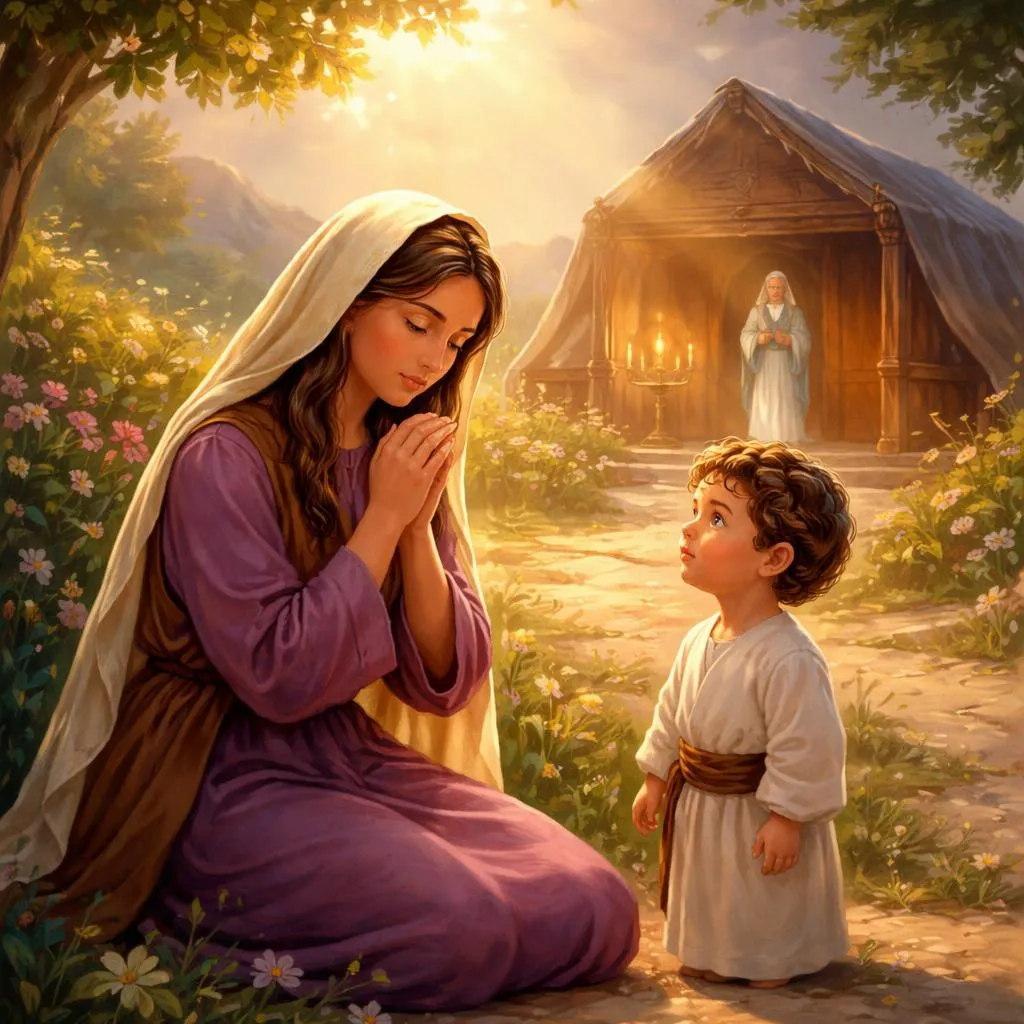

A woman weeps at the temple. Her lips move, but no sound comes out. The priest thinks she has drunk too much wine. But Hannah prays from her deepest heart. She wants one thing more than anything else. She wants a child. Children's Bible stories Hannah and Samuel tell us what happens when God answers that desperate prayer.
This story touches something deep in all of us. It speaks of longing and waiting. It shows that God hears even the prayers we cannot put into words. Let us walk together into this ancient temple and meet a mother whose faith changed history.
<h2>What is the story?</h2> Children's Bible stories Hannah and Samuel begin with a family problem. A man named Elkanah has two wives. One wife, Peninnah, has many children. The other wife, Hannah, has none. Peninnah mocks Hannah year after year. Hannah feels heartbroken and ashamed.Every year the family travels to the temple at Shiloh. They go to worship and offer sacrifices. One year, Hannah feels especially sad. She goes to the temple alone. She prays with all her heart. She cries and makes a promise to God.
O Lord Almighty, she prays, if you will look upon my sorrow and give me a son, I will give him back to you. He will serve you all his life. No razor will ever touch his head.
The priest Eli watches her. He sees her lips moving but hears nothing. He thinks she is drunk. How long will you keep on drinking? he asks. Get rid of your wine.
Hannah answers gently. No, my lord, she says. I am a woman deeply troubled. I have not been drinking wine. I have been pouring out my soul to the Lord.
Eli understands and blesses her. Go in peace, he says. May the God of Israel grant what you have asked.
Hannah goes home with hope in her heart. Soon she becomes pregnant and gives birth to a son. She names him Samuel, which means God has heard.
<h2>The message of the story</h2> Children's Bible stories Hannah and Samuel carry powerful messages about prayer and keeping promises. Hannah prayed with complete honesty. She held nothing back from God. She poured out her soul like water. This teaches children that they can tell God everything, even their deepest sadness.The story also shows that God hears. Hannah waited years for a child. She faced mockery and pain. But she kept praying. God did answer, in his own time. Children learn that waiting does not mean God has forgotten.
Hannah kept her promise too. When Samuel grew old enough, she took him to the temple. She gave him back to God just as she promised. This must have been so hard. But she did it anyway. Children learn that promises matter, especially promises made to God.
Samuel grew up to become one of Israel's greatest prophets. He listened to God and led his people. All because one mother prayed and kept her word.
We can ask our children, What do you pray for? How does it feel when you have to wait? These questions help them connect to Hannah's experience.
<h2>Vocabulary learning</h2> Children's Bible stories Hannah and Samuel introduce wonderful words that help children understand this ancient world.The word vow appears in this story. A vow is a serious promise, especially one made to God. Hannah made a vow that if God gave her a son, she would give him back for God's service.
Children learn about the temple, which was God's house where people came to worship. They meet the priest, who led worship and spoke to God for the people. They hear about prophets, who shared God's messages with everyone.
The name Samuel itself teaches something. It sounds like the Hebrew words for God has heard. Every time someone said his name, they remembered that God hears prayer.
We also meet words like mock and taunt. Peninnah did these things to Hannah. These words name unkind behaviors. We can talk about how words can hurt and how we should treat others instead.
After reading, we can use these words. When your child makes a serious promise, you might say, That sounds like a vow. When you listen carefully, you might say, You are hearing just like God heard Hannah.
<h2>Phonics points</h2> The names in children's Bible stories Hannah and Samuel give us lovely phonics practice. Each name has sounds children can explore.Hannah has two syllables. Han-nah. Both start with H, which requires breathing out. Hhh-hannah. The first H is at the beginning. The second H is in the middle. Practice saying Hannah with a little breath for each H.
Samuel has three syllables. Sam-u-el. The S at the beginning is a hissing sound. Sss-samuel. The M in the middle requires closing the lips. Mm-samuel. The L at the end requires lifting the tongue. Lll-samuel.
Eli has two syllables but only three letters. E-li. The E is long, like in eat. The L is at the end of the second syllable. Children love short names they can read easily.
We can play with these sounds by finding other names with similar patterns. Hannah and Sarah both end with H sounds. Samuel and Daniel both end with el, which means God in Hebrew.
<h2>Grammar patterns</h2> Children's Bible stories Hannah and Samuel use language patterns that help children understand how sentences work. The story structure builds naturally from problem to prayer to answer.We see wonderful examples of direct speech. Hannah said, I am a woman deeply troubled. Eli said, Go in peace. These direct quotes help children hear how people talked long ago.
The story uses past tense throughout. Hannah prayed. God answered. Samuel grew. This consistent tense helps children follow the timeline.
We also see cause and effect patterns. Because Hannah prayed, God gave her a son. Because she kept her vow, Samuel served at the temple. These cause-effect relationships help children understand why things happened.
After reading, we can notice these patterns. The story said Hannah was sad because she had no children. What happened because Hannah prayed? God gave her Samuel. This builds comprehension of story logic.
<h2>Learning activities</h2> Children's Bible stories Hannah and Samuel inspire gentle activities that help children connect with the story's themes.Create a prayer journal together. Use a simple notebook. Your child can draw pictures of things they want to pray about. They can look back later and see how God answered, just like Hannah did.
Make a promise bracelet using string or yarn. Tie a knot for each promise you want to make or remember. Hannah kept her promise to God. What promises do we want to keep?
Visit a quiet place together like a library or a garden. Sit silently for a few minutes like Hannah praying. Talk afterward about what it felt like to be quiet and still. This connects to Hannah pouring out her soul in the temple.
Draw a timeline of Samuel's life. Start with Hannah praying. Show his birth, his time at the temple, and his growth into a prophet. This builds understanding of how stories unfold over time.
<h2>Printable materials</h2> Many wonderful printable materials exist for children's Bible stories Hannah and Samuel. These enrich your family reading and reflection time.Look for coloring pages showing Hannah praying at the temple. Children can color Eli watching her and the temple around them. This helps them picture the scene.
Find printable finger puppets of Hannah, Samuel, and Eli. Cut them out and act out the story together. Your child can be Hannah pouring out her heart. You can be Eli giving the blessing.
Some websites offer printable prayer cards with simple prayers based on Hannah's example. Dear God, you hear me when I pray. Help me trust your timing. These give children words for their own prayers.
You might also find printable worksheets with simple questions about the story. Who was sad? What did Hannah promise? How did God answer? These build comprehension gently.
<h2>Educational games</h2> Games based on Hannah and Samuel help children internalize the story through play. These games feel gentle and meaningful.Play a listening game called Can You Hear Me? One person whispers something. The other tries to hear and repeat it. Talk about how God hears us even when we whisper or pray silently like Hannah.
Create a promise matching game. On cards, write promises people make. On other cards, write whether they kept them. Hannah kept her promise. Can you match promises to outcomes?
Play a memory game with story elements. Place pictures of Hannah praying, baby Samuel, Eli the priest, and Samuel as a boy. Turn them over and find matches. When you find a match, tell something about that part of the story.
For younger children, play a simple naming game. Hold up pictures of Hannah, Samuel, and Eli. Say the names together. Can your child point to Hannah when you say her name? Can they say the name when you point?
These games show that Bible stories become part of us through repetition and play. Children absorb the lessons while having fun together.
Children's Bible stories Hannah and Samuel have touched hearts for thousands of years. A mother's desperate prayer. God's faithful answer. A child given back in gratitude. These elements speak to something universal.
Hannah teaches us about honest prayer. She did not use fancy words. She did not pretend to be fine. She told God exactly how she felt. Children need to know they can do the same. God can handle their honest feelings.
Samuel teaches us about listening. From his first night in the temple, he learned to say, Speak, Lord, your servant is listening. This remains the heart of faith. Not talking at God, but listening for God.
When we share this story with our children, we give them models for their own spiritual lives. They learn to pray honestly. They learn to wait trustingly. They learn to keep promises. They learn that God hears, God answers, and God has plans for every child.
So find a children's Bible with beautiful pictures of Hannah and Samuel. Settle into a quiet spot. Let the ancient story unfold. A woman praying silently. A priest who misunderstands. A baby born by miracle. A child serving God. These images will stay in your child's heart, just as Hannah's prayer stayed in God's heart until the answer came.