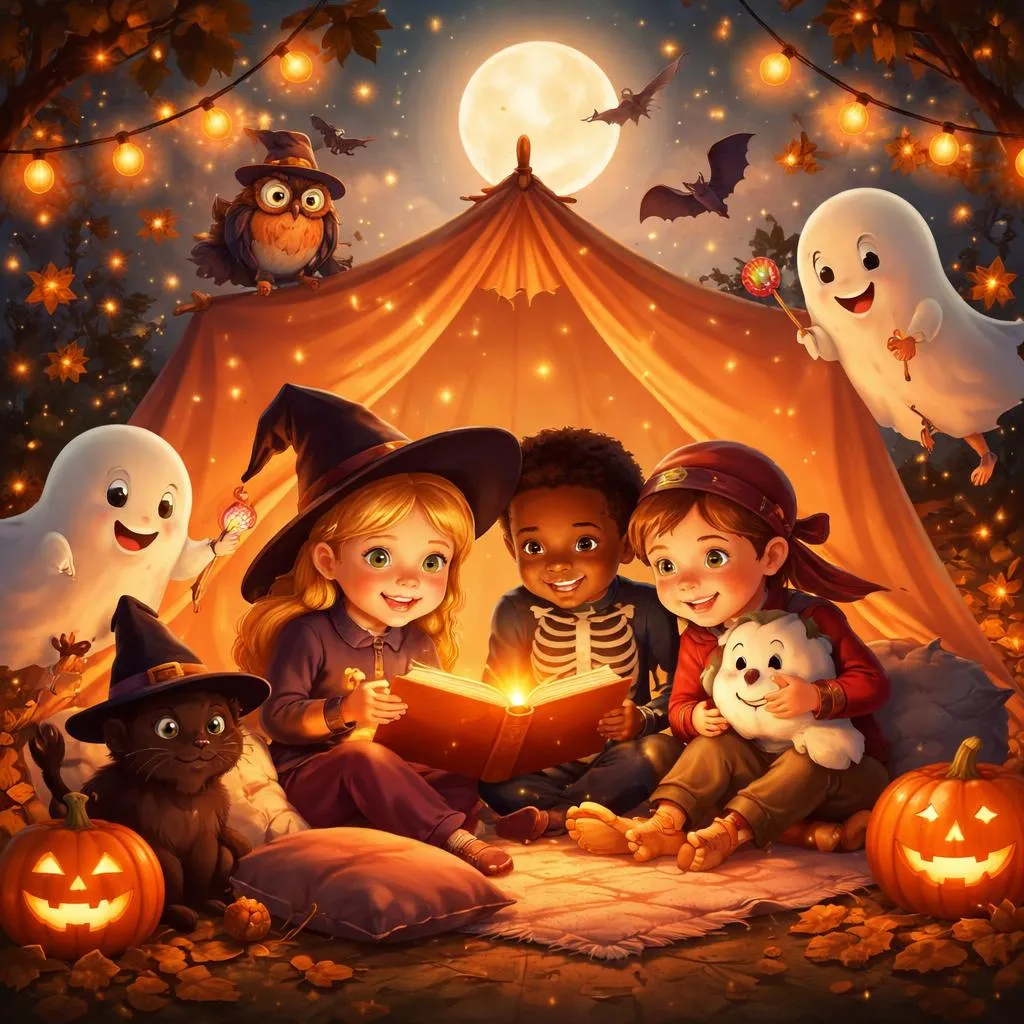

Pumpkins glow on porches. Children dress as heroes and creatures. The night fills with magic and candy. Children's Halloween stories capture this special feeling. They offer just enough spookiness to thrill but not enough to scare. They turn a night of costumes and candy into stories children will remember forever.
Let us explore together the best Halloween stories and how to share them with your family.
<h2>What is the story?</h2> Children's Halloween stories come in many forms. Some are about friendly monsters. Some are about costume adventures. Some are about the magic of the night itself.One beloved story is "Room on the Broom" by Julia Donaldson. A kind witch flies through the sky on her broom. She drops her hat, then her bow, then her wand. Animals find and return them. Each asks for a ride on the broom. The witch says yes to everyone.
The broom gets crowded. It snaps in half. A dragon appears and wants to eat the witch. The animals work together. They make a scary monster sound. The dragon flees. The witch uses a spell to make a new broom with seats for everyone.
Another favorite is "The Little Old Lady Who Was Not Afraid of Anything" by Linda Williams. A little old lady walks through the forest. She hears sounds. Two shoes go CLOMP, CLOMP. Pants go WIGGLE, WIGGLE. A shirt goes SHAKE, SHAKE. Gloves go CLAP, CLAP. A hat goes NOD, NOD. A pumpkin head goes BOO, BOO.
She runs home and locks the door. The clothes and pumpkin gather outside. She tells them she is not afraid. Then she has an idea. She tells them to follow her into the garden. They become a scarecrow that scares crows all year.
"Creepy Carrots" by Aaron Reynolds tells of Jasper Rabbit who loves carrots. He eats them everywhere. Then the carrots start following him. He sees them everywhere. He is scared. He builds a fence around the carrot patch. The carrots cannot get out. Jasper feels safe. But the carrots smile. They wanted him to build the fence. They are safe from him now.
For older children, "The Witches" by Roald Dahl tells of a boy who discovers real witches. They hate children. They plan to turn them all into mice. The boy and his grandmother fight back. It is scary but also funny and clever.
<h2>The message of the story</h2> Children's Halloween stories carry messages about courage, kindness, and cleverness. Room on the Broom teaches that helping others brings help when you need it. The witch shares her broom. The animals save her from the dragon.The Little Old Lady teaches that we can face what scares us. She does not run forever. She faces the clothes and gives them a purpose. Fear becomes fun.
Creepy Carrots teaches that things are not always as they seem. Jasper thinks the carrots are chasing him. They actually want him to build their fence. The story is funny and surprising.
Halloween stories also teach about community. People come together on Halloween. Neighbors give candy. Families walk together. Stories show this coming together.
We can ask our children, What would you put on your broom? How would you help the little old lady? Why do you think the carrots wanted Jasper to build a fence?
<h2>Vocabulary learning</h2> Children's Halloween stories introduce fun holiday words.Witch means a woman with magic powers. The witch in Room on the Broom is kind and friendly.
Broom is what witches fly on. Also what you sweep with.
Dragon is a large, fire-breathing creature. The dragon in the story is scary but easily tricked.
Scarecrow is a figure dressed in old clothes to scare crows. The clothes and pumpkin become a scarecrow.
Costume is what children wear on Halloween. Stories often feature costume adventures.
Pumpkin is the orange vegetable carved into jack-o-lanterns. The pumpkin head in the story is friendly.
After reading, we can use these words naturally. When you see a jack-o-lantern, you might say, That pumpkin looks like the one in the story. When you dress up, you might say, You have a wonderful costume.
<h2>Phonics points</h2> The words in children's Halloween stories give us phonics practice.Witch has one syllable. W-i-tch. The W rounds lips. The I is short. The TCH makes a ch sound. Witch. Like which but different spelling.
Broom has one syllable. Br-oo-m. The BR blends. The OO makes an OO sound. The M closes lips. Broom.
Pumpkin has two syllables. Pump-kin. The P pops. The U is short. The M closes lips. The P again. The K is hard. The I is short. The N is nasal. Pump-kin.
Scarecrow has two syllables. Scare-crow. The SC makes a SK sound. The ARE makes an air sound. The C is hard. The ROW makes a long O sound. Scare-crow.
We can play with these sounds by finding other words with the same patterns. Witch and window both start with Wi. Broom and broomstick share broom. Pumpkin and pump share Pump.
<h2>Grammar patterns</h2> Children's Halloween stories use language patterns that create rhythm and fun.Repetition builds pattern. CLOMP, CLOMP. WIGGLE, WIGGLE. SHAKE, SHAKE. Children love joining in.
Sound words bring the story alive. Clomp, wiggle, shake, clap, nod, boo. Words that sound like what they mean.
Rhyming adds music to the story. Room on the Broom rhymes throughout. Children hear the patterns and predict the rhymes.
Questions create participation. What will happen next? Who is that? Will the witch be okay? Children ask and answer as they listen.
After reading, we can notice these patterns. The story said CLOMP, CLOMP many times. Why? Because the shoes kept walking. What sound do your shoes make?
<h2>Learning activities</h2> Children's Halloween stories inspire wonderful hands-on activities.Make a broom like the witch's. Use a stick and straw or yarn. Decorate it. Talk about who you would give rides to on your broom.
Create a scarecrow like in the story. Stuff old clothes with newspaper. Add a pumpkin head or a bag head. Put it in your garden or yard.
Carve or paint pumpkins together. Make faces like the pumpkin head. Talk about how the pumpkin in the story helped scare crows.
Dress up as characters from the stories. Witch, dragon, shoes, pants, shirt, gloves, hat, pumpkin. Act out the stories together.
<h2>Printable materials</h2> Many wonderful printable materials exist for children's Halloween stories.Look for coloring pages featuring the witch and her animals, the little old lady and the clothes, Jasper and the carrots, and friendly monsters.
Find printable masks of story characters. Witch mask, dragon mask, pumpkin head mask. Wear them while you read or act out stories.
Some websites offer printable story sequencing cards for Halloween stories. Put Room on the Broom in order. Witch loses things. Animals help. Dragon appears. Animals save witch. New broom.
You might also find printable Halloween bingo with characters and objects from favorite stories.
<h2>Educational games</h2> Games based on Halloween stories make learning playful.Play Room on the Broom memory. Put out pictures of the witch's items. Hat, bow, wand. Take one away. What is missing?
Create a little old lady listening game. Make sounds like the story. Clomp, wiggle, shake, clap, nod, boo. Your child guesses what makes each sound.
Play Creepy Carrots hide and seek. Hide carrot pictures around the room. Your child finds them. Talk about how Jasper felt when carrots followed him.
For younger children, play a simple matching game matching characters to their sounds. Shoes to clomp. Pants to wiggle. Shirt to shake. Gloves to clap. Hat to nod. Pumpkin to boo.
These games show that Halloween stories offer endless opportunities for learning through play. Children absorb the fun while having fun together.
<h2>Making Halloween magical</h2> Children's Halloween stories help make the holiday magical. They give children stories to connect to the costumes and candy. They provide characters to dress as and adventures to imagine.Reading Halloween stories also builds traditions. Every October, families pull out the same books. They read them together. They remember reading them last year. They look forward to reading them next year.
Stories also help children understand the holiday. Why do we dress up? Why do we carve pumpkins? Why do we say trick or treat? Stories answer these questions in gentle ways.
Most of all, Halloween stories create moments. A child snuggled close, listening to a witch's adventure. A family laughing at a silly pumpkin story. A little one feeling brave after reading about the little old lady who was not afraid.
<h2>What we learn from Halloween stories</h2> Halloween stories teach us that things that seem scary can be fun. The clothes that chased the little old lady became a scarecrow. The dragon that wanted to eat the witch got scared away. The carrots that followed Jasper wanted his help.Halloween stories also teach us about community. The witch needed her animal friends. The little old lady found a use for the clothes. Jasper and the carrots worked out their problem. We need each other.
Most of all, Halloween stories teach us that imagination makes everything better. A night of costumes and candy becomes magical. Ordinary things become stories. And stories become memories.
When we share children's Halloween stories with our children, we give them a gift. We give them words for the magic they feel on this special night. We give them characters to love and adventures to imagine. We give them traditions that will last a lifetime.
So find your favorite Halloween books. Gather some blankets and a flashlight. Turn down the lights just a little. Read about witches and dragons, shoes and scarecrows, carrots and costumes. Let the magic of the stories blend with the magic of the night. Happy Halloween reading.