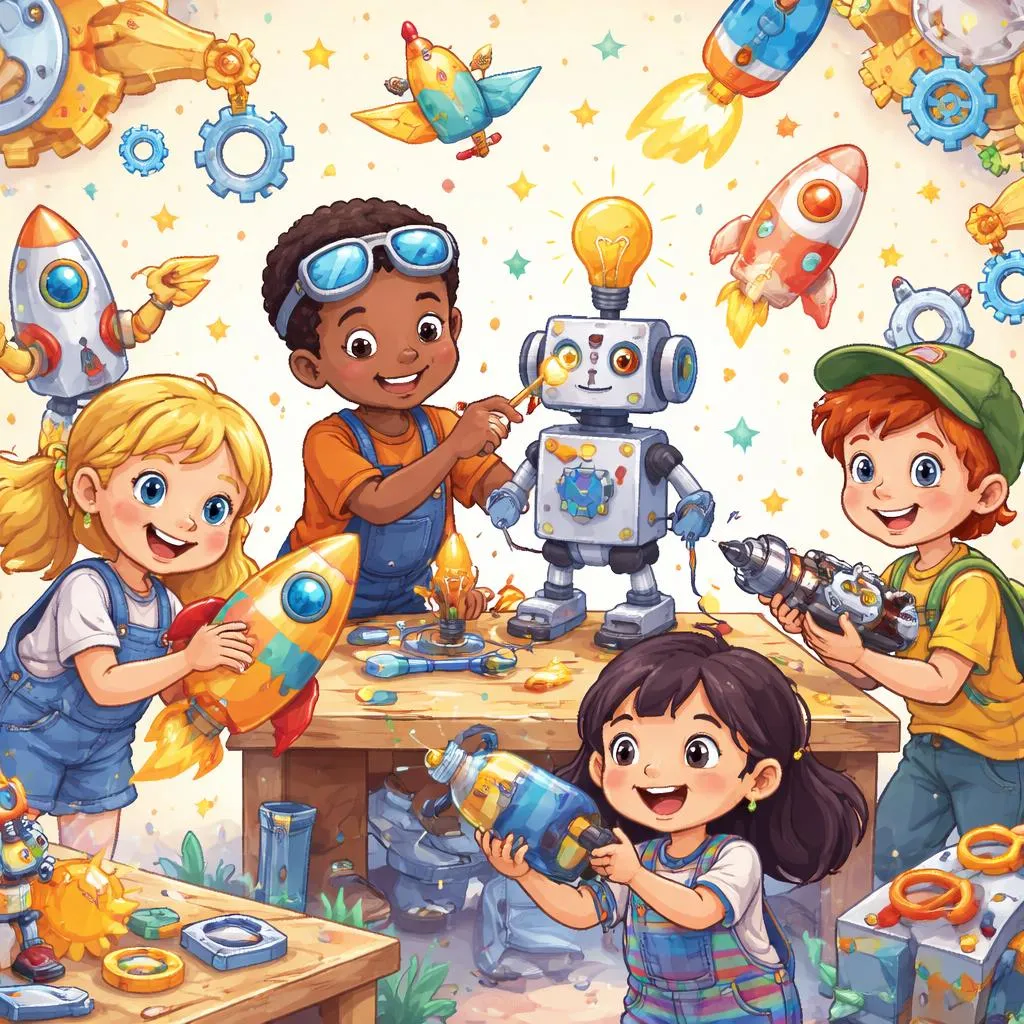

Every child builds things. Every child imagines new ideas. Sometimes a child makes something completely new. That act of creation has a name. The word family starts with “invent.” From this root come three more words. “Invention” names the new thing itself. “Inventor” names the person who makes it. “Inventive” describes the kind of thinking that leads to new things. These four words celebrate creativity. They also give your child tools to talk about their own ideas. Let us explore this inspiring family.
What Does “Same Word, Different Forms” Mean? One action leads to many word shapes. “Invent” means to create something for the first time. “Invention” is the result of inventing. “Inventor” is the person who invents. “Inventive” describes a mind full of new ideas. Your child sees this pattern in other words. “Create” becomes “creation” and “creator.” “Build” becomes “building” and “builder.” “Invent” follows the same logic. Learn the root. Then add endings. Each ending gives a new way to use the word.
Personal Pronouns Change Their Form Pronouns also shift shape. “I” becomes “me.” “He” becomes “him.” “We” becomes “us.” This shows that English changes words for different grammar positions. Our word family “invent” changes for different grammar positions too. But it also changes the meaning. A verb shows action. A noun shows a thing or person. An adjective shows a quality. Learning these shifts helps your child use words precisely.
From Verb to Noun to Adjective – One Family, Many Words “Invent” is the verb. A person invents a new tool. “Invention” is the noun. The tool itself is an invention. “Inventor” is also a noun. It names the person behind the tool. “Inventive” is the adjective. An inventive mind thinks of many new tools. This family gives your child three different nouns from one verb. One noun for the action. One noun for the result. One noun for the person. Plus one adjective for the thinking style. That is rich learning from one small root.
One Root, Many Roles – How Words Grow from Actions to Qualities Let us follow a real example. A child wants to build a better paper airplane. The child decides to invent a new design. The new fold becomes the invention. The child feels like an inventor. The child uses inventive thinking. See how “invent” runs through all four sentences. Each form adds a new layer. Your child can say “I will invent something.” “Look at my invention.” “I am the inventor.” “That was inventive.” One root gives your child a whole story.
Same Meaning, Different Jobs – Is It a Verb or a Noun? How does your child know the job? Look at the sentence position. After “can,” “will,” or “want to,” use the verb. Example: “She wants to invent a new game.” After “an,” “the,” or “her,” use the noun. Example: “Her invention works well.” For a person noun, use “a” or “the.” Example: “The inventor received an award.” Before a noun, use the adjective. Example: “That is an inventive solution.” Endings also give clues. “-vent” signals the verb base. “-ion” signals a thing noun. “-or” signals a person noun. “-ive” signals an adjective.
Adjectives and Adverbs – When Do We Add -ly? From “inventive” we can make an adverb. Add “-ly” to make “inventively.” Example: “The child inventively solved the puzzle.” This word is advanced. Young learners do not need it right away. But show the rule briefly. Many adjectives become adverbs with “-ly.” “Careful” becomes “carefully.” “Quick” becomes “quickly.” “Inventive” becomes “inventively.” Your child will meet “-ly” words every day. Knowing the rule builds writing power later.
Watch Out for Tricky Spelling Changes (Double Letters, y to i, and More) “Invent” has no double letters. Good news. “Invention” adds “-ion.” Keep the “t.” No change. “Inventor” adds “-or.” Keep the “t.” No change. “Inventive” adds “-ive.” Keep the “t.” No change. This family is very stable. No silent “e” to drop. No “y” to change. No double letters to remember. However, watch the similar word “inventory.” That means a list of items. It looks like “invent” but means something different. Teach your child to see the whole word. Context will help.
Let’s Practice – Can You Choose the Right Form? Try these simple sentences at home.
Can you (invent / invention) a new kind of snack? (Answer: invent)
The wheel was a great (inventor / invention). (Answer: invention)
Who is your favorite (inventive / inventor)? (Answer: inventor)
She has an (invent / inventive) way of drawing. (Answer: inventive)
They want to (invention / invent) a faster boat. (Answer: invent)
Make your own sentences from daily life. Say “Let us invent a new handshake.” Say “This drawing is your invention.” Say “You are the inventor of this game.” Say “That was an inventive way to fix the toy.”
Tips for Parents – Help Your Child Learn Word Families in a Fun Way Create a home invention box. Fill it with paper, tape, string, and small containers. Once a week, say “Let us invent something.” Use the word “invent” as you start. Call the finished object “our invention.” Call your child “the inventor” of that object. Call the process “inventive thinking.” This simple activity teaches the whole word family. It also builds problem-solving skills.
Read books about real inventors. Many children’s books tell stories of people who invented light bulbs, airplanes, and bandages. Pause during reading. Ask “What did this person invent?” Ask “What is the name of that invention?” Ask “Who was the inventor?” Ask “Was that an inventive idea?” These questions connect vocabulary to inspiring stories.
Play the inventive game. Show your child a common object. Ask “What could you invent to make this better?” Use the words. Say “That is an inventive thought.” Say “You would be a great inventor.” Say “What would you call your invention?” This game stretches imagination and vocabulary at the same time.
Celebrate small inventions at home. When your child finds a new way to stack blocks, call it an invention. When your child creates a new recipe for play dough, call them an inventor. When your child solves a problem in a new way, call the solution inventive. This positive language builds confidence. Your child learns that anyone can invent. You do not need a lab or a degree. You just need a curious mind.
Keep a family invention journal. Every month, write down one thing your family invented together. A new bedtime routine. A new way to organize toys. A new game for car rides. Write “We invented ______.” Write “Our invention helps us ______.” Write “The inventor was ______.” Write “That was inventive because ______.” Over time, this journal becomes a record of your family’s creativity.
Do not correct mistakes harshly. If your child says “I am an invention,” smile. Say “Yes, you invented something today. You are the inventor.” Or say “Your idea was very inventive.” No need to explain that “invention” is a thing and “inventor” is a person. Just model the correct form. Your child will catch on naturally.
Connect invention to everyday fixes. When a drawer sticks, say “We need to invent a solution.” When a pencil breaks, say “Let us invent a sharper holder.” When a game gets boring, say “Time to invent a new rule.” These small moments teach that invention is not just for scientists. It is for everyone. Every day. Every problem.
Now you have everything you need. Invent small things together. Celebrate every invention. Honor your child as an inventor. Nurture inventive thinking. This word family does more than teach English. It teaches creativity. It teaches confidence. It teaches that every problem holds a new idea. Keep inventing together. One word family at a time.