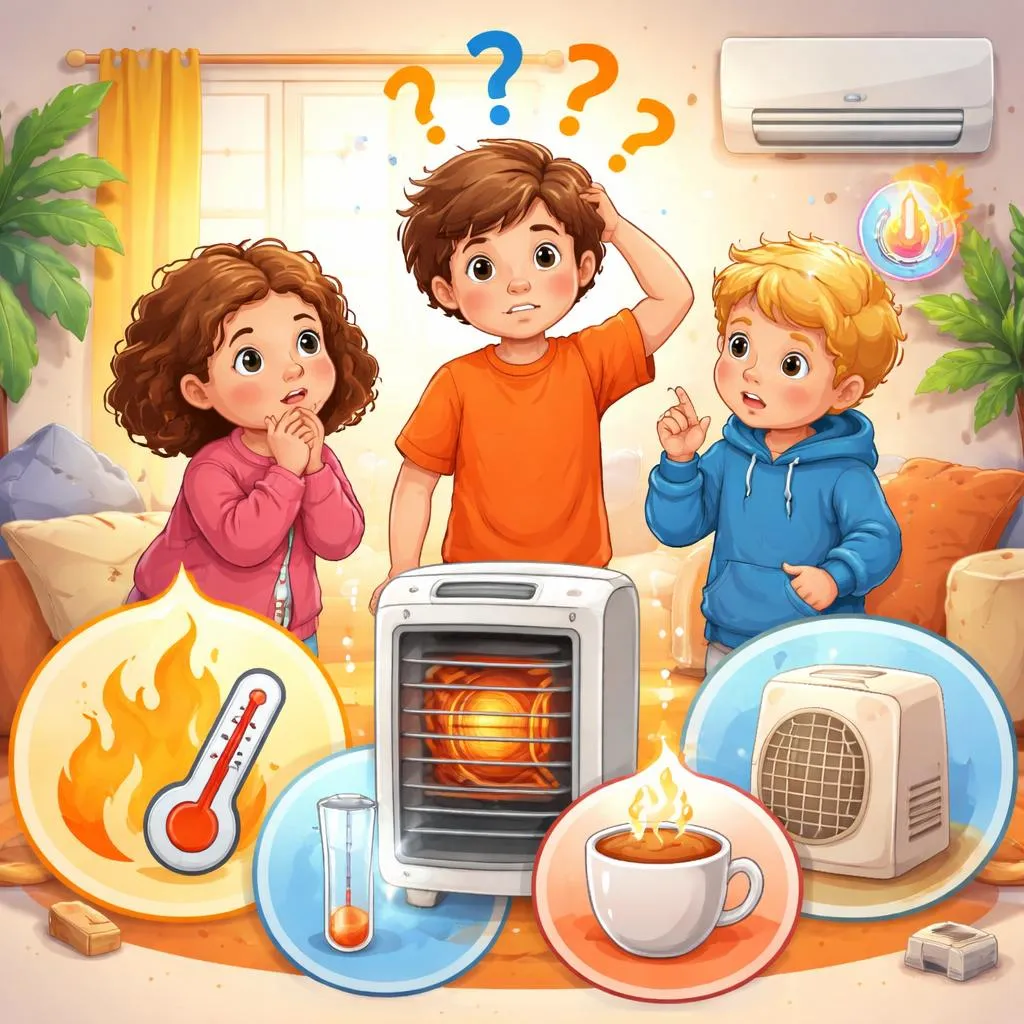

Life’s Little Embarrassment
Meet Sam the squirrel. He loves cozy winter days. One morning, his family sat for breakfast. The room was cold. Sam wanted to say the heater was on. He mixed up words. He shouted, “The heat is heating!” Everyone laughed. They thought the food was cooking. Sam felt silly. This happens to many kids. Today, we learn the word family. Think of them as tools in a box. Each has a special job. We call them heat, heater, heating, and heated. They look alike but work differently. By the end, you will never mix them again.
Core Comparison Zone: Deep Analysis
Sam’s day continues. We follow him everywhere. First, meet the members.
Heat is the energy guy. He makes things warm. We call him “Warmth Maker”. Heater is the machine. It gives out heat. We call it “Cozy Machine”. Heating is the process. It shows warming up. We call it “Action Flow”. Heated is the past result. It shows something got warm. We call it “Past Warmer”.
Now, let’s explore five ways they differ.
Time Dimension
Clocks tick. Calendars flip. Words show when things happen.
At home, Sam feels heat from soup. The heating system runs now. The heater started early. The room heated quickly this morning.
At the playground, Sam feels heat from the sun. The heating pavement warms feet. The heater in the shed works. The metal slide heated by noon.
At school, Sam feels heat from the radiator. The heating classroom stays warm. The heater hums softly. The lab beaker heated safely.
In nature, Sam feels heat from a campfire. The heating rocks glow. The heater in the cabin fails. The ground heated under sunlight.
Each word shows time. Heat is general. Heating is ongoing. Heater is a thing. Heated is finished.
Job Dimension
Words have jobs in sentences. Some act. Some describe.
At home, heat acts. “Feel the heat.” Heater is a thing. “The heater runs.” Heating describes. “The heating soup steams.” Heated describes. “The heated towel warms.”
At the playground, heat acts. “Avoid the heat.” Heater is a thing. “The heater broke.” Heating describes. “The heating sand burns.” Heated describes. “The heated swing seat cools.”
At school, heat acts. “Measure the heat.” Heater is a thing. “The heater clicks.” Heating describes. “The heating lab is safe.” Heated describes. “The heated wire glows.”
In nature, heat acts. “Seek the heat.” Heater is a thing. “No heater here.” Heating describes. “The heating earth warms.” Heated describes. “The heated stones crack.”
Warmth Maker acts alone. Cozy Machine names objects. Action Flow describes processes. Past Warmer describes results.
Partners Dimension
Some words need friends. Others stand alone.
At home, heat stands alone. “Heat rises.” Heater needs “the”. “The heater works.” Heating needs “is” or “the”. “The heating is on.” Heated needs “was” or “got”. “It got heated fast.”
At the playground, heat stands alone. “Heat hurts skin.” Heater needs “a”. “A heater helps.” Heating needs “is”. “Sand is heating up.” Heated needs “has”. “It has heated already.”
At school, heat stands alone. “Heat expands metal.” Heater needs “the”. “The heater buzzes.” Heating needs “the”. “The heating system fails.” Heated needs “was”. “The tube was heated.”
In nature, heat stands alone. “Heat melts ice.” Heater needs “no”. “No heater outside.” Heating needs “is”. “Rock is heating slowly.” Heated needs “got”. “Stone got heated.”
Warmth Maker is independent. Cozy Machine likes articles. Action Flow likes helpers. Past Warmer likes past words.
Nuances Dimension
Sometimes choices matter. Small differences change meaning.
At home, say “Turn on the heat” for energy. Say “Use the heater” for the machine. Say “Check the heating” for the system. Say “Touch the heated pan” for past warmth.
At the playground, “Avoid the heat” means hot weather. “Find a heater” means a device. “Feel the heating slide” means it is warming. “Sit on the heated bench” means it warmed before.
At school, “Study heat” means science. “Fix the heater” means repair. “Control the heating” means adjust. “Handle the heated rod” means it is hot now.
In nature, “Sense heat” means feel warmth. “Carry no heater” means no tool. “Observe heating lava” means flowing. “Walk on heated soil” means baked.
Use Warmth Maker for energy. Use Cozy Machine for devices. Use Action Flow for processes. Use Past Warmer for results.
The Trap
This part is long. Many kids fall into traps. We fix them together.
Trap one: Using “heated” as a noun. Wrong: “The heated is high today.” Right: “The heat is high today.” Why? “Heated” describes something. It is not a thing. Only “heat” names the energy. Memory tip: “Heated describes, heat names.”
Trap two: Mixing “heating” and “heater”. Wrong: “Turn on the heating.” Right: “Turn on the heater.” Why? “Heating” is the process or system. “Heater” is the machine. If you switch a device, use “heater”. If you mean the whole system, use “heating”. Memory tip: “Add ‘er’ for the box, drop it for the system.”
Trap three: Using “heat” as an adjective. Wrong: “The heat water boils.” Right: “The heated water boils.” Why? “Heat” is a noun or verb. To describe water, use “heated”. Memory tip: “Need ‘ed’ to describe.”
Trap four: Wrong tense with “heated”. Wrong: “The pan heats yesterday.” Right: “The pan heated yesterday.” Why? “Heats” is present. “Heated” is past. Match time words. Memory tip: “Yesterday needs ‘ed’, today needs ‘s’.”
Trap five: Confusing all four. Example: “The heater heating heated heat.” Nonsense. Fix: “The heater provides heat while heating the room.” Clear now. Always ask: Is it a thing? An action? A process? A result? Memory tip: “Thing, action, process, result—pick one.”
These traps trip many. Practice spotting them. Soon you will dodge them easily.
Detailed Summary
Let’s tie it all together. If you talk about warmth energy, use “heat”. If you name the machine, use “heater”. If you describe the warming process, use “heating”. If you talk about something that became warm, use “heated”. Remember their partners. “Heat” stands alone. “Heater” likes “the” or “a”. “Heating” likes “is” or “the”. “Heated” likes “was” or “got”. Keep these rules in mind. You will master the word family.
Practice
Task A: Best Choice. Fill in the blank. Choose between two options.
Scene: Morning. Dad says, “____ the room with the heater.” Options: Heat / Heater. Answer: Heat. Because it is the action.
Scene: Winter. Mom says, “The ____ keeps us warm.” Options: heating / heater. Answer: heater. Because it is the machine.
Scene: Kitchen. Sam says, “The ____ soup smells good.” Options: heated / heat. Answer: heated. Because it describes the soup.
Task B: Eagle Eyes. Find and fix mistakes. Read the paragraph.
“Yesterday, the heat was heating. I turned on the heater. The heated made the room warm. The heating is a machine.”
Fixes: “Yesterday, the room was heating. I turned on the heater. The heat made the room warm. The heater is a machine.”
Task C: Be the Director. Create sentences. Use two forms.
Scene: Bathroom. Use “heater” and “heated”. Sample: The heater warms the towel. The heated towel feels nice.
Scene: Sunny day. Use “heat” and “heating”. Sample: The sun’s heat is strong. The sand is heating up.
What You Learned
You learned to tell heat, heater, heating, and heated apart. You practiced using them in real scenes. You spotted common mistakes and fixed them. You gained confidence in choosing the right word.
Your Action Step
Notice heat sources today. Say one sentence with “heater” at home. Draw a picture showing “heating” this afternoon. Tell a friend about something “heated” yesterday. Keep practicing every day.