
Life’s Little Embarrassment
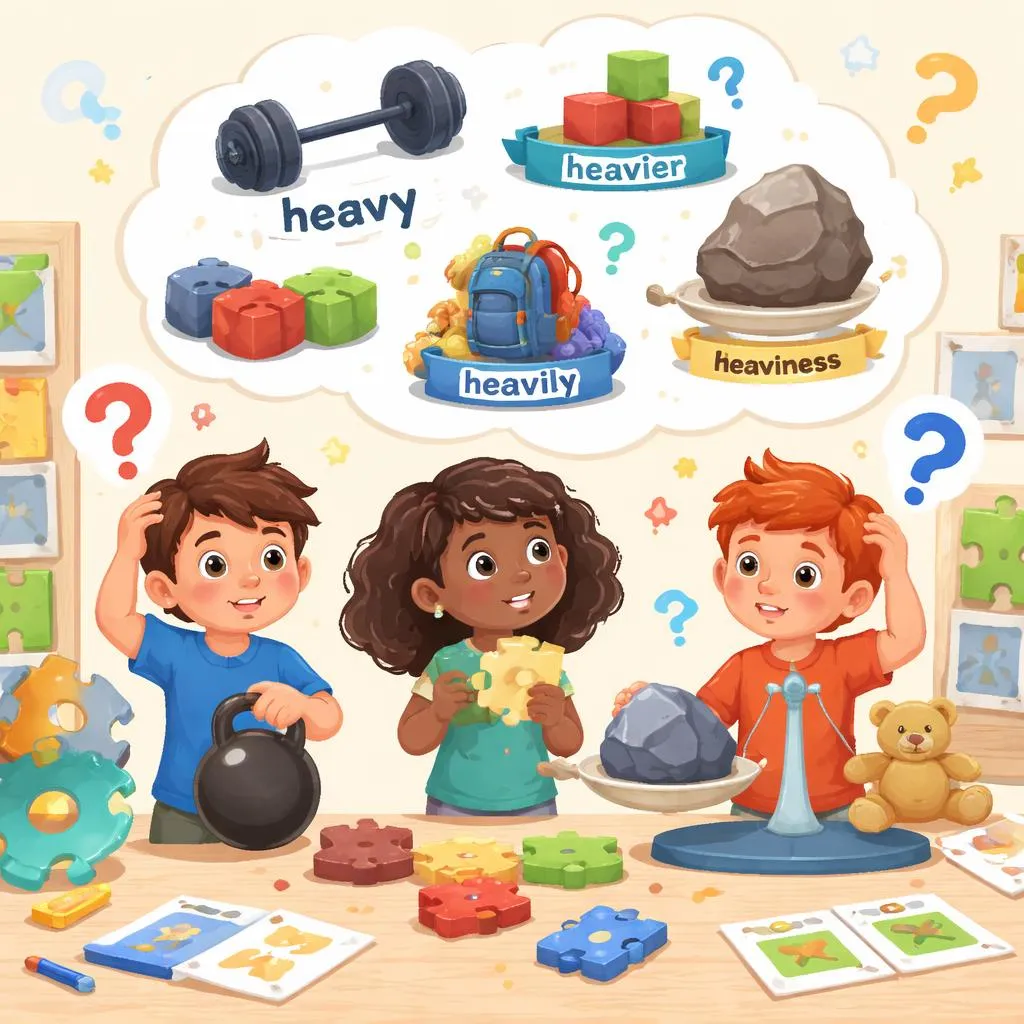
Meet Sam the squirrel. He loves snack time with family. Last Sunday, Grandma made soup. Sam wanted to say the bowl felt heavy. He mixed up words. He shouted, “The soup is eating heavily!” Everyone laughed. They thought soup was chewing loudly. Sam felt silly. This happens to many kids. Today, we learn the word family. Think of them as tools in a box. Each has a special job. We call them heavy, heavily, heaviness, and heavier. They look alike but work differently. By the end, you will never mix them again.
Core Comparison Zone: Deep Analysis
Sam’s day continues. We follow him everywhere. First, meet the members.
Heavy is the weight boss. It describes how much things weigh. We call it “Weight Boss”. Heavily is the action helper. It tells how someone does something. We call it “Action Helper”. Heaviness is the weight name. It talks about the idea of being heavy. We call it “Weight Name”. Heavier is the compare king. It shows which thing weighs more. We call it “Compare King”.
Now, let’s explore five ways they differ.
Time Dimension
Clocks tick. Calendars flip. Words show when things happen.
At home, Sam sees heavy books daily. Mom stirs soup heavily now. Yesterday, the bag had great heaviness. The box is heavier than last week.
At the playground, Sam lifts heavy rocks often. Kids run heavily in mud. The ball’s heaviness surprises him. His backpack is heavier than mine.
At school, Sam carries heavy folders usually. He writes heavily with a pencil. The paper’s heaviness matters. Her book is heavier than his.
In nature, Sam finds heavy pinecones sometimes. Rain falls heavily on leaves. The log’s heaviness slows him. The stone is heavier than the twig.
Each word shows time. Heavy is always or now. Heavily is happening now. Heaviness is a fact. Heavier is comparison.
Role Dimension
Words have jobs in sentences. Some act. Some describe.
At home, heavy describes the book. It is a makeup artist. Heavily describes how Mom stirs. It is a worker. Heaviness names the weight. It is a thing. Heavier compares the boxes. It is a judge.
At the playground, heavy describes the rock. Makeup artist job. Heavily describes how kids run. Worker job. Heaviness names the ball’s weight. Thing job. Heavier compares backpacks. Judge job.
At school, heavy describes the folder. Makeup artist. Heavily describes how he writes. Worker. Heaviness names the paper’s weight. Thing. Heavier compares books. Judge.
In nature, heavy describes the pinecone. Makeup artist. Heavily describes how rain falls. Worker. Heaviness names the log’s weight. Thing. Heavier compares stone and twig. Judge.
Weight Boss decorates nouns. Action Helper modifies verbs. Weight Name is a noun. Compare King judges differences.
Partners Dimension
Some words need friends. Others stand alone.
At home, heavy stands alone. “The book is heavy.” Heavily needs a verb. “Mom stirs heavily.” Heaviness needs “of”. “The heaviness of the bag.” Heavier needs “than”. “Heavier than the box.”
At the playground, heavy stands alone. “The rock is heavy.” Heavily needs a verb. “Kids run heavily.” Heaviness needs “of”. “The ball’s heaviness.” Heavier needs “than”. “Heavier than my pack.”
At school, heavy stands alone. “The folder is heavy.” Heavily needs a verb. “He writes heavily.” Heaviness needs “of”. “The paper’s heaviness.” Heavier needs “than”. “Heavier than his book.”
In nature, heavy stands alone. “The pinecone is heavy.” Heavily needs a verb. “Rain falls heavily.” Heaviness needs “of”. “The log’s heaviness.” Heavier needs “than”. “Heavier than the twig.”
Weight Boss is independent. Action Helper tags along verbs. Weight Name likes “of”. Compare King loves “than”.
Nuances Dimension
Small choices change meaning. Let’s see tiny differences.
At home, say “heavy bag” for its weight. Say “stirs heavily” for how she moves. Say “heaviness of soup” for the weight idea. Say “heavier box” for comparison.
At the playground, “heavy rock” describes size. “Runs heavily” tells movement style. “Ball’s heaviness” names the trait. “Heavier pack” compares loads.
At school, “heavy folder” shows weight. “Writes heavily” describes pressure. “Paper’s heaviness” is a fact. “Heavier book” picks the bigger load.
In nature, “heavy pinecone” feels solid. “Falls heavily” describes rain force. “Log’s heaviness” is its mass. “Heavier stone” beats the twig.
Use Weight Boss for single items. Use Action Helper for actions. Use Weight Name for ideas. Use Compare King for choices.
The Trap
This part is long. Many kids fall into traps. We fix them together.
Trap one: Using “heavily” to describe a thing. Wrong: “The heavily bag hurts my shoulder.” Right: “The heavy bag hurts my shoulder.” Why? “Heavily” is an adverb. It modifies verbs, not nouns. “Bag” is a noun. Only adjectives like “heavy” can describe it. Memory tip: “Adverbs don’t hug nouns, adjectives do.”
Trap two: Using “heaviness” as an adjective. Wrong: “I carry a heaviness box.” Right: “I carry a heavy box.” Why? “Heaviness” is a noun. It names the idea of weight. It cannot sit before a noun like “heavy” does. Memory tip: “Nouns name, adjectives decorate.”
Trap three: Adding “more” to “heavier”. Wrong: “This stone is more heavier than that.” Right: “This stone is heavier than that.” Why? “Heavier” is already a comparative adjective. Adding “more” is redundant. Comparatives like “-er” don’t need extra help. Memory tip: “-Er words stand alone, no more needed.”
Trap four: Using “heavy” to modify a verb. Wrong: “She walks heavy to the bus.” Right: “She walks heavily to the bus.” Why? “Walks” is a verb. Verbs need adverbs like “heavily” to describe how they happen. “Heavy” only describes nouns. Memory tip: “Verbs get adverbs, nouns get adjectives.”
Trap five: Mixing all four in one sentence. Wrong: “The heaviness bag is heavier than the heavily one.” Right: “The heavy bag is heavier than the light one.” Why? “Heaviness” is a noun, not an adjective. “Heavily” modifies verbs, not nouns. Keep roles clear. Memory tip: “One job per word, no mixing roles.”
These traps trip many. Practice spotting them. Soon you will dodge them easily.
Detailed Summary
Let’s tie it all together. If you describe a thing’s weight, use “heavy”. If you tell how an action happens, use “heavily”. If you talk about the idea of weight, use “heaviness”. If you compare two things, use “heavier”. Remember their partners. “Heavy” stands alone. “Heavily” needs a verb. “Heaviness” needs “of”. “Heavier” needs “than”. Keep these rules in mind. You will master the word family.
Practice
Task A: Best Choice. Fill in the blank. Choose between two options.
Scene: Dinner. Dad says, “Pass the ____ plate, please.” Options: heavy / heavily. Answer: heavy. Because it describes the plate (noun).
Scene: Playground. Sam shouts, “The rain is falling ____!” Options: heavy / heavily. Answer: heavily. Because it modifies “falling” (verb).
Scene: School. Teacher asks, “Which book is ____?” Options: heavier / heaviness. Answer: heavier. Because it compares two books.
Task B: Eagle Eyes. Find and fix mistakes. Read the paragraph.
“Yesterday, I carried a heaviness backpack. It rained heavy all day. My shoes felt heavily. The heaviness of the walk was heavier than before.”
Fixes: “Yesterday, I carried a heavy backpack. It rained heavily all day. My shoes felt heavy. The heaviness of the walk was surprising.”
Task C: Be the Director. Create sentences. Use two forms.
Scene: Family picnic. Use “heavy” and “heavier”. Sample: The basket is heavy. My brother’s basket is heavier.
Scene: Nature hike. Use “heavily” and “heaviness”. Sample: Rain falls heavily on the tent. The heaviness of the wet coat surprises me.
What You Learned
You learned to tell heavy, heavily, heaviness, and heavier apart. You practiced using them in real scenes. You spotted common mistakes and fixed them. You gained confidence in choosing the right word.
Your Action Step
Notice weights today. Say one sentence with “heavy” at breakfast. Draw a picture showing “heavily” this afternoon. Compare two toys and say which is “heavier” tonight. Keep practicing every day.