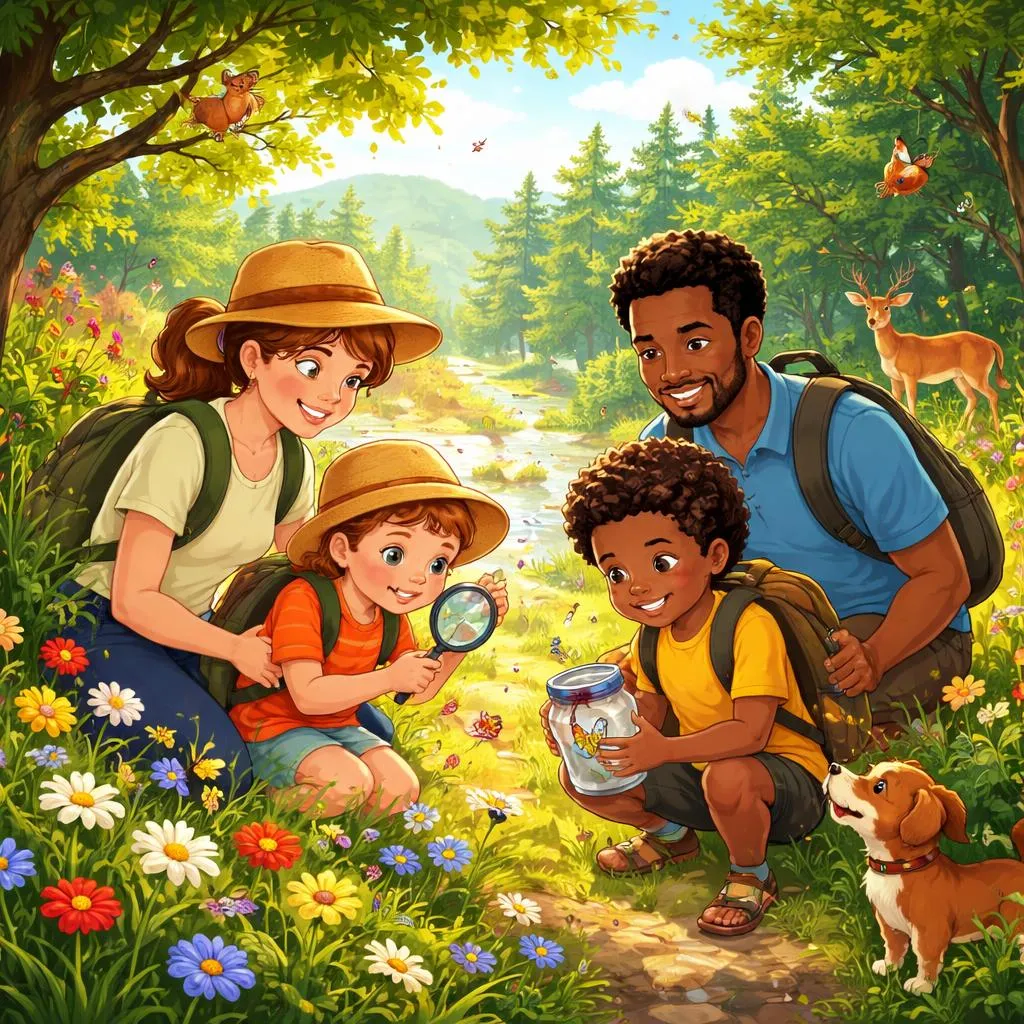

Every child loves the outdoors. Trees, clouds, bugs, and stars fill them with wonder. English gives us a beautiful family of words for this love of the living world. The root is “nature.” From this root come three more words. “Natural” describes anything from nature or done without effort. “Naturally” describes how something happens in a normal, unforced way. “Naturalist” names a person who studies nature closely. These four words help children notice the world around them. They also help children become careful observers. Let us explore this wondrous family.
What Does “Same Word, Different Forms” Mean? One world takes different word shapes. “Nature” is the noun. Nature includes trees, rivers, animals, and sky. “Natural” is the adjective. Natural light fills the room in the morning. “Naturally” is the adverb. Flowers grow naturally without help. “Naturalist” is the person noun. A naturalist studies birds and plants. Your child sees this pattern in other words. “World” becomes “worldly.” “Earth” becomes “earthly.” “Nature” gives us even more options.
Personal Pronouns Change Their Form Pronouns shift shape too. “I” becomes “me.” “She” becomes “her.” “We” becomes “us.” This shows that English changes words for grammar. Our word family “nature” changes for grammar as well. But it also changes for meaning. A noun names the world or a person. An adjective describes. An adverb describes an action. Learning these roles helps your child talk about the outdoors clearly.
From Noun to Adjective to Adverb to Person – One Family, Many Words “Nature” is the noun. Nature provides us with air and water. “Natural” is the adjective. Natural foods have no artificial colors. “Naturally” is the adverb. She naturally smiled when she saw the puppy. “Naturalist” is the person noun. The naturalist identified every bird by its song. This family gives your child four tools for loving the outdoors. One root. Four ways to explore.
One Root, Many Roles – How Words Grow from the World to the People Who Love It Let us follow a nature story. A child spends time in nature every weekend. The child notices natural patterns, like leaves changing color. The child naturally becomes curious about why seasons change. The child decides to become a naturalist who protects forests. See how “nature” runs through all four sentences. Each form adds a new layer. Your child can say “I love nature.” “This is a natural material.” “I naturally feel calm outside.” “I want to be a naturalist.” One root tells a whole story of discovery.
Same Meaning, Different Jobs – Is It a Noun or an Adjective? How does your child know the job? Look at the sentence position. As a subject or object, use the noun “nature.” Example: “Nature is beautiful in autumn.” Before a noun or after “be,” use “natural.” Example: “That is a natural bridge.” For the person noun, use “a” or “the.” Example: “The naturalist carried binoculars.” Before a verb or at the end of a clause, use “naturally.” Example: “The river flows naturally.” Endings give clues. “Nature” is the noun for the world. “-al” signals an adjective. “-ally” signals an adverb. “-ist” signals a person who studies or practices.
Adjectives and Adverbs – When Do We Add -ly? This family shows the “-ly” rule clearly. Take the adjective “natural.” Add “-ly” to make “naturally.” No spelling change. Many adjectives work this way. “Quick” becomes “quickly.” “Musical” becomes “musically.” “Natural” becomes “naturally.” Also note that “naturally” has a second meaning: “of course.” “Naturally, I said yes.” That is advanced. Focus first on the meaning “in a natural way.” Most “-al” adjectives become “-ally” adverbs.
Watch Out for Tricky Spelling Changes (Double Letters, y to i, and More) “Nature” has a silent “e” at the end. When we add “-al” to make “natural,” we drop the “e.” “Nature” becomes “natural.” When we add “-ly” to make “naturally,” we keep the “al.” “Natural” + “ly” = “naturally.” No double letters. When we add “-ist” to make “naturalist,” we keep the “al.” “Natural” + “ist” = “naturalist.” The main challenge is dropping the “e” for “natural.” “Nature” to “natural” is like “culture” to “cultural.” Practice this change. Also note that “nature” has a “ture” ending. The “ture” sounds like “cher.” Say “na-cher.” Not “na-toor.”
Let’s Practice – Can You Choose the Right Form? Try these simple sentences with your child.
(Nature / Natural) gives us fresh air and sunshine. (Answer: Nature)
Wood is a (nature / natural) building material. (Answer: natural)
Birds (naturally / naturalist) build nests without lessons. (Answer: naturally)
The (natural / naturalist) recorded every butterfly she saw. (Answer: naturalist)
It is (nature / natural) to feel curious about the stars. (Answer: natural)
Make your own sentences from daily life. Say “Let us go explore nature.” Say “This juice has natural sugar.” Say “Leaves naturally fall in autumn.” Say “A naturalist loves to watch animals.”
Tips for Parents – Help Your Child Learn Word Families in a Fun Way Go outside together every week. A park. A garden. A forest. A beach. As you explore, use the words. Say “Look at nature.” Say “This is a natural trail.” Say “The stream flows naturally.” Say “You are becoming a little naturalist.” This hands-on learning teaches vocabulary and love for the earth.
Play the naturalist game. Give your child a notebook. Go outside. Ask them to draw three natural things. A leaf. A cloud. A bug. Say “A naturalist records what they see.” Say “You are a naturalist today.” This game builds observation and documentation skills.
Use “naturally” for easy actions. When your child shares without being asked, say “You naturally share.” When your child helps a friend, say “Kindness comes naturally to you.” This connects the word to character.
Read books about naturalists. John Muir. Jane Goodall. David Attenborough. Young naturalists in children’s fiction. Pause during reading. Ask “What did this naturalist discover?” Ask “What natural thing did they love?” Ask “Did they naturally feel curious?” These questions build inspiration.
Create a nature collection. Leaves, rocks, feathers, shells. Label each item. Say “This is from nature.” Say “These are natural objects.” Say “A naturalist keeps a collection.” This activity builds science and vocabulary.
Distinguish “natural” from “normal.” Natural means from nature or unforced. Normal means common. Say “It is natural for leaves to fall. It is normal for birds to fly south.” This distinction builds precise language.
Use “nature” for character too. “It is in his nature to be kind.” “She has a curious nature.” This shows your child that “nature” can mean someone’s essential character.
Now you have a complete guide. Spend time in nature. Appreciate natural beauty. Act naturally with curiosity. Become a family of naturalists. This word family does more than teach English. It teaches that the earth is our first teacher. It teaches that observation is a superpower. It teaches that every child can love and protect nature. Keep exploring. Keep growing together. One word family at a time.