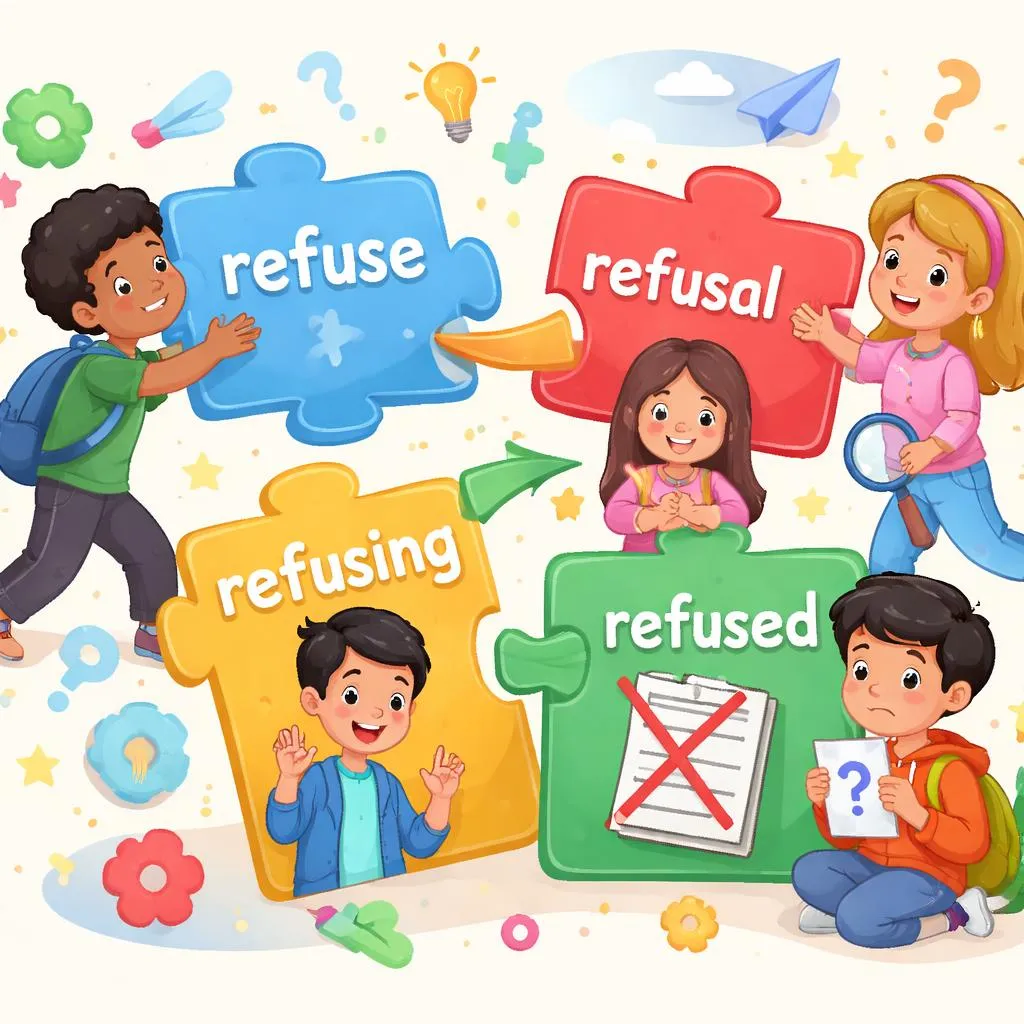

What Does “Same Word, Different Forms” Mean?
Many English words belong to families.
A word family starts with one root and grows into related forms.
The words refuse and refusal belong to one family.
They share the same core meaning.
Both connect to saying no or not accepting something.
But they do not do the same grammar job.
Refuse is a verb. Refusal is a noun.
This is an important pattern for children to learn.
One word shows action.
One word names the action.
When children understand this, vocabulary feels more connected.
That supports reading and writing.
Personal Pronouns Change Their Form
Children already know words can change form.
They see:
I, me, my he, him, his
Different forms.
Related meaning.
Word families work the same way.
Look at these:
I refuse to cheat. His refusal surprised everyone.
The idea stays connected.
The grammar role changes.
That pattern appears often in English.
Seeing these relationships helps children understand how words work.
That is stronger than memorizing single words.
From Verb to Noun to Adjective to Adverb – One Family, Many Words
Some word families grow into many forms.
This one mainly shows a verb and noun pair.
That is still an important pattern.
Refuse as a Verb
Refuse shows action.
It means not to accept, allow, or agree.
Examples:
I refuse to lie. She refused the offer. They refuse unhealthy food.
This word often appears in daily life.
Children hear it in stories and conversations.
It teaches both language and decision-making.
Refusal as a Noun
Refusal names the act of refusing.
Examples:
His refusal was polite. Her refusal surprised us. The refusal caused a debate.
Now the action becomes a thing we can talk about.
That is how many noun forms work.
Compare:
arrive → arrival approve → approval refuse → refusal
Patterns repeat.
That helps children learn faster.
One Root, Many Roles – How Words Grow from Actions to Qualities
The root refuse grows into another role.
refuse → action refusal → named event or idea
One root.
Two roles.
That may seem simple.
But it teaches a big idea.
Words can shift jobs.
And suffixes often help.
The ending -al often forms nouns.
Examples:
refuse → refusal approve → approval renew → renewal
Once children see the pattern, they can apply it elsewhere.
That builds independence.
Same Meaning, Different Jobs – Is It a Verb or a Noun?
Children often mix forms.
That is natural.
Ask:
Is this word showing an action?
Or naming the action?
Look here:
Correct:
I refuse the invitation. His refusal was respectful.
Not correct:
I refusal the invitation. His refuse was respectful.
Meaning connects.
Grammar decides usage.
This habit helps children choose the right form.
That strengthens writing.
Adjectives and Adverbs – When Do We Add -ly?
This word family does not commonly grow into an everyday -ly adverb.
That is useful to notice.
Not every word family has all forms.
Some have verbs and nouns only.
Some have wider families.
Children should learn that language has patterns, but not every pattern is identical.
Still, we can compare related ideas.
Example:
She gave a firm refusal. She answered firmly.
Here firmly is an adverb, though not from refuse.
This helps children see how description works around the family.
That is also valuable learning.
Watch Out for Tricky Spelling Changes (Double Letters, y to i, and More)
This family has an important spelling shift.
Refuse to Refusal
Children may ask:
Why does refuse become refusal, not refuseal?
English often changes spelling when endings join.
The final e drops.
Then -al is added.
refuse → refusal
This happens in many words.
Learning this pattern supports spelling.
Watch the Meaning of Refuse
There is another tricky point.
Refuse has two meanings.
As a verb:
I refuse to go.
As a noun, pronounced differently, it can mean trash.
The truck collected refuse.
That surprises many learners.
Same spelling.
Different pronunciation.
Different meaning.
English sometimes works this way.
Children often enjoy discovering that.
Let’s Practice – Can You Choose the Right Form?
Try these.
- I ______ to break the rules.
Answer: refuse
It shows action.
- Her ______ was very polite.
Answer: refusal
It names the act.
- They ______ the unfair deal.
Answer: refused
Verb form.
- His sudden ______ shocked everyone.
Answer: refusal
Noun form.
Practice like this helps children compare forms clearly.
That builds confidence.
Tips for Parents – Help Your Child Learn Word Families in a Fun Way
Word families can feel simple and playful.
Build a Mini Word Family Chart
Write:
refuse refusal
Talk about the connection.
Add examples.
Children remember patterns through comparison.
Spot the Suffix
Teach children to notice -al.
Ask:
Can you find other words with -al?
This turns reading into discovery.
Practice Sentence Swaps
Change verb to noun.
Example:
I refuse the request. My refusal was polite.
Children see how grammar changes.
That is powerful learning.
Use Real-Life Situations
Talk about respectful refusal.
Refusing can mean setting boundaries.
Vocabulary can support social learning too.
That makes words meaningful.
Compare Similar Families
Try:
arrive / arrival approve / approval refuse / refusal
Patterns repeat.
That helps children remember.
Why This Word Family Helps Reading Growth
Even a small word family teaches big skills.
Children learn:
roots suffixes grammar roles spelling patterns
These support literacy.
They also support comprehension.
When children meet refusal in books, they can connect it to refuse.
That reduces confusion.
That supports fluent reading.
Common Mix-Ups Children Make Refuse and Refusal
Most common challenge.
One is action.
One names the action.
Compare:
I refuse the idea. My refusal was clear.
Different jobs.
Shared meaning.
Forgetting the Spelling Change
Some children write refuseal.
That is understandable.
But the correct form is refusal.
Pattern awareness helps.
Confusing the Two Meanings of Refuse
This is another challenge.
Verb:
refuse an offer
Noun:
collect refuse
Same spelling.
Different pronunciation.
Different meaning.
Context tells the difference.
That is a strong reading skill.
How Small Word Families Build Big Vocabulary
Some families have many forms.
Some have only a few.
Both matter.
Even two-word families teach structure.
And structure builds vocabulary.
When children learn roots and endings, they stop seeing words as random.
They begin seeing systems.
That changes how they learn.
It often makes vocabulary feel easier.
Learning refuse and refusal as One Family
These two words may seem simple.
But they teach major ideas.
A verb can become a noun.
A suffix can change grammar.
One root can support many meanings.
That is how English grows.
When children learn refuse and refusal as a family, they are not only learning two words.
They are learning how words connect.
And once children begin noticing those connections, reading, spelling, and expression often grow in much stronger ways.