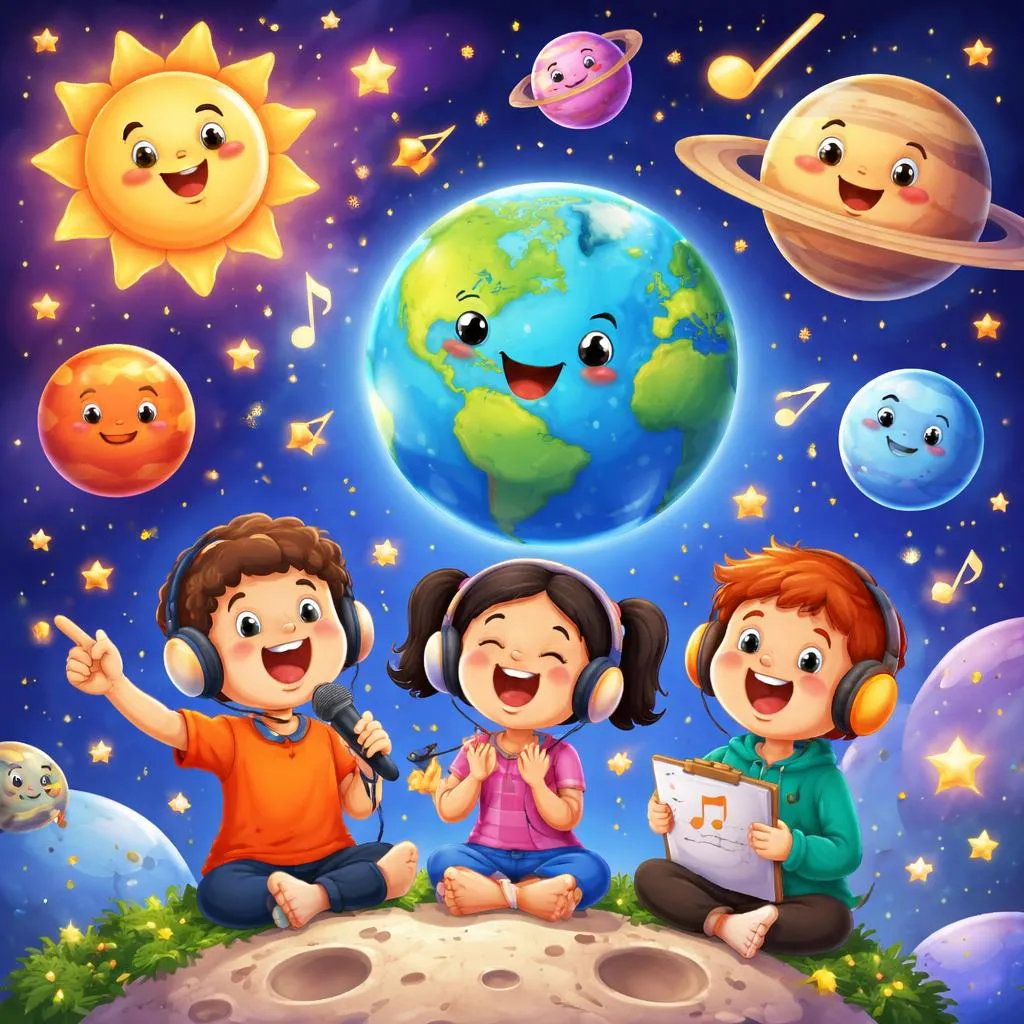

Hello, young space explorers! Today brings an exciting journey through our solar system. The planets orbiting our Sun have wonderful names and amazing features. Learning them all can seem difficult at first. But a special tool makes this task much easier. A "planet song for kids" turns facts into music. The melody helps memory. The rhythm creates patterns. The words stick in young minds. Let us discover together how songs help children learn about our cosmic neighbors.
What Is a "Planet Song for Kids"? A "planet song for kids" is a musical learning tool. It presents information about planets through song. The melody makes the facts easy to remember. Children sing along and absorb knowledge without effort.
These songs come in many styles. Some use familiar tunes like "Twinkle Twinkle Little Star." Others have original music composed just for planet learning. Some focus only on planet names in order. Others include facts about size, color, or temperature. Each version offers different learning benefits.
The best planet songs include all eight planets in order from the Sun. Mercury comes first, then Venus, then Earth. Mars follows, then Jupiter, then Saturn. Uranus and Neptune complete the journey. Singing this order repeatedly builds strong memory.
What makes a "planet song for kids" special is its multisensory approach. Children hear the words. They feel the rhythm. They often move or clap along. Some versions include pictures or hand motions. This combination of senses creates stronger learning than listening alone.
The Lyrics of Typical Planet Songs Let us look at the words found in popular planet songs. Different versions exist, but most follow similar patterns.
A simple naming song might go like this:
Mercury, Venus, Earth, and Mars Jupiter, Saturn, Uranus, Neptune These are the planets that circle our Sun Eight special worlds, every one!
Another version adds descriptive words:
Mercury is closest to the Sun Venus is the hottest one Earth is where we live and play Mars is red far away
Jupiter is big and bright Saturn has rings of light Uranus spins on its side Neptune has a windy ride
Some songs use the tune of "Twinkle Twinkle Little Star":
Twinkle, twinkle, little star I wonder what the planets are Mercury, Venus, Earth, and Mars Jupiter, Saturn, Uranus, Neptune These are the planets in our solar system Twinkle, twinkle, little star Now I know what the planets are!
The repetition in these songs helps children remember. The rhyming words create patterns that stick in memory. The friendly tunes invite participation.
Vocabulary Learning from Planet Songs A "planet song for kids" introduces rich scientific vocabulary. Young learners hear the names of all eight planets repeatedly. This builds strong recognition of each name.
The planet names themselves carry meaning. Mercury connects to speed. Venus connects to beauty. Mars connects to the color red. Jupiter connects to size. Saturn connects to rings. These associations help children remember which planet is which.
Order words become familiar through singing. First, second, third, and so on appear naturally. Children learn that Mercury comes first from the Sun. Neptune comes eighth. This ordinal vocabulary supports math learning too.
Descriptive words enrich the songs. Hot, cold, big, small, red, blue, ringed, and windy appear. Children learn adjectives that describe each planet's characteristics. This builds descriptive language skills.
Scientific terms appear in some versions. Orbit, solar system, planet, and star become familiar. Children learn that planets orbit or go around the Sun. They learn that our Sun and its planets make up the solar system.
The songs also teach that planets differ from stars. Stars produce their own light. Planets reflect light from the Sun. This fundamental concept appears in well-written planet songs.
Phonics Points in Planet Songs Phonics learning happens naturally with planet songs. The rhythm and rhyme draw attention to word patterns. Children hear specific sounds again and again.
The "er" sound appears in many planet names. Mercury, Jupiter, and Saturn contain this sound. Children practice this common letter combination through singing. They learn that "er" at the end of words sounds the same across different contexts.
The "ar" sound appears in Mars. This vowel combination makes a distinct sound. Children can connect it to other "ar" words like star, car, and far. The song provides a memorable context for this phonics pattern.
The long "u" sound appears in Uranus. This less common sound gets practice through the song. Children learn that "u" can make its own name sound in some words.
Syllable awareness develops through singing. Children feel how many beats each planet name takes. Mercury has three syllables. Venus has two. Jupiter has three. Saturn has two. This rhythmic awareness supports reading development.
Word stress becomes natural through melody. The songs place emphasis on the correct syllable in each planet name. Children learn to say "MER-cur-y" not "mer-CUR-y." This pronunciation support proves valuable for clear communication.
Grammar Patterns Emerging from Planet Songs Grammar learning happens effortlessly through these songs. The natural language provides excellent models. Children absorb correct structures without formal lessons.
Subject-verb agreement appears in song lyrics. "Mercury is closest" uses singular verb with singular subject. "The planets circle" uses plural verb with plural subject. Children hear these patterns repeated correctly.
Prepositions show location and relationship. "Around the Sun" uses "around" to show orbital path. "From the Sun" uses "from" to show starting point. "In our solar system" uses "in" to show inclusion. These small but important words gain meaning through context.
Adjectives modify nouns throughout the songs. "Red Mars" uses "red" to describe Mars. "Big Jupiter" uses "big" to describe Jupiter. "Windy Neptune" uses "windy" to describe Neptune. Children learn that adjectives add information to nouns.
Question forms appear in some versions. "What are the planets?" models question word order. "How many orbit the Sun?" uses "how many" to ask about quantity. Children absorb question formation through these examples.
Comparative language appears in descriptive versions. "Hottest" shows the superlative form. "Closest" shows another superlative. Children learn that "-est" endings indicate the most of something.
Learning Activities for Planet Songs A "planet song for kids" inspires countless learning activities. These ideas extend the song into deeper science practice. Each activity builds different skills while maintaining the fun.
Planet walks create a physical experience of the solar system. Mark distances on the playground or hallway. Start with a "Sun" at one end. Place Mercury a short distance away. Continue placing each planet farther out. Children walk the distances while singing the planet song. This builds understanding of both names and relative distances.
Planet crafts bring the solar system into the classroom. Use paper plates for each planet. Paint them appropriate colors. Mercury gray, Venus yellow, Earth blue and green, Mars red. Jupiter orange with stripes, Saturn yellow with rings, Uranus light blue, Neptune dark blue. Hang them in order around the room. Children sing the song while looking at their creations.
Planet fact cards extend learning beyond names. Create cards with one planet on each. Include a picture and one key fact. "Mercury is closest to the Sun." "Venus is hottest." "Earth has life." "Mars has the biggest volcano." Children match fact cards to planet models while singing.
Planet size comparison builds math connections. Use different sized balls or fruits to represent planets. A small pea for Mercury. A grape for Venus. A grape for Earth. A smaller pea for Mars. A large watermelon for Jupiter. A medium cantaloupe for Saturn. A lemon for Uranus. A lime for Neptune. Children see the size differences while singing.
Planet order games reinforce sequence. Write planet names on cards. Mix them up. Children arrange them in correct order while singing the song. Time each attempt and try to improve. This builds speed in name recall.
Printable Materials for Planet Songs Printable materials support learning at home and school. These resources give children something to hold and use. They extend the song into independent practice.
Planet flashcards provide versatile learning tools. Print cards showing each planet clearly. The name appears on the back. Children practice naming planets from pictures. They check their answers by looking at the name. This builds recognition skills.
Planet order charts help with sequence memory. Print a simple chart showing the Sun and all eight planets in order. Display it where children can see during singing. Point to each planet as the song mentions it. This connects visual and auditory learning.
Planet coloring pages offer creative engagement. Print outlines of each planet. Children color them appropriately. They write the planet name below each picture. This combines art with literacy and science.
Mini books let children own planet knowledge. Create a simple folded book with a page for each planet. Each page shows the planet and its name. A short fact appears below. Children color the illustrations. They practice reading their books to family members. This builds pride and reading confidence.
Planet matching games build visual discrimination. Create two sets of planet cards. Children find matches. When they make a match, they name the planet and sing its part of the song. This combines memory skills with vocabulary practice.
Educational Games Based on Planet Songs Games turn learning into pure joy. These game ideas use planet songs as their foundation. Children practice science knowledge while having fun.
Planet Bingo reinforces recognition. Create bingo cards with planet pictures instead of numbers. Call out planet names. Children cover matching pictures. The first to cover a row wins. This builds listening skills along with planet knowledge.
Planet Hopscotch combines movement with learning. Draw a hopscotch grid with planet names instead of numbers. Children hop through the solar system in order. They call out each planet as they land on it. This combines gross motor skills with science learning.
Planet Memory Match builds visual recognition. Create pairs of planet cards. Mix them face down. Children take turns finding matches. When they make a match, they say the planet name and one fact about it. This builds deeper knowledge along with memory skills.
Guess the Planet uses descriptive clues. Describe a planet without saying its name. "I am the largest planet. I have many moons. I have colorful stripes." Children guess Jupiter. This builds listening and reasoning skills.
Planet Song Scavenger Hunt sends children on a space adventure. Hide pictures of planets around the room. Play the planet song. When the music stops, children find a planet picture nearby. They name the planet they found before the song resumes. This builds quick recall under fun pressure.
The "planet song for kids" transforms solar system learning from challenge to joy. The melody carries information effortlessly into memory. Children sing about Mercury, Venus, Earth, and Mars without struggle. They remember the order because the song creates a mental container. Each planet finds its place in the melody. The rhythm provides a framework for recall. Years later, adults still remember facts learned through childhood songs. This lasting power makes musical learning invaluable. Planet songs work because they engage the whole brain. Language centers process the words. Musical centers process the melody. Motor centers may add movement or clapping. This integrated learning creates stronger memory than any single approach. Our solar system holds wonders beyond counting. Planet songs open the door for children to explore these wonders. The songs provide the first steps on a lifelong journey of space discovery.