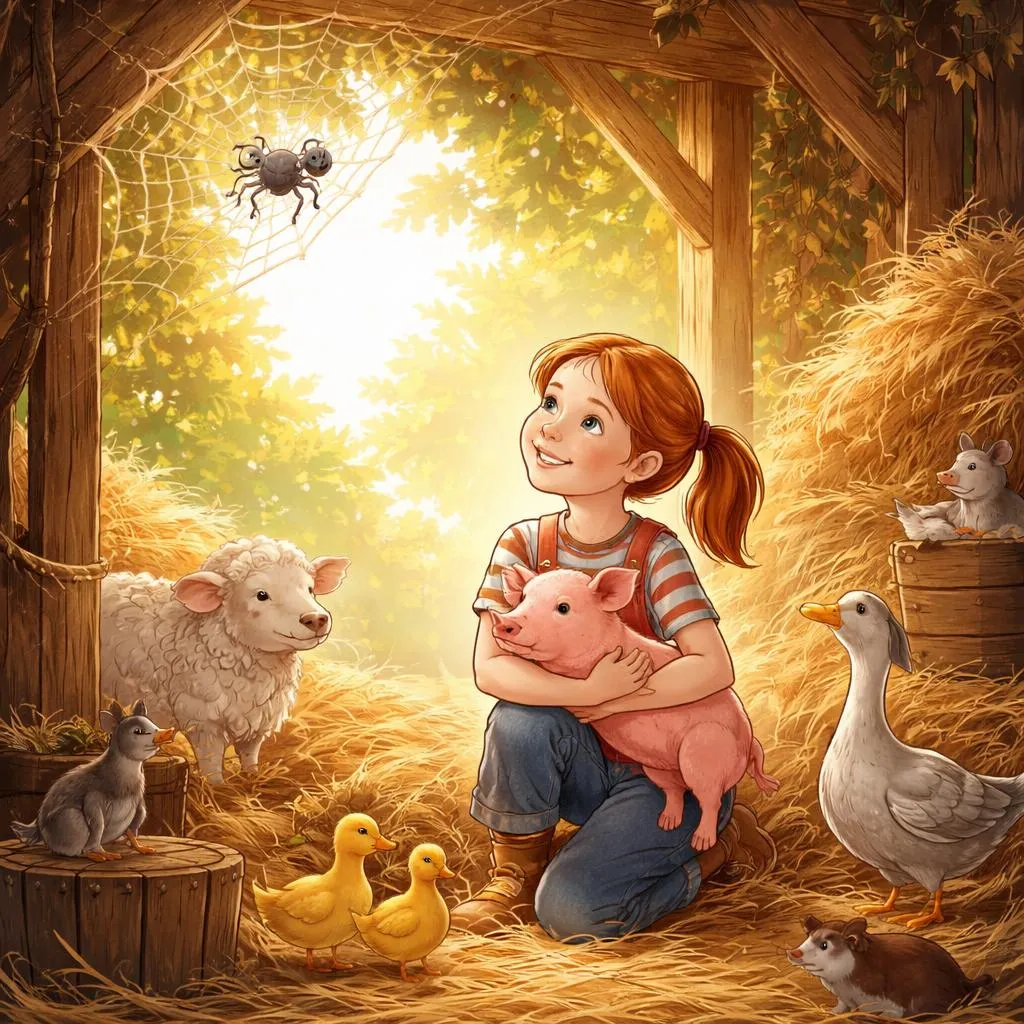

Morning mist rises over the barn. A small pig squeals for attention. A gray spider watches from her web above. These simple images begin one of the most beloved children's books ever written. Charlotte's Web children's story has touched millions of hearts since it first appeared in 1952. Children still cry when Charlotte dies. They still cheer when Wilbur lives. The magic continues across generations.
Let us walk together into the barn and meet characters who teach us about friendship, loyalty, and the cycle of life.
<h2>What is the story?</h2> Charlotte's Web children's story begins on a farm. A girl named Fern saves a tiny pig from being killed. She names him Wilbur and raises him like a baby. She feeds him with a bottle and pushes him in her doll carriage. Wilbur grows healthy and strong.Soon Wilbur moves to her uncle's farm. He lives in a barn with many animals. He feels lonely at first. He wants a friend. One morning, a voice greets him. The voice belongs to Charlotte, a gray spider who lives above his pen.
Charlotte becomes Wilbur's best friend. When they learn that Wilbur will become Christmas dinner, Charlotte promises to save him. She begins writing words in her web. Some pig. Terrific. Radiant. Humble. People come from far away to see the miracle spider. Wilbur becomes famous and wins a prize at the fair. Charlotte saves her friend but grows tired. She lays her egg sac and dies at the fair. Wilbur takes the sac home and cares for Charlotte's children for the rest of his life.
<h2>The message of the story</h2> Charlotte's Web children's story carries deep messages about friendship and sacrifice. Charlotte gives everything to save Wilbur. She asks nothing in return. She simply says, You have been my friend. That in itself is a tremendous thing.The story also teaches about the cycle of life. Animals are born. They live. They die. Charlotte explains this to Wilbur gently. We are born, we live a little while, we die. By helping you, perhaps I was trying to lift up my life. A spider's life can't help being something of a mess, with all this trapping and eating flies. By helping you, I was trying to make something of myself.
This honesty helps children understand that life includes loss. But the story balances sadness with hope. Charlotte's children and grandchildren stay in the barn. Wilbur never lacks for friends. Life continues.
We can ask our children, What does friendship mean to you? What would you do for a good friend? These questions help them connect Charlotte's sacrifice to their own lives.
<h2>Vocabulary learning</h2> E.B. White uses beautiful words in Charlotte's Web children's story. He paints pictures with language that children can see and feel.The story introduces barn vocabulary. Children learn about manure, which is animal waste that helps things grow. They meet troughs where animals eat. They discover pens where animals live alone. They see the hayloft where children play.
Charlotte uses wonderful words in her web. Radiant means shining with happiness. Humble means modest, not proud. Terrific means very great or intense. These words become part of children's vocabulary through the story.
We also meet animal names like gander for a male goose and runt for the smallest baby animal. Wilbur starts as the runt of his litter. These specific words help children understand the farm world.
After reading, we can look for chances to use these words. Your child might draw a radiant sun. You might call a meal terrific. The words from the story become part of your family language.
<h2>Phonics points</h2> The character names in Charlotte's Web children's story give us lovely phonics practice. Each name sounds like the character it represents.Wilbur starts with W. This sound requires rounding the lips. Www-ilbur. Practice making that sound together. What other W words can you think of? Web starts with W. So does web, which is perfect for a spider story.
Charlotte has two important sounds. The CH at the beginning requires pushing air through the teeth. Ch-ch-charlotte. The T at the end is soft, almost silent in some accents. Charlotte. Children love saying this elegant name.
Templeton the rat has a name full of T sounds. Templeton. T-t-templeton. The name sounds a little sneaky, doesn't it? That matches the rat character who only helps when food is involved.
We can play with these sounds by finding other words that begin the same way. Wilbur and web. Charlotte and cheese. Templeton and trouble. This play builds phonemic awareness naturally.
<h2>Grammar patterns</h2> E.B. White was a master of English style. Charlotte's Web children's story shows beautiful grammar patterns that children absorb through reading.White uses dialogue tags in wonderful ways. He doesn't just say said. He writes, whispered Charlotte, or cried Wilbur, or muttered Templeton. This shows children different words for speaking. Each word carries different meaning.
The story also shows how to build sentences with rhythm. The barn was very large. It was very old. It smelled of hay and it smelled of manure. It smelled of the perspiration of tired horses and the wonderful sweet breath of patient cows. The sentences grow longer, building a picture step by step.
White uses repetition for effect. Wilbur burst into tears. I don't want to die, he moaned. I want to stay alive. I want to stay here in this beautiful barn. The repeated I want emphasizes Wilbur's desperate wish.
After reading, we can notice how the author builds sentences. Let's try writing one like E.B. White about our own home. This gentle imitation builds writing skills.
<h2>Learning activities</h2> After enjoying Charlotte's Web children's story, we can extend the experience with simple activities. These help children connect with the story on deeper levels.Create a simple web using yarn and a paper plate. Cut notches around the plate edge. Wrap yarn across to create a web pattern. Hang it in your child's room. Talk about how Charlotte built her webs and why they mattered.
Visit a farm if possible. See real pigs, cows, and sheep. Watch for spiders in barn corners. Talk about how the animals live and what they need. This connects story to real world.
Plant something small like a bean in a cup. Watch it grow day by day. Talk about how all living things grow and change, just like Wilbur. This connects to the life cycle themes in the story.
Draw a picture of the barn and all its inhabitants. Include Wilbur in his pen, Charlotte in her web, Templeton in his tunnel, and the geese in their corner. This builds comprehension of story setting.
<h2>Printable materials</h2> Many wonderful printable materials exist for Charlotte's Web children's story. These enrich your family reading time.Look for coloring pages showing Fern feeding Wilbur with a bottle, or Charlotte spinning words into her web. Children can color while you talk about these important scenes.
Find printable character cards showing Wilbur, Charlotte, Templeton, Fern, and the other animals. Cut them out and use them to retell the story. Your child can hold up each character as they appear.
Some websites offer printable word cards featuring vocabulary from the story. Words like radiant, humble, and terrific appear with simple definitions. Practice using these words in sentences.
You might also find simple mazes where children help Wilbur find Charlotte, or connect-the-dot activities that reveal a spider web. These feel like games while building skills.
<h2>Educational games</h2> Games based on Charlotte's Web make learning active and memorable. These work well for family time or quiet afternoons.Play a memory matching game with character names and descriptions. Match Charlotte with the spider who saved Wilbur. Match Templeton with the rat who loved food. Match Fern with the girl who saved the pig.
Create a web word game. Draw a simple web on paper. In each section, write a word from the story. Take turns choosing a word and using it in a sentence. This builds vocabulary and sentence skills.
Play a game of Would You Rather using story situations. Would you rather live in the barn with Wilbur or in the house with Fern? Would you rather spin webs like Charlotte or eat like Templeton? Children explain their choices, building reasoning skills.
For younger children, play a simple animal sounds game. Make the sound of each animal in the barn. Can your child guess which animal you are? Can they make the sound themselves? This connects to the story's animal characters.
These games show that Charlotte's Web offers endless opportunities for learning through play. Children absorb the story while having fun together.
Charlotte's Web children's story has lasted for over seventy years because it speaks to something deep in human hearts. It shows that friendship can cross any boundary. A pig and a spider seem very different, but they love each other completely. Charlotte gives everything for Wilbur. Wilbur remembers her forever.
The story also teaches that life includes sadness. Children cry when Charlotte dies. This is good. They learn that tears come with love. They learn that we can feel sad and grateful at the same time. Charlotte's children fill the barn. Life continues. Hope remains.
When we share this story with our children, we give them a gift. They meet characters they will never forget. They learn lessons that will stay with them always. They discover that words have power, that friendship matters, and that even small creatures can do great things.
So find a cozy spot and open the book together. Meet Wilbur and Charlotte. Cry when you need to. Celebrate when you can. The story will stay in your hearts forever, just like Charlotte stays in Wilbur's heart, and in the hearts of all who read about her.