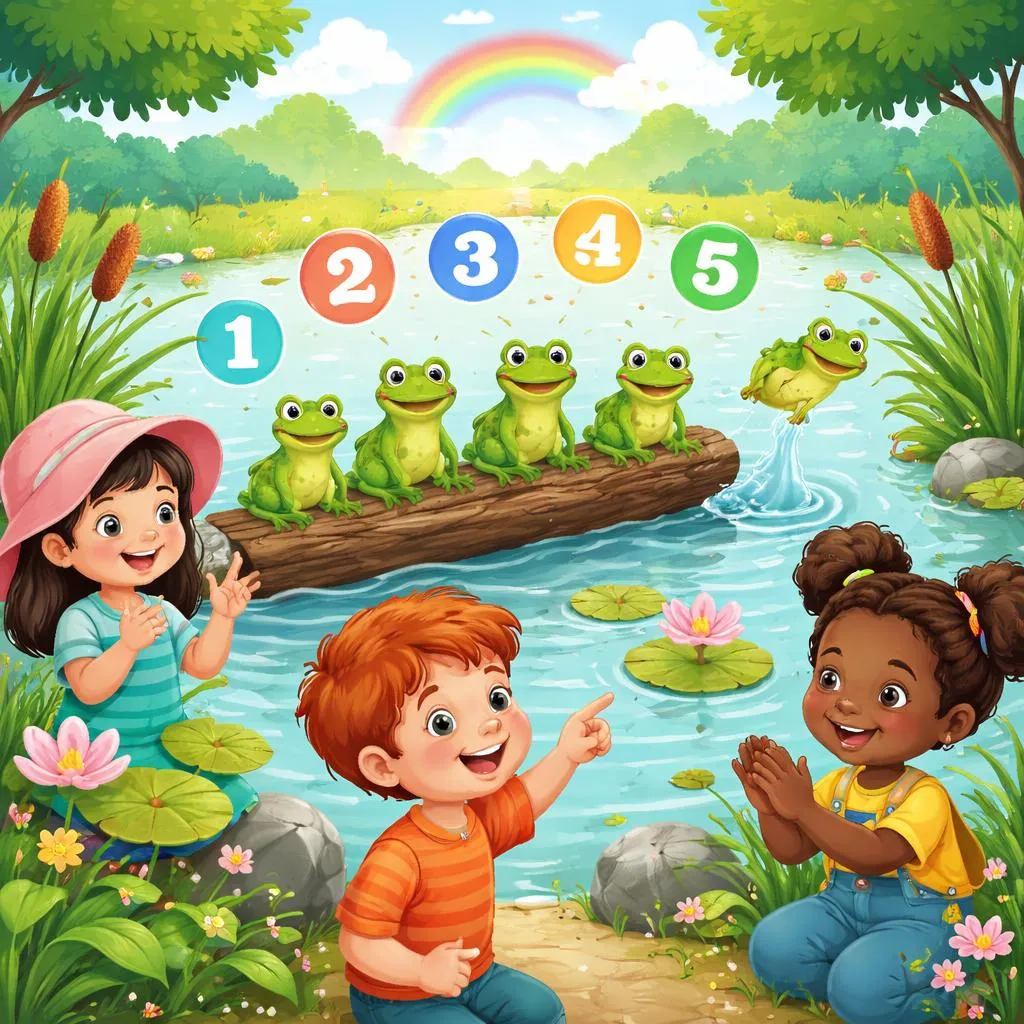

Hello, dear teachers and parents! Today brings a wonderful opportunity to explore a beloved counting song. This catchy tune has entertained children for generations. It tells the story of five frogs sitting by a pool. One by one, they jump into the water. The "Five Green and Speckled Frogs Song" offers so much more than fun. It teaches subtraction naturally through repetition. It introduces animal vocabulary and descriptive words. The simple melody makes learning effortless. Let us discover together why this song remains a favorite in classrooms everywhere.
What Is the "Five Green and Speckled Frogs" Nursery Rhyme? The "Five Green and Speckled Frogs Song" is a classic children's counting rhyme. It also goes by the name "Five Little Speckled Frogs." The song follows a simple pattern. Five frogs sit on a log eating bugs. One by one, they jump into the pool. The water is nice and cool. After each frog jumps, the number decreases. The song continues until no frogs remain.
The story takes place in a peaceful setting. A log sits by a pool of water. Flies and bugs buzz nearby. The frogs enjoy their meal. The cool water invites them in. Each frog makes the choice to jump. The repetition helps children predict what comes next.
What makes this song special is its mathematical structure. Each verse subtracts one frog from the group. Children see and hear the number decreasing. They learn counting backward naturally. The song provides concrete practice with early subtraction concepts.
The "Five Green and Speckled Frogs Song" also teaches through rhythm. The words flow in a bouncy, frog-like pattern. Children clap along or bounce as they sing. The physical movement reinforces the learning. Music, movement, and math combine into one joyful experience.
The Lyrics of the "Five Green and Speckled Frogs" Song Let us look closely at the words of this wonderful song. The lyrics follow a clear pattern that helps children learn. Here are the complete verses.
The first verse introduces all five frogs:
Five green and speckled frogs Sat on a speckled log Eating some most delicious bugs Yum yum One jumped into the pool Where it was nice and cool Then there were four green speckled frogs Glub glub
The second verse continues with four frogs:
Four green and speckled frogs Sat on a speckled log Eating some most delicious bugs Yum yum One jumped into the pool Where it was nice and cool Then there were three green speckled frogs Glub glub
The pattern repeats for three frogs, then two frogs:
Three green and speckled frogs Sat on a speckled log Eating some most delicious bugs Yum yum One jumped into the pool Where it was nice and cool Then there were two green speckled frogs Glub glub
Two green and speckled frogs Sat on a speckled log Eating some most delicious bugs Yum yum One jumped into the pool Where it was nice and cool Then there was one green speckled frog Glub glub
The final verse ends with one frog:
One green and speckled frog Sat on a speckled log Eating some most delicious bugs Yum yum It jumped into the pool Where it was nice and cool Then there were no green speckled frogs Glub glub
The repeated "Yum yum" and "Glub glub" give children fun parts to sing. The number change each verse builds anticipation. Children love counting down to zero.
Vocabulary Learning from the Frog Song The "Five Green and Speckled Frogs Song" introduces wonderful new words. Young learners encounter number words first. Five, four, three, two, one, and zero appear in sequence. Children learn to count backward through repetition.
Color words enrich the vocabulary learning. Green describes the frogs' color. Speckled describes their spotted pattern. These descriptive words build adjective knowledge. Children learn that speckled means covered with small marks or spots.
Animal vocabulary centers on frogs. Children learn where frogs live. They sit on a log by a pool. They eat bugs for food. They jump into water. This builds basic knowledge about amphibians and their habitat.
Food words add tasty vocabulary. The frogs eat bugs described as "most delicious." Children learn that delicious means very tasty. They connect the word with the frogs' enjoyment. The "Yum yum" sound reinforces the meaning.
Action words fill every verse. Sat describes the frogs' position. Eating describes their activity. Jumped shows their movement into the pool. These verbs help children describe actions in their own lives.
Nature words create the setting. Log, pool, and bugs all appear. Children learn that a log is a piece of wood from a tree. A pool is a small body of water. Bugs are small insects. The song builds environmental vocabulary naturally.
Phonics Points in the Frog Song Phonics learning happens naturally with this song. The rhythm and rhyme draw attention to word patterns. Children hear specific sounds again and again.
The short "o" sound appears frequently. Log and frog share this sound. Children hear the pattern clearly. They start to notice that rhyming words often share spelling patterns. This builds foundational reading skills.
The "oo" sound appears in pool and cool. This vowel combination makes a long sound. Children practice forming this sound through repetition. They feel their lips round as they sing. This physical practice builds articulation skills.
The "gr" blend appears in green and frogs. This consonant combination requires precise mouth movement. Children practice blending the "g" and "r" sounds smoothly. The song provides many opportunities for this practice.
The "sp" blend appears in speckled. This combination also requires practice. Children learn that "sp" at the beginning of words makes a special sound. They can find other "sp" words like spot or spin after learning this song.
Word families emerge from the rhyme. The "-og" family includes frog and log. Children learn that changing the first sound creates new words. This understanding supports decoding skills for reading. Dog, hog, and bog all follow the same pattern.
Grammar Patterns Emerging from the Song Grammar teaching becomes effortless with this song. The natural language provides perfect models. Children absorb correct structures without formal lessons.
Number agreement appears throughout. "Five frogs sat" uses plural verb form. "One frog sat" uses singular. Children hear the difference naturally. They learn that subjects and verbs must agree in number.
Past tense verbs tell the story. Sat, jumped, and was all show completed actions. Children learn that adding "-ed" often creates past tense. They also encounter irregular past forms like sat. This variety builds flexible grammar understanding.
Prepositions show location. On the log describes position above the surface. Into the pool shows movement from outside to inside. Children absorb these small but important words through context.
Descriptive adjectives add detail. Green and speckled modify frogs. Delicious modifies bugs. Nice and cool modify pool. Children learn that adjectives add information to nouns. Their own descriptions become richer through this modeling.
The phrase "there were" introduces existence statements. "There were five frogs" tells what existed. "There were no frogs" shows absence. This structure appears frequently in English. Children gain familiarity through repetition.
Learning Activities for the Frog Song The "Five Green and Speckled Frogs Song" inspires countless learning activities. These ideas extend the song into deeper language practice. Each activity builds different skills while maintaining the fun.
Frog puppets bring counting to life. Create simple frog puppets using green paper or craft foam. Add spots with markers or stickers. Children use five puppets while singing. Each time a frog jumps, they remove one puppet. This hands-on experience makes subtraction visible. Children see the number decreasing right before their eyes.
Log and pool dramatic play creates the story setting. Use a brown towel or paper for the log. Blue fabric or paper represents the pool. Place five frog toys on the log. Children act out the song, moving one frog to the pool each verse. This physical experience reinforces counting concepts.
Frog counting mats provide structured practice. Print simple mats showing a log and a pool. Give children five frog counters. As the song plays, they move counters from log to pool. The mat keeps the activity organized. Children develop fine motor skills along with math understanding.
Number sequencing extends learning beyond the song. After singing, arrange number cards from one to five. Practice counting forward. Then arrange them backward from five to one. Connect this to the song's action. Each verse moved one frog, making the number go down by one.
Bug eating game adds pretend play. Place small bug pictures or toys around the room. Children pretend to be frogs. They hop around "eating" bugs by collecting them. Count how many each child collects. This builds counting skills while connecting to the song's content.
Printable Materials for the Frog Song Printable materials support learning at home and school. These resources give children something to hold and use. They extend the song into independent practice.
Frog counting cards provide versatile learning tools. Print cards showing one to five frogs on a log. Children arrange them in order. They match each card to the correct number. They use them while singing to follow along. Laminating extends their life for repeated use.
Frog and log templates inspire creative projects. Print simple outlines of frogs and a log. Children color and cut them out. They can create their own counting scenes. They can glue the correct number of frogs onto the log. This builds number sense along with fine motor skills.
Mini books let children own the song. Create a simple folded book with pages for each verse. Each page shows the correct number of frogs. Simple text guides singing. Children color the illustrations. They practice reading their books to family members. This builds pride and reading confidence.
Number writing worksheets connect the song to math skills. Create pages with traceable numbers from one to five. Children practice writing each number. They draw the correct number of frogs beside each number. This builds number recognition and formation skills.
Word cards focus on key vocabulary. Print each important word separately. Frog, log, pool, bugs, green, speckled, jump, eat appear on cards. Children match words to pictures. They arrange words in song order. They use cards for spelling practice. Multiple uses from one simple resource.
Educational Games Based on the Song Games turn learning into pure joy. These game ideas use the "Five Green and Speckled Frogs Song" as their foundation. Children practice language and math skills while having fun.
Frog Hop Counting gets children moving. Create five large lily pads from paper. Number them from one to five. Place them on the floor. Children hop from pad to pad while counting. For backward counting, arrange pads in reverse order. Call out numbers for children to find and hop to. This combines movement with number recognition.
Hide and Seek Frogs builds observation skills. Hide five frog toys around the room. Children search for them while singing. Each time someone finds a frog, everyone sings the corresponding verse. For the first frog found, sing about five frogs. For the second, sing about four, and so on. This builds anticipation and number awareness.
Frog Pond Sensory Bin provides exploratory play. Fill a bin with blue water beads or blue rice. Add a small log made from bark or brown clay. Place five toy frogs in the bin. Children play freely while singing. They move frogs from log to water. The sensory experience reinforces the song's content.
Memory Match builds vocabulary recognition. Create pairs of cards showing song elements. One pair shows a frog. Another shows a log. Another shows bugs. Another shows the pool. Place cards face down. Children take turns finding matches. When they make a match, they use the word in a sentence from the song.
What Number Is Missing? challenges number sense. Place five frog toys on the log. Children close their eyes. Remove one frog. Children open their eyes and identify how many frogs remain. They also identify how many jumped away. This builds early subtraction skills in a playful context.
The "Five Green and Speckled Frogs Song" continues teaching long after the final "Glub glub." Its simple story carries rich learning potential. Number words become concrete through repetition. Subtraction concepts develop naturally. Vocabulary grows through meaningful context. Phonics patterns emerge from rhyming words. Grammar structures appear in natural language. Every child connects to the playful frogs and their cool pool adventure. Through this beloved song, children learn without even trying. They absorb English and math through joyful participation. That is the lasting magic of counting songs in early childhood education.