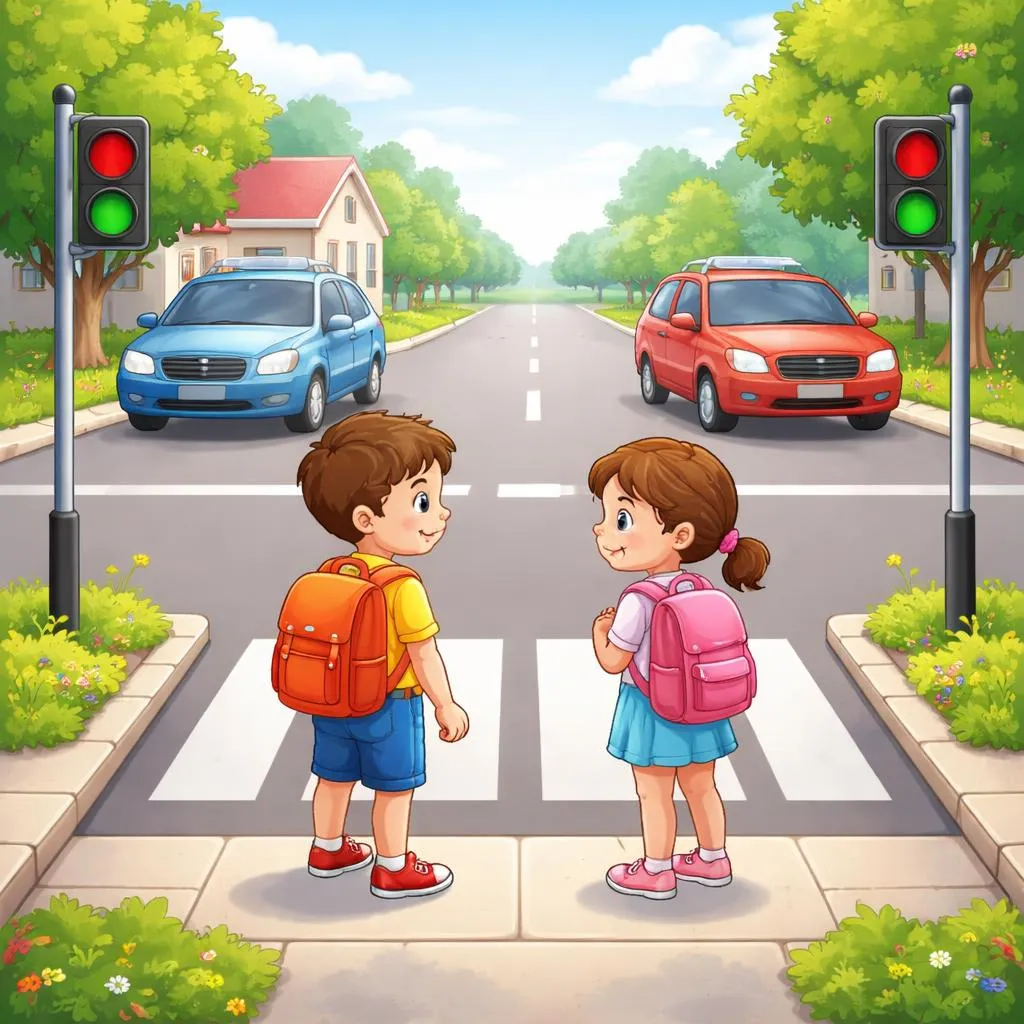

Hello, wonderful young learners! Today brings an essential lesson about keeping safe. Every day, children walk near streets and roads. Knowing how to cross safely saves lives. The simple phrase "stop and wait look both ways" contains powerful guidance. These words remind us of crucial steps before crossing. Let us discover together why this rule matters so much and how to practice it every time.
Meaning: What Does "Stop and Wait Look Both Ways" Really Mean? The phrase "stop and wait look both ways" describes the safe way to cross a street. Each word represents an important action. Together, they form a life-saving routine.
Stop means exactly that. Come to a complete halt. Do not keep moving toward the street. Place both feet firmly on the ground. Stopping gives time to think and observe. It prevents rushing into danger.
Wait means pause before proceeding. Do not step off the curb immediately. Take a moment to prepare for the next steps. Waiting creates space for careful observation. It builds the habit of patience near roads.
Look both ways means check in every direction. First look left for cars coming from that side. Then look right for cars approaching from the other direction. Then look left again because cars move quickly. This thorough checking ensures nothing gets missed.
These three actions work together as a complete safety routine. Children learn to do them in order every single time. The repetition builds automatic habits. Eventually, children follow these steps without even thinking about them.
Conjugation: Using Safety Verbs in Different Situations The verbs in "stop and wait look both ways" can change to match different subjects. Understanding these forms helps children talk about safety in various contexts.
For "I," we say "I stop, I wait, I look both ways." A child might tell a parent, "I always stop before the street." This describes personal action.
For "you," we say "you stop, you wait, you look both ways." A teacher might remind a class, "You stop at the curb." This gives direct instruction.
For "we," we say "we stop, we wait, we look both ways." A group crossing together uses this form. "We all stop together before crossing."
For past tense, we use "stopped, waited, looked." "Yesterday, I stopped at the corner and looked both ways." This describes completed actions.
For future tense, we use "will stop, will wait, will look." "Tomorrow, we will stop and wait before crossing." This talks about planned actions.
The imperative form gives commands. "Stop!" "Wait!" "Look both ways!" Adults use these short commands in urgent situations. Children learn to respond immediately to these words.
Present Tense: Using Safety Rules Every Day The present tense describes actions happening now or always true. Safety rules belong in this category. They apply every single day.
Every time children approach a street, they stop. They do not continue walking toward the road. Their feet stop moving completely. This action happens in the present moment each time.
After stopping, they wait. They pause at the edge of the sidewalk. They do not step down into the street. Waiting gives them time for the next step.
Then they look both ways. They turn their head left to see cars coming from that direction. They turn their head right to check the other side. They look left again to double-check. This happens every time, in the present moment.
The rule applies in all locations. At school, children stop and wait look both ways before crossing streets near the building. At home, they follow the same rule near their own neighborhood. At the park, the rule still applies when leaving to go home.
Parents and teachers model this present tense behavior. Children watch adults stop and wait look both ways. They see that the rule applies to everyone, not just children. This modeling reinforces the lesson.
Past Tense: Remembering Safe Crossings The past tense helps children talk about times they followed safety rules. These conversations reinforce learning and build confidence.
A child might tell a parent, "I stopped at the corner today." The parent can praise this good behavior. "I waited for you after school." This describes a recent action. "I looked both ways before crossing with my teacher." This shares a successful safety experience.
Teachers can ask questions using past tense. "Who stopped at the crosswalk this morning?" Children raise hands and share experiences. "Did everyone wait for the crossing guard?" This checks understanding of daily routines.
Past tense also helps discuss mistakes safely. "Yesterday, I forgot to look both ways." This admission opens conversation about why looking matters. "I almost stepped into the street without stopping." This real concern leads to deeper learning about consequences.
Parents can share their own past experiences. "When I was little, I ran into the street once." This honesty helps children understand that everyone must learn safety. "I learned to always stop after that scare." The lesson becomes personal and memorable.
Future Tense: Planning for Safe Crossings The future tense helps children think ahead about safety. Planning builds intention and commitment.
Before a field trip, a teacher might say, "We will stop at every corner tomorrow." Children visualize themselves following the rule. "Everyone will wait for the signal from a teacher." This prepares them for the upcoming situation.
Parents can use future tense during morning routines. "When we walk to school today, we will look both ways at Maple Street." This previews the specific crossing ahead. Children mentally prepare for the action.
Children can make promises using future tense. "I will stop and wait every time." "I will look both ways before crossing." These commitments build personal responsibility. Saying the words aloud strengthens intention.
Future tense also helps with goal setting. "Soon I will be able to cross with my older sister." This acknowledges growing independence. "I will remember to always stop first." This reinforces the priority of the first step.
Questions: Asking About Safety Rules Questions help children understand why safety rules matter. They also check comprehension and build critical thinking.
Basic questions establish knowledge. "Where do we stop?" The answer identifies the curb or edge of the sidewalk. "How long do we wait?" The answer emphasizes waiting until no cars come. "Why do we look both ways?" The answer explains that cars come from two directions.
Hypothetical questions build deeper understanding. "What if a car looks far away but moves fast?" This helps children understand that distance can be deceiving. "What if we stop but our friend keeps walking?" This addresses peer pressure and personal responsibility.
Safety check questions prepare children for real situations. "Do you see any cars coming?" "Is it safe to cross now?" "Which way do we look first?" These questions become internal dialogue as children mature.
Parents and teachers can use questions to guide rather than command. "What should we do before crossing this street?" The child recalls the rule independently. "Which direction should we look first?" This prompts the correct sequence without simply telling.
Other Uses: Extending Safety Language Beyond Streets The phrase "stop and wait look both ways" teaches lessons beyond street safety. The same principles apply to many situations.
In social situations, children can stop before reacting. Instead of immediate response, they pause. They wait to think about what happened. They look both ways by considering different perspectives. This thoughtful approach prevents conflicts.
When making decisions, the same pattern helps. Stop before choosing impulsively. Wait to consider options. Look both ways at possible consequences. This builds critical thinking skills that last a lifetime.
In the classroom, children stop talking when the teacher needs attention. They wait for instructions. They look at the teacher to show they are ready. This classroom management application extends the safety lesson.
When feeling strong emotions, the rule applies. Stop before saying something hurtful. Wait for the intense feeling to pass. Look both ways at how words might affect others. This emotional intelligence builds from the familiar safety phrase.
Learning Tips: Making Safety Rules Stick Teaching "stop and wait look both ways" requires repetition and reinforcement. These tips help make the lesson memorable.
Use a simple song or chant. "Stop, wait, look both ways. Do it every time!" Music helps memory. Children can sing while practicing the actions. The tune becomes associated with the safety routine.
Create hand motions for each step. Hold up one hand like a stop sign for "stop." Hold both hands out like waiting for "wait." Point left, then right, then left again for "look both ways." Physical movement reinforces learning.
Practice at every opportunity. Every time the class approaches a street, say the words together. Children perform the actions. This repeated practice builds automatic habits. Eventually, they do it without reminders.
Use stories about animals or characters who follow the rule. A bunny who always stops and looks before hopping across the path. A puppy who learns to wait for his mother. Stories make the rule memorable and engaging.
Praise every safe behavior. "I saw you stop at the corner. Excellent work!" "You looked both ways so carefully!" Positive reinforcement encourages repetition of good habits.
Educational Games: Practicing Safety Through Play Games make safety practice enjoyable. These activities help children internalize "stop and wait look both ways" through play.
Red Light, Green Light teaches stopping and waiting. When the leader says "red light," everyone stops. When the leader says "green light," they walk forward. This game practices the stop command in a fun context. Add "look both ways" as an extra command for more practice.
Safety Simon Says incorporates the full routine. "Simon says stop at the curb." Children stop. "Simon says look both ways." Children turn their heads left and right. "Simon says wait for the signal." Children pause. This builds listening skills along with safety knowledge.
Crossing Guard Dramatic Play lets children practice in character. Set up a pretend street with chairs or tape. One child plays the crossing guard. Others practice stopping, waiting, and looking before crossing. The crossing guard gives feedback. This role-play builds confidence.
Traffic Light Craft reinforces the visual cues. Create paper traffic lights with red, yellow, and green circles. Red means stop. Yellow means wait and prepare. Green means look both ways and go if safe. Children use their crafts during practice crossings.
Safety Bingo builds vocabulary and recognition. Create bingo cards with safety images. Stop sign, traffic light, crosswalk, crossing guard, looking left, looking right. Call out the images or descriptions. Children cover matching pictures. This builds safety vocabulary.
Obstacle Course Crossing combines physical activity with safety practice. Set up a simple obstacle course. Include a "street" marked with tape. Children must stop, wait, and look both ways before crossing. They complete the rest of the course afterward. This builds the habit of pausing before crossing, even when excited.
The phrase "stop and wait look both ways" carries life-saving importance. These simple words guide children through the most dangerous part of any journey. The street crossing routine protects them from harm. But the lessons extend far beyond traffic safety. Stopping before acting builds impulse control. Waiting develops patience. Looking both ways teaches thorough observation. These skills serve children throughout life. Every time they pause to think before speaking, they use the stop skill. Every time they wait for the right moment, they use the wait skill. Every time they consider different perspectives, they use the look both ways skill. A simple safety phrase becomes a framework for thoughtful living. Teaching children to stop, wait, and look both ways at streets also teaches them to approach all of life with care and attention. That is the deeper gift of this essential safety rule.