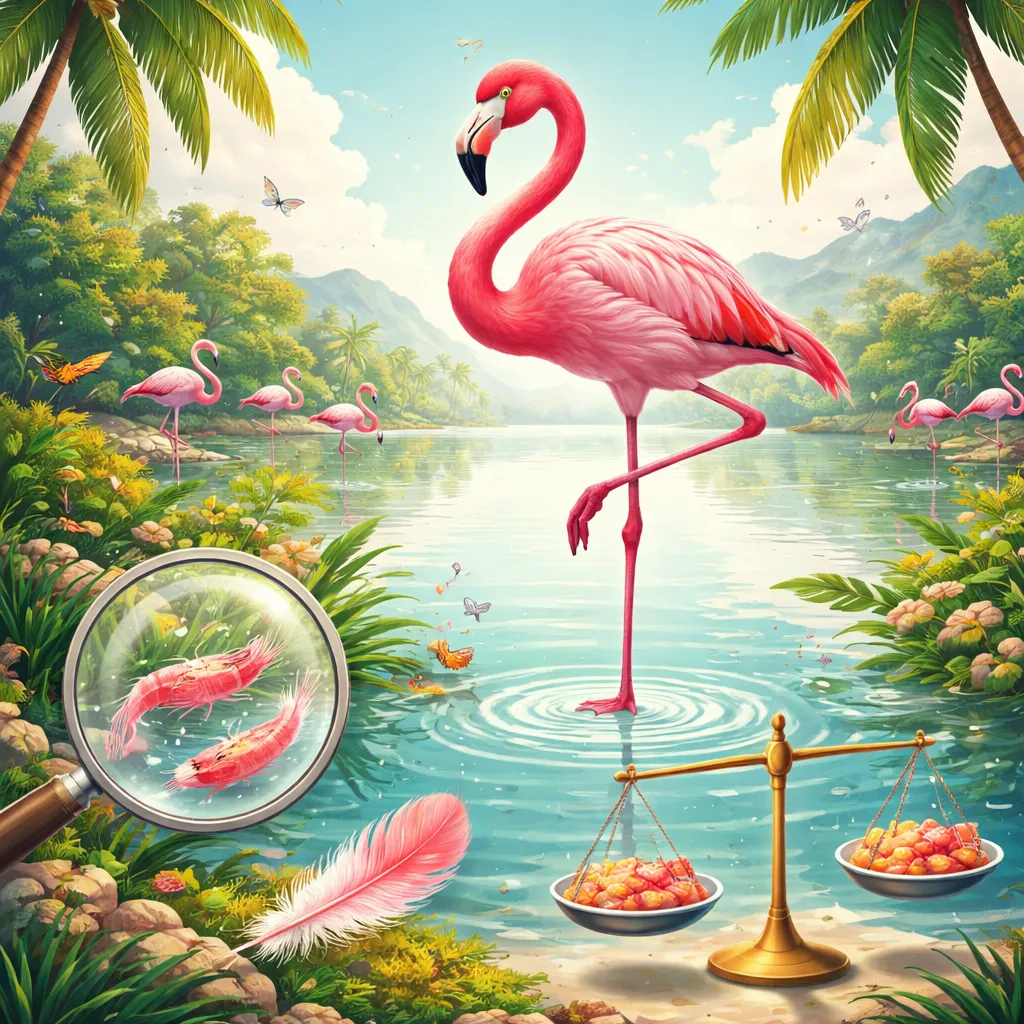

Have you ever seen a picture of a bird standing on one long, thin leg, with beautiful pink feathers and a funny, curved beak? That’s a flamingo! These elegant birds look like they’re from a fairy tale. With their bright color and amazing balance, flamingos are fascinating to watch. Learning about flamingos is a colorful adventure that takes us to shallow lakes and lagoons. Let’s begin our journey of learning about flamingo beauty and secrets.
English Language Learning
Vocabulary and Spelling Our elegant, pink friend is called a flamingo. The word "flamingo" is a noun. A noun names a person, place, or thing. So, a flamingo is a thing—a tall, living bird. Spelling "flamingo" is interesting: F-L-A-M-I-N-G-O. The 'F' starts the word, the 'L' and 'A' are in the middle, and it ends with 'M-I-N-G-O'. F-L-A-M-I-N-G-O spells flamingo.
Sound and Pronunciation Let’s say the word correctly. It sounds like this: /fləˈmɪŋ.ɡoʊ/. We can say it in three clear parts. First, say "fluh". It’s a soft, quick sound. Next, say "ming". It rhymes with "sing". Last, say "go". It’s just like the word "go". Now, put it together! "Fluh" "ming" "go". Flamingo! Great! The word "flamingo" has three beats, or three syllables. Clap three times: Fla-min-go. It’s a fun, flowing word.
Related Words Learning about flamingos is more fun with new words! Here are some important ones. Group: A group of flamingos is called a flamboyance. A baby flamingo is called a chick. Body Part: A flamingo’s long, thin leg is perfect for wading. Its curved beak is for filter-feeding. Action: The way flamingos stand on one leg is called unipedal standing.
A Famous Saying People sometimes say: "As graceful as a flamingo." This means someone who is very elegant, poised, and balanced. It comes from the flamingo’s calm, one-legged stance and smooth movements. It reminds us to carry ourselves with grace and poise. Say the saying with me: "As graceful as a flamingo." Can you stand as gracefully?
Now you know the word "flamingo"! Are you ready to learn about these stunning birds? Let’s wade from words to wonderful knowledge!
Animal Knowledge
Who Are They? – Family and Group What kind of animal is a flamingo? Flamingos are birds. They are warm-blooded, have feathers, and lay eggs. They are in their own family, Phoenicopteridae. There are six species, like the Greater Flamingo and the American Flamingo. They are ancient birds, related to grebes and pigeons.
What Do They Look Like? – Amazing Bodies Flamingos are tall birds, as tall as a young child! They have very long legs, a long neck, and bright pink or orange feathers. Their most famous features are their long, stilt-like legs and their curved, filter-feeding beak. Their pink color is a super clue to their diet! They get their color from the carotenoids in the algae and tiny shrimp they eat. No shrimp, no pink! Their special beak is upside down to help them filter food from the water. Flamingos have special adaptations. They are filter feeders. They turn their heads upside down in the water and use their tongue to pump water through their beak, trapping tiny food. Their long legs let them wade into deeper water than other birds.
Where Do They Live and How? – Home and Habits Flamingos live in warm, shallow waters. Their homes are salt lakes, lagoons, and mudflats in Africa, Asia, the Americas, and Europe. They need salty or alkaline water that has lots of tiny food. Flamingos are filter feeders. This means they eat very small plants and animals. Their diet is algae, diatoms, and small crustaceans like brine shrimp. They are the reason they are pink! Flamingos are very social and live in huge colonies of thousands of birds. They are active during the day. They spend their time wading, filter-feeding, preening their feathers, and resting. A group on the ground is a flamboyance.
A Flamingo’s Life Story – Growing Up A baby flamingo is called a chick. Flamingos are birds, so chicks hatch from eggs. Parents build a tall mud nest to keep the egg safe, and they lay one egg at a time. Both parents take care of the chick. They take turns keeping the egg warm and then feeding the chick a special "crop milk" they make in their throat. The chicks gather in large groups called crèches. Chicks are born with gray or white fluffy feathers. They are not pink! They get their pink color from their diet as they grow. They learn to walk and swim quickly but stay with the colony for protection. It takes a few years for them to turn completely pink.
How Do They "Talk"? – Communication Flamingos are very noisy in their colonies! They honk, grunt, and make goose-like calls. Their calls help the colony stay together. They use impressive body language. Their group displays, where they all move together, marching and turning, are a way to talk and strengthen their bonds. Preening each other is also a friendly act. Their best senses are their eyesight and hearing. They have good vision to spot predators and to coordinate in large groups. Their hearing helps them stay in touch in a noisy colony.
Are They Okay? – Taking Care of Them Some flamingo species are doing well, but others are near threatened. Their special wetland homes are fragile. The main threats are pollution of their water, disturbance of their nesting sites, and climate change affecting water levels. People sometimes collect their eggs. You can be a flamingo friend! You can support groups that protect wetlands and lakes around the world. You can be mindful of water pollution. If you visit a place with flamingos, always watch from a designated distance and never disturb them.
Life Connections and Inspiration
How to Be With Them – Safety and Love Flamingos are wild birds that live in sensitive environments. We must always respect them and their space. The rule is: Admire their beauty from a very safe distance. In the wild, use binoculars or a viewing platform. Never try to approach, feed, or scare a flamingo. Never enter their feeding or nesting areas. Your presence can stress them and damage their habitat. We show our love by protecting the clean, salty waters and mudflats they call home. We can be advocates for the conservation of all wetlands.
Super Qualities We Learn from Them Flamingos teach us wonderful things. One super quality is perfect balance and poise. A flamingo can stand on one leg for hours, even while sleeping. This teaches us the importance of finding our balance, both physically and in life—balancing work, play, and rest. Another quality is the beauty of community. Flamingos thrive in huge, vibrant colonies. They are safer and stronger together. This reminds us of the power and beauty of our own communities, families, and friendships. We are more colorful and stronger together. Think about it: How can you find your own balance in daily activities? How can you contribute to and appreciate your own community, like a flamingo in its flamboyance?
Take Action! – Your "Flamingo Balance" Project Let’s do a graceful and balancing activity! Your project is to create a flamingo sculpture that balances on one leg. Use colorful pipe cleaners or modeling clay. Make a long, thin body and a long neck. Shape a small head with a curved beak. Now, the challenge: can you make it stand on one pipe cleaner or clay leg? You might need a base. Decorate it with pink feathers or pink paper. This shows the flamingo’s amazing balance and lets you practice your own design skills.
Closing Learning about flamingo grace is a vibrant and wonderful adventure! We learned the word "flamingo" and how to say its three-part name. We discovered amazing facts about their pink color from shrimp, their filter-feeding beaks, and their life in huge, colorful colonies. We know that flamingos are balanced, social birds that need clean, salty wetlands to survive. You can use your new words to share the dazzling story of these elegant birds. You can use your knowledge to understand the importance of wetlands and wildlife protection. The animal world is full of balanced and communal teachers. Always remember to respect wildlife from a safe distance, find your own balance in life, and value the strength and beauty of your community. Keep exploring with curiosity, stand tall with grace, and be a friend to the wild. Your caring actions and balanced spirit make you a true friend to the amazing flamingo.