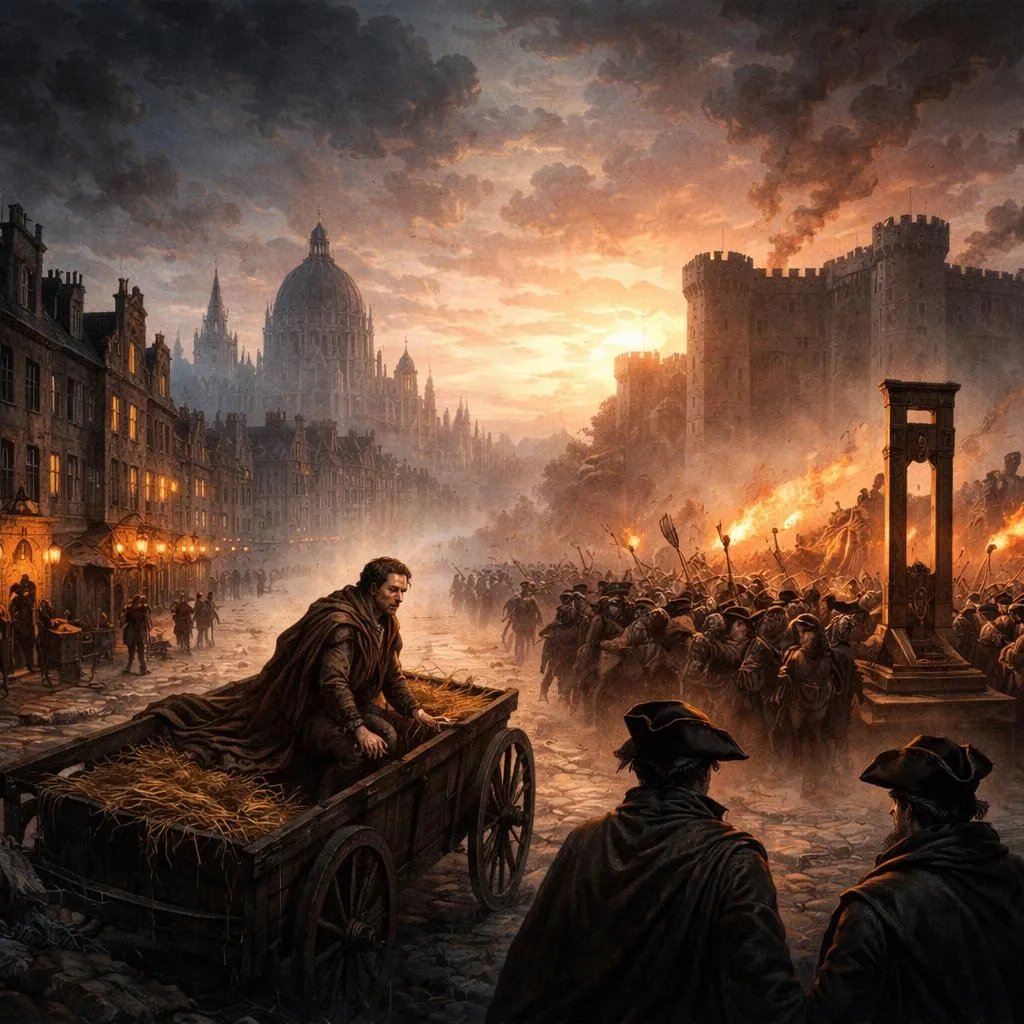

It was the best of times, it was the worst of times, it was the age of wisdom, it was the age of foolishness, it was the epoch of belief, it was the epoch of incredulity, it was the season of Light, it was the season of Darkness, it was the spring of hope, it was the winter of despair, we had everything before us, we had nothing before us, we were all going direct to Heaven, we were all going direct the other way—in short, the period was so far like the present period, that some of its noisiest authorities insisted on its being received, for good or for evil, in the superlative degree of comparison only.
There were a king with a large jaw and a queen with a plain face, on the throne of England; there were a king with a large jaw and a queen with a fair face, on the throne of France. In both countries it was clearer than crystal to the lords of the State preserves of loaves and fishes, that things in general were settled for ever.
It was the year of Our Lord one thousand seven hundred and seventy-five. Spiritual revelations were conceded to England at that favoured period, as at this. Mrs. Southcott had recently attained her five-and-twentieth blessed birthday, of whom a prophetic private in the Life Guards had heralded the sublime appearance by announcing that arrangements were made for the swallowing up of London and Westminster. Even the Cock-lane ghost had been laid only a round dozen of years, after rapping out its messages, as the spirits of this very year last past (supernaturally deficient in originality) rapped out theirs. Mere messages in the earthly order of events had lately come to the English Crown and People, from a congress of British subjects in America: which, strange to relate, have proved more important to the human race than any communications yet received through any of the chickens of the Cock-lane brood.
France, less favoured on the whole as to matters spiritual than her sister of the shield and trident, rolled with exceeding smoothness down hill, making paper money and spending it. Under the guidance of her Christian pastors, she entertained herself, besides, with such humane achievements as sentencing a youth to have his hands cut off, his tongue torn out with pincers, and his body burned alive, because he had not kneeled down in the rain to do honour to a dirty procession of monks which passed within his view, at a distance of some fifty or sixty yards. It is likely enough that, rooted in the woods of France and Norway, there were growing trees, when that sufferer was put to death, already marked by the Woodman, Fate, to come down and be sawn into boards, to make a certain movable framework with a sack and a knife in it, terrible in history. It is likely enough that in the rough outhouses of some tillers of the heavy lands adjacent to Paris, there were sheltered from the weather that very day, rude carts, bespattered with rustic mire, snuffed about by pigs, and roosted in by poultry, which the Farmer, Death, had already set apart to be his tumbrils of the Revolution. But that Woodman and that Farmer, though they work unceasingly, work silently, and no one heard them as they went about with muffled tread: the rather, forasmuch as to entertain any suspicion that they were awake, was to be atheistical and traitorous.
In England, there was scarcely an amount of order and protection to justify much national boasting. Daring burglaries by armed men, and highway robberies, took place in the capital itself every night; families were publicly cautioned not to go out of town without removing their furniture to upholsterers’ warehouses for security; the highwayman in the dark was a City tradesman in the light, and, being recognised and challenged by his fellow- tradesman whom he stopped in his character of “the Captain,” gallantly shot him through the head and rode away; the mall was waylaid by seven robbers, and the guard shot three dead, and then got shot dead himself by the other four, “in consequence of the failure of his ammunition:” after which the mall was robbed in peace; that magnificent potentate, the Lord Mayor of London, was made to stand and deliver on Turnham Green, by one highwayman, who despoiled the illustrious creature in sight of all his retinue; prisoners in London gaols fought battles with their turnkeys, and the majesty of the law fired blunderbusses in among them, loaded with rounds of shot and ball; thieves snipped off diamond crosses from the necks of noble lords at Court drawing-rooms; musketeers went into St. Giles’s, to search for contraband goods, and the mob fired on the musketeers, and the musketeers fired on the mob, and nobody thought any of these occurrences much out of the common way. In the midst of them, the hangman, ever busy and ever worse than useless, was in constant requisition; now, stringing up long rows of miscellaneous criminals; now, hanging a housebreaker on Saturday who had been taken on Tuesday; now, burning people in the hand at Newgate by the dozen, and now burning pamphlets at the door of Westminster Hall; to-day, taking the life of an atrocious murderer, and to-morrow of a wretched pilferer who had robbed a farmer’s boy of sixpence.
All these things, and a thousand like them, came to pass in and close upon the dear old year one thousand seven hundred and seventy-five. Environed by them, while the Woodman and the Farmer worked unheeded, those two of the large jaws, and those other two of the plain and the fair faces, trod with stir enough, and carried their divine rights with a high hand. Thus did the year one thousand seven hundred and seventy-five conduct their Greatnesses, and myriads of small creatures—the creatures of this chronicle among the rest—along the roads that lay before them.
Contexte et présentation de l'auteur
Ce passage est le célèbre début d'Un conte de deux cités, un roman historique écrit par Charles Dickens, publié pour la première fois en 1859. Dickens était l'un des plus grands romanciers anglais de l'époque victorienne, connu pour ses personnages vivants, sa critique sociale et sa narration qui combinait drame, humour et une profonde empathie pour les luttes humaines. Un conte de deux cités se déroule pendant les temps turbulents de la Révolution française, contrastant la vie à Londres et à Paris. Le roman explore les thèmes du sacrifice, de la résurrection et de l'affrontement entre la tyrannie et la liberté.
Interprétation détaillée et signification
Les premiers vers donnent le ton à l'ensemble du roman en présentant un monde de contradictions—espoir et désespoir, sagesse et folie, lumière et obscurité. Dickens utilise ces opposés pour souligner la complexité de l'époque, montrant que l'histoire n'est jamais simplement bonne ou mauvaise, mais un mélange des deux. Les « meilleurs des temps » et les « pires des temps » reflètent les bouleversements sociaux et politiques qui ont façonné le XVIIIe siècle et font écho aux défis auxquels nous sommes confrontés aujourd'hui.
Le passage introduit les troubles politiques et sociaux en Angleterre et en France, laissant entrevoir la révolution à venir. Dickens brosse un tableau vivant de l'injustice, de la cruauté et de l'inégalité, comme les punitions sévères en France et l'anarchie en Angleterre. Les figures métaphoriques du Bûcheron (le Destin) et du Fermier (la Mort) préparant silencieusement les outils de la révolution rappellent aux lecteurs que les grands changements historiques se produisent souvent en silence, inaperçus jusqu'à ce qu'ils éclatent.
Leçons et perspectives pour les étudiants
-
Comprendre la complexité de l'histoire : Le passage enseigne aux étudiants que l'histoire est multiforme. Les événements ont de multiples facettes et impacts, et la compréhension de cette complexité aide à développer la pensée critique.
-
Empathie et justice : La représentation de la souffrance et de l'injustice par Dickens encourage les lecteurs à faire preuve d'empathie envers ceux qui sont opprimés et à valoriser l'équité et les droits de l'homme.
-
Le pouvoir du changement : Le roman montre que le changement est inévitable, parfois violent, mais nécessaire au progrès. Les étudiants peuvent en apprendre davantage sur la résilience et l'importance de défendre la justice.
-
Réflexion morale : Le contraste entre la lumière et l'obscurité invite les lecteurs à réfléchir à leurs propres choix—comment la sagesse et la folie coexistent, et comment la croyance et le scepticisme façonnent nos vies.
Application dans la vie, les études et les situations sociales
-
Dans l'apprentissage : Les étudiants peuvent appliquer la leçon consistant à regarder au-delà des apparences pour comprendre des vérités plus profondes, que ce soit en histoire, en littérature ou dans l'actualité.
-
Dans les interactions sociales : L'accent mis par le roman sur l'empathie et la justice peut inspirer les étudiants à être gentils et justes dans leurs relations, en reconnaissant les luttes des autres.
-
Dans le développement personnel : Le thème de la résurrection et de la transformation encourage les étudiants à croire aux secondes chances et à la possibilité d'une amélioration personnelle.
Cultiver des valeurs positives à partir de l'histoire
-
Courage et sacrifice : Les personnages du roman font preuve de bravoure face au danger. Les étudiants peuvent apprendre à affronter les défis avec courage et à valoriser l'altruisme.
-
Conscience et responsabilité : Le travail silencieux du Bûcheron et du Fermier enseigne que même les actions invisibles ont des conséquences. Les étudiants doivent être conscients de leurs choix et de leurs responsabilités.
-
Pensée critique : En reconnaissant les contradictions et les complexités, les étudiants développent la capacité d'analyser les situations de manière critique plutôt que d'accepter des explications simples.
Conclusion
Un conte de deux cités reste une histoire puissante pour les jeunes lecteurs, offrant de riches leçons sur l'histoire, la nature humaine et la moralité. Il encourage les étudiants non seulement à comprendre le passé, mais aussi à appliquer ses leçons dans leur vie quotidienne—en favorisant l'empathie, la justice, le courage et une réflexion approfondie. En étudiant ce roman, les étudiants peuvent grandir intellectuellement et moralement, en se préparant à contribuer positivement à leurs communautés et au monde.
