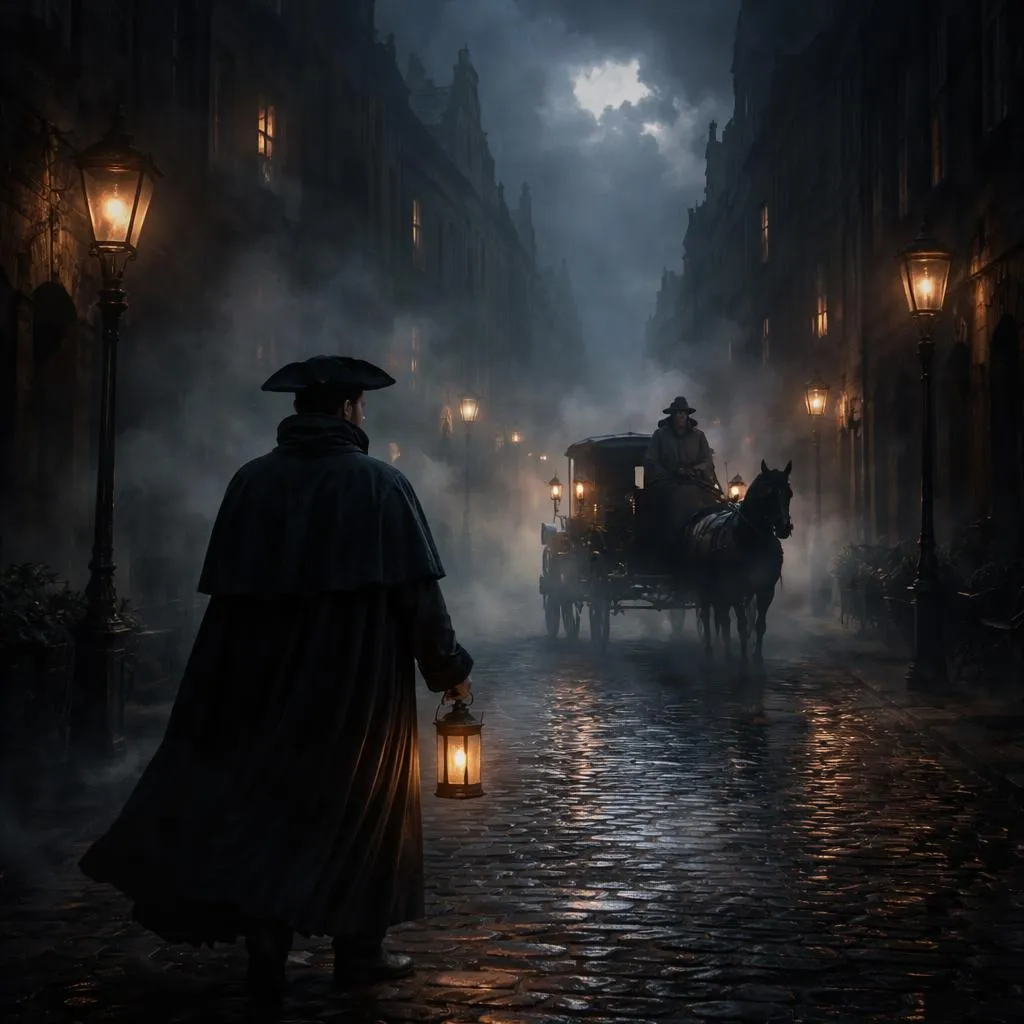

A Wonderful fact to reflect upon, that every human creature is constituted to be that profound secret and mystery to every other. A solemn consideration, when I enter a great city by night, that every one of those darkly clustered houses encloses its own secret; that every room in every one of them encloses its own secret; that every beating heart in the hundreds of thousands of breasts there, is, in some of its imaginings, a secret to the heart nearest it! Something of the awfulness, even of Death itself, is referable to this. No more can I turn the leaves of this dear book that I loved, and vainly hope in time to read it all. No more can I look into the depths of this unfathomable water, wherein, as momentary lights glanced into it, I have had glimpses of buried treasure and other things submerged. It was appointed that the book should shut with a a spring, for ever and for ever, when I had read but a page. It was appointed that the water should be locked in an eternal frost, when the light was playing on its surface, and I stood in ignorance on the shore. My friend is dead, my neighbour is dead, my love, the darling of my soul, is dead; it is the inexorable consolidation and perpetuation of the secret that was always in that individuality, and which I shall carry in mine to my life’s end. In any of the burial-places of this city through which I pass, is there a sleeper more inscrutable than its busy inhabitants are, in their innermost personality, to me, or than I am to them?
As to this, his natural and not to be alienated inheritance, the messenger on horseback had exactly the same possessions as the King, the first Minister of State, or the richest merchant in London. So with the three passengers shut up in the narrow compass of one lumbering old mail coach; they were mysteries to one another, as complete as if each had been in his own coach and six, or his own coach and sixty, with the breadth of a county between him and the next.
The messenger rode back at an easy trot, stopping pretty often at ale-houses by the way to drink, but evincing a tendency to keep his own counsel, and to keep his hat cocked over his eyes. He had eyes that assorted very well with that decoration, being of a surface black, with no depth in the colour or form, and much too near together—as if they were afraid of being found out in something, singly, if they kept too far apart. They had a sinister expression, under an old cocked-hat like a three-cornered spittoon, and over a great muffler for the chin and throat, which descended nearly to the wearer’s knees. When he stopped for drink, he moved this muffler with his left hand, only while he poured his liquor in with his right; as soon as that was done, he muffled again.
“No, Jerry, no!” said the messenger, harping on one theme as he rode. “It wouldn’t do for you, Jerry. Jerry, you honest tradesman, it wouldn’t suit YOUR line of business! Recalled—! Bust me if I don’t think he’d been a drinking!”
His message perplexed his mind to that degree that he was fain, several times, to take off his hat to scratch his head. Except on the crown, which was raggedly bald, he had stiff, black hair, standing jaggedly all over it, and growing down hill almost to his broad, blunt nose. It was so like Smith’s work, so much more like the top of a strongly spiked wall than a head of hair, that the best of players at leap-frog might have declined him, as the most dangerous man in the world to go over.
While he trotted back with the message he was to deliver to the night watchman in his box at the door of Tellson’s Bank, by Temple Bar, who was to deliver it to greater authorities within, the shadows of the night took such shapes to him as arose out of the message, and took such shapes to the mare as arose out of HER private topics of uneasiness. They seemed to be numerous, for she shied at every shadow on the road.
What time, the mail-coach lumbered, jolted, rattled, and bumped upon its tedious way, with its three fellow-inscrutables inside. To whom, likewise, the shadows of the night revealed themselves, in the forms their dozing eyes and wandering thoughts suggested.
Tellson’s Bank had a run upon it in the mail. As the bank passenger— with an arm drawn through the leathern strap, which did what lay in it to keep him from pounding against the next passenger, and driving him into his corner, whenever the coach got a special jolt—nodded in his place, with half-shut eyes, the little coach-windows, and the coach-lamp dimly gleaming through them, and the bulky bundle of opposite passenger, became the bank, and did a great stroke of business. The rattle of the harness was the chink of money, and more drafts were honoured in five minutes than even Tellson’s, with all its foreign and home connection, ever paid in thrice the time. Then the strong-rooms underground, at Tellson’s, with such of their valuable stores and secrets as were known to the passenger (and it was not a little that he knew about them), opened before him, and he went in among them with the great keys and the feebly-burning candle, and found them safe, and strong, and sound, and still, just as he had last seen them.
But, though the bank was almost always with him, and though the coach (in a confused way, like the presence of pain under an opiate) was always with him, there was another current of impression that never ceased to run, all through the night. He was on his way to dig some one out of a grave.
Now, which of the multitude of faces that showed themselves before him was the true face of the buried person, the shadows of the night did not indicate; but they were all the faces of a man of five-and- forty by years, and they differed principally in the passions they expressed, and in the ghastliness of their worn and wasted state. Pride, contempt, defiance, stubbornness, submission, lamentation, succeeded one another; so did varieties of sunken cheek, cadaverous colour, emaciated hands and figures. But the face was in the main one face, and every head was prematurely white. A hundred times the dozing passenger inquired of this spectre:
“Buried how long?”
The answer was always the same: “Almost eighteen years.”
“You had abandoned all hope of being dug out?”
“Long ago.”
“You know that you are recalled to life?”
“They tell me so.”
“I hope you care to live?”
“I can’t say.”
“Shall I show her to you? Will you come and see her?”
The answers to this question were various and contradictory. Sometimes the broken reply was, “Wait! It would kill me if I saw her too soon.” Sometimes, it was given in a tender rain of tears, and then it was, “Take me to her.” Sometimes it was staring and bewildered, and then it was, “I don’t know her. I don’t understand.”
After such imaginary discourse, the passenger in his fancy would dig, and dig, dig—now with a spade, now with a great key, now with his hands—to dig this wretched creature out. Got out at last, with earth hanging about his face and hair, he would suddenly fan away to dust. The passenger would then start to himself, and lower the window, to get the reality of mist and rain on his cheek.
Yet even when his eyes were opened on the mist and rain, on the moving patch of light from the lamps, and the hedge at the roadside retreating by jerks, the night shadows outside the coach would fall into the train of the night shadows within. The real Banking-house by Temple Bar, the real business of the past day, the real strong rooms, the real express sent after him, and the real message returned, would all be there. Out of the midst of them, the ghostly face would rise, and he would accost it again.
“Buried how long?”
“Almost eighteen years.”
“I hope you care to live?”
“I can’t say.”
Dig—dig—dig—until an impatient movement from one of the two passengers would admonish him to pull up the window, draw his arm securely through the leathern strap, and speculate upon the two slumbering forms, until his mind lost its hold of them, and they again slid away into the bank and the grave.
“Buried how long?”
“Almost eighteen years.”
“You had abandoned all hope of being dug out?”
“Long ago.”
The words were still in his hearing as just spoken—distinctly in his hearing as ever spoken words had been in his life—when the weary passenger started to the consciousness of daylight, and found that the shadows of the night were gone.
He lowered the window, and looked out at the rising sun. There was a ridge of ploughed land, with a plough upon it where it had been left last night when the horses were unyoked; beyond, a quiet coppice-wood, in which many leaves of burning red and golden yellow still remained upon the trees. Though the earth was cold and wet, the sky was clear, and the sun rose bright, placid, and beautiful.
“Eighteen years!” said the passenger, looking at the sun. “Gracious Creator of day! To be buried alive for eighteen years!”
Contexte et présentation de l'auteur
Ce passage est tiré du roman de Charles Dickens, Un conte de deux cités, publié pour la première fois en 1859. Dickens était l'un des écrivains anglais les plus célèbres de l'époque victorienne, connu pour ses personnages vivants, sa critique sociale et ses récits complexes. Un conte de deux cités se déroule pendant les temps troublés de la Révolution française et explore les thèmes de la résurrection, du sacrifice et de la dualité de la nature humaine. Le roman oppose la vie à Londres et à Paris, révélant les luttes et les secrets cachés derrière les façades de la société.
Interprétation détaillée et signification
L'extrait réfléchit au profond mystère de chaque être humain — comment chaque personne est un secret pour les autres, même pour ceux qui leur sont les plus proches. Le narrateur contemple la solitude et l'impénétrabilité de la vie humaine, comparant les gens à des livres fermés à clé ou à des eaux profondes cachant des trésors et des secrets. L'imagerie du messager, de la diligence et des passagers de la banque symbolise les couches de mystère et de vies cachées au sein d'une ville animée.
Le thème récurrent d'être "enterré vivant" pendant dix-huit ans fait allusion métaphoriquement à l'emprisonnement émotionnel ou spirituel — un état de désespoir, d'isolement ou d'espoir perdu. Le dialogue onirique du passager avec la figure fantomatique représente une lutte intérieure avec les regrets du passé et l'espoir de la résurrection ou du renouveau. Cela correspond aux thèmes plus larges du roman sur la rédemption et la transformation.
Leçons et perspectives pour les étudiants
-
Comprendre la complexité humaine : Ce passage enseigne aux élèves que chaque personne a un monde intérieur unique qui peut ne pas être visible aux autres. Il encourage l'empathie et la patience dans les relations, nous rappelant que nous ne pouvons pas connaître pleinement les luttes ou les sentiments d'autrui.
-
Le pouvoir de l'espoir et de la résurrection : L'idée d'être "rappelé à la vie" après de nombreuses années symbolise l'espoir et la possibilité de changement, peu importe depuis combien de temps on est coincé dans le désespoir ou l'épreuve. Les élèves peuvent apprendre à ne jamais abandonner, ni eux-mêmes, ni les autres.
-
Réflexion sur la mortalité et la vie : La contemplation de la mort et des mystères de la vie invite les jeunes lecteurs à réfléchir profondément à leur propre existence et à la valeur de la vie, encourageant la pleine conscience et l'appréciation du présent.
-
L'importance des secrets et de la vie privée : Reconnaître que tout le monde a des secrets peut favoriser le respect des limites personnelles et encourager une communication réfléchie.
Appliquer ces leçons dans la vie quotidienne
-
À l'école : Les élèves peuvent pratiquer l'empathie en comprenant que leurs camarades de classe peuvent être confrontés à des défis invisibles. Cela peut favoriser la gentillesse et réduire l'intimidation.
-
Dans les contextes sociaux : Respecter la vie privée des autres et être patient lorsque les gens partagent leurs sentiments contribue à renforcer les amitiés.
-
Dans le développement personnel : Adopter l'idée de la résurrection encourage les élèves à considérer les échecs ou les revers comme des opportunités de nouveaux départs.
Cultiver les traits positifs de l'histoire
-
Curiosité et réflexion : Comme le narrateur qui contemple les mystères de la vie, les élèves doivent cultiver la curiosité envers les gens et le monde qui les entoure, associée à une pensée réflexive.
-
Résilience : Le thème d'être "sorti de la tombe" enseigne métaphoriquement la résilience — la force de se relever après les difficultés.
-
Empathie : Comprendre que chacun porte des luttes cachées encourage la compassion et un comportement de soutien.
Conclusion
Ce passage de Un conte de deux cités offre une riche matière aux jeunes lecteurs pour explorer la nature humaine, l'importance de l'espoir et la valeur de l'empathie. En réfléchissant à ces thèmes, les élèves peuvent développer une intelligence émotionnelle plus profonde et une vision plus compatissante de la vie, ce qui leur sera bénéfique dans leurs études, leurs amitiés et leurs futurs défis.
